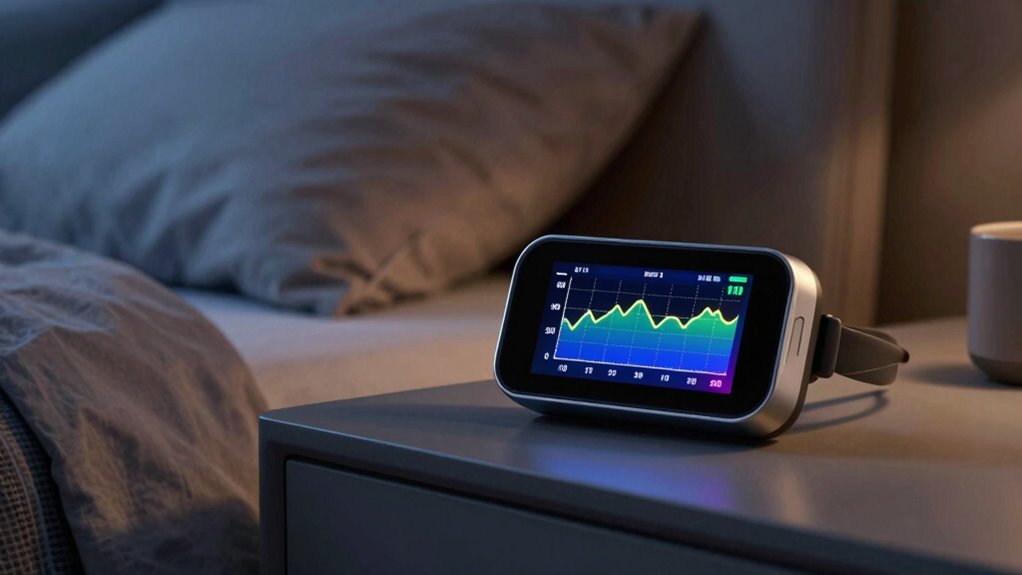
To track if a colder environment helps your sleep, monitor dream frequency and vividness as indicators of deep, restorative REM sleep. Use a sleep tracker or app to assess sleep stages and duration. Keep your room temperature between 60-67°F (15-19°C) and note any changes in your sleep quality or dream patterns. Consistently recording your environment alongside your sleep experiences can reveal how cold affects your rest, and exploring further offers more useful tips.
Key Takeaways
- Use sleep tracking devices or apps to monitor sleep stages, especially REM, which is influenced by room temperature.
- Record your sleep environment details, including room temperature, to identify correlations with sleep quality.
- Track dream vividness and frequency as indirect indicators of sufficient REM and restorative sleep.
- Keep a sleep journal noting temperature adjustments and their effects on sleep depth and restfulness.
- Analyze trends over time to determine if cooler environments consistently improve metrics like sleep duration, REM, and dream quality.
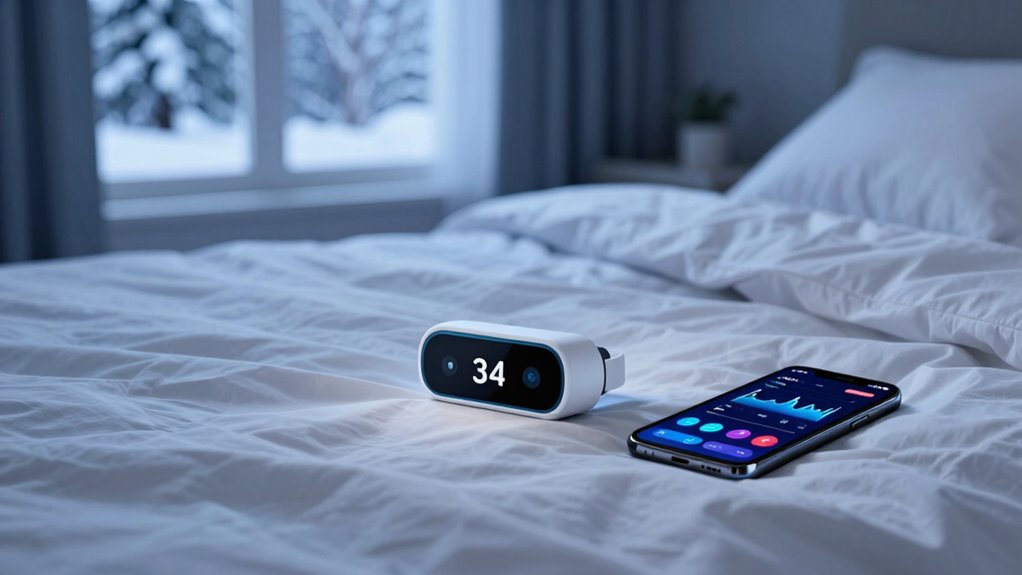
Have you ever wondered how you can tell if you’re getting enough restful sleep? Tracking your sleep quality might seem straightforward—just look at how long you sleep or how often you wake up during the night. But to truly understand whether your sleep is restorative, you need to dig a little deeper. One effective way is through dream analysis. Dreams can reveal a lot about your sleep cycles and overall restfulness. Vivid, frequent dreams might indicate that you’re spending enough time in REM sleep, which is vital for mental and emotional health. Conversely, if dreams are absent or fragmented, it could suggest your sleep isn’t as deep or restorative as it should be. Paying attention to your dreams can provide subtle clues about your sleep quality that go beyond simple duration.
Equally important is your sleep environment. The setting where you sleep plays a significant role in how restful your sleep is. A cool, dark, and quiet environment tends to promote better sleep, especially if you’re trying to determine whether a cold helps you sleep better. When your room is too warm, it can interfere with your body’s ability to reach and sustain deep sleep stages. Conversely, a cooler environment can facilitate sleep initiation and prolong deep sleep phases, making your sleep more restorative. Keep your bedroom temperature around 60-67°F (15-19°C) for best results, and consider using a fan or air conditioner to maintain this. Besides temperature, your sleep environment should be free from distractions—dim lighting, minimal noise, and comfortable bedding all contribute to a more restful night. Additionally, monitoring sleep environment factors over time can help you identify patterns that correlate with better sleep. For example, if you notice that nights when your room is cooler lead to more vivid dreams or longer deep sleep periods, you might conclude that the cold indeed helps improve your sleep quality. You can also use sleep tracking devices or apps that analyze sleep cycles, but combining this data with your observations about dream content and environment gives a clearer picture. Remember, sleep is complex, and no single metric can tell you everything. But paying close attention to your dreams and refining your sleep environment are powerful steps toward understanding and improving your sleep quality. Ultimately, by integrating dream analysis insights with environmental adjustments, you can tailor your sleep habits to wake up feeling more refreshed and rejuvenated.
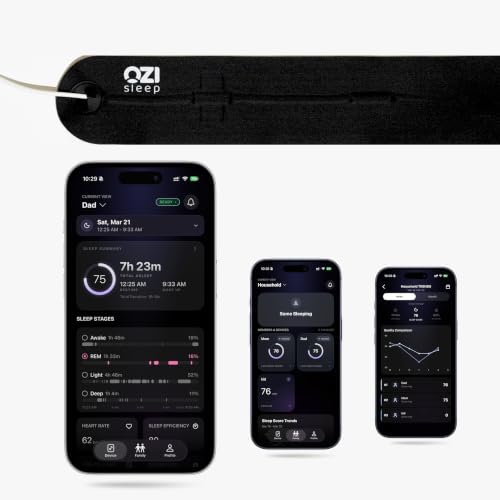
OZI Smart Sleep Tracker, Non-Wearable Contactless Under-Sheet Sleep Monitor
- No Wearable Needed: Slides under sheet to monitor sleep
- Comprehensive Sleep Data: Tracks sleep stages, heart rate, and more
- Real-Time Alerts: Notifies about bed exits and health changes
As an affiliate, we earn on qualifying purchases.
As an affiliate, we earn on qualifying purchases.
Frequently Asked Questions
Can Cold Exposure Improve Sleep Quality Long-Term?
Cold exposure can improve your sleep quality long-term by enhancing thermal regulation, helping your body maintain a stable core temperature. This supports better sleep hygiene, making it easier to fall asleep and stay asleep. Regular cold exposure may also reduce stress and inflammation, contributing to overall sleep health. Just make certain you practice safely, gradually incorporating cold techniques to avoid shock or discomfort, and listen to your body’s signals.
What Temperature Range Is Ideal for Sleep?
You’ll find that an ideal sleep temperature hovers between 60-67°F (15-19°C), where your sleep environment promotes natural temperature regulation. Think of it as the sweet spot between a cozy, warm bed and a chilly morning. Too hot, and you’ll toss and turn; too cold, and you might wake up shivering. Maintaining this range helps your body relax, ensuring restful, uninterrupted sleep all night.
How Does Cold Therapy Affect REM Sleep?
Cold therapy can improve REM sleep by supporting your body’s thermoregulation benefits, helping you fall asleep faster and stay in REM stages longer. When you expose yourself to cool temperatures, your body adjusts, promoting better sleep quality and more vivid dreams. You might notice enhanced REM sleep and overall restfulness, making cold therapy a useful tool in your sleep routine for optimizing restorative sleep phases.
Are There Risks to Sleeping in Cold Environments?
Sleeping in cold environments can pose hypothermia risks if temperatures drop too low, especially if you’re unprotected or ill. To guarantee sleep environment safety, keep your room at a comfortable, moderate temperature and use appropriate bedding. Always monitor how you feel; if you shiver or feel numb, it’s a sign to warm up. Prioritize your safety to enjoy the benefits of cold therapy without risking your health.
How Quickly Can Cold Help Improve Sleep Quality?
Cold can start improving your sleep quality within a few nights, especially if you use sleep tracking devices and temperature sensors. These tools help you monitor how your body responds to cooler conditions. By adjusting your room temperature gradually, you may notice better sleep patterns in about 3 to 7 nights. Consistent temperature control makes it easier to fall asleep faster and enjoy deeper, more restorative sleep.

Frigidaire 5,000 BTU Window-Mounted Air Conditioner, Cools Up to 150 Sq. Ft., Quiet Operation, Effortless Temperature Control, 2 Fan Speeds, Auto Restart, White
- Effortless Temperature Control: Customizable settings with 2 fan speeds
- Easy-to-Clean Filter: Washable filter for easy maintenance
- Quiet Operation: Operates at 52 dBA for peaceful comfort
As an affiliate, we earn on qualifying purchases.
As an affiliate, we earn on qualifying purchases.
Conclusion
Tracking your sleep quality metrics can seem complicated, but it’s worth the effort—especially if you’re curious whether cold exposure helps you sleep better. You might worry it’s too much hassle or won’t make a difference, but even small adjustments can lead to noticeable improvements. By paying attention to your data, you can confidently fine-tune your routine. Give it a try, and you might find cold therapy becomes your new sleep secret.

Levoit Tower Fan for Bedroom, 28ft/s Fans that Blow Cold Air, 28dB Quiet
- Versatile Airflow: Up to 28 ft/s with wide oscillation
- Quiet Operation: Near-silent noise level for sleep
- All-Night Timer: 12-hour timer for continuous use
As an affiliate, we earn on qualifying purchases.
As an affiliate, we earn on qualifying purchases.

EMAY Sleep Oxygen Monitor with Built-in Recording Capability | Track Continuous Blood Oxygen Levels & Pulse Rate Overnight | Provides Sleep Report & Raw Data
- Extended Data Storage: 40 hours of continuous recording
- Offline Recording: Records without real-time connection
- Mobile App Compatibility: Review and export data via iOS/Android
As an affiliate, we earn on qualifying purchases.
As an affiliate, we earn on qualifying purchases.