
TL;DR
An electric roasting pan cooks a turkey on the countertop, freeing your main oven for sides and dessert. Check the manufacturer’s bird-size guidance, follow the manual, and use a food thermometer to confirm 165°F (74°C) in the breast and innermost thigh. Its covered cooking space holds moisture, so the turkey may have less crisp skin than an oven-roasted bird.
Thanksgiving dinner can turn your oven into a traffic jam: the turkey needs hours, the rolls need a hot finish, and the sweet potatoes are waiting for their turn. An electric roasting pan gives you another cooking space on the counter, so the main oven can handle the dishes that need it most.

Get home appliances delivered free with Prime
- Fast, free delivery on millions of items
- Prime Video, Amazon Music and more included
- Member-only deals all year
This countertop appliance with a removable pan can be handy in a small kitchen or when you’re cooking for a crowd. You’ll learn what it does well, how to choose one that fits your bird, and what to expect from its cooking results. A little planning helps you avoid the two holiday surprises nobody wants: a lid that won’t close and a turkey that needs more time.
The main tradeoff is simple: more oven space, softer skin. A covered roaster traps moisture, which can cook the meat nicely but may limit browning. With a thermometer and a plan for the rest of your meal, you can make that tradeoff work for your table.
Use an electric roaster to free your main oven for Thanksgiving sides, pies, and rolls.
Check the manufacturer’s turkey-size limit and lid clearance; quart capacity alone does not confirm fit.
Follow the manual and use a thermometer to confirm 165°F (74°C) in the thickest breast and innermost thigh.
Expect less-crisp skin from covered cooking, and confirm insert care and stovetop rules before making gravy.
Keep hot food at 140°F (60°C) or above, and consider borrowing a roaster if you’ll use it only once.
Free your oven for sides while the turkey cooks
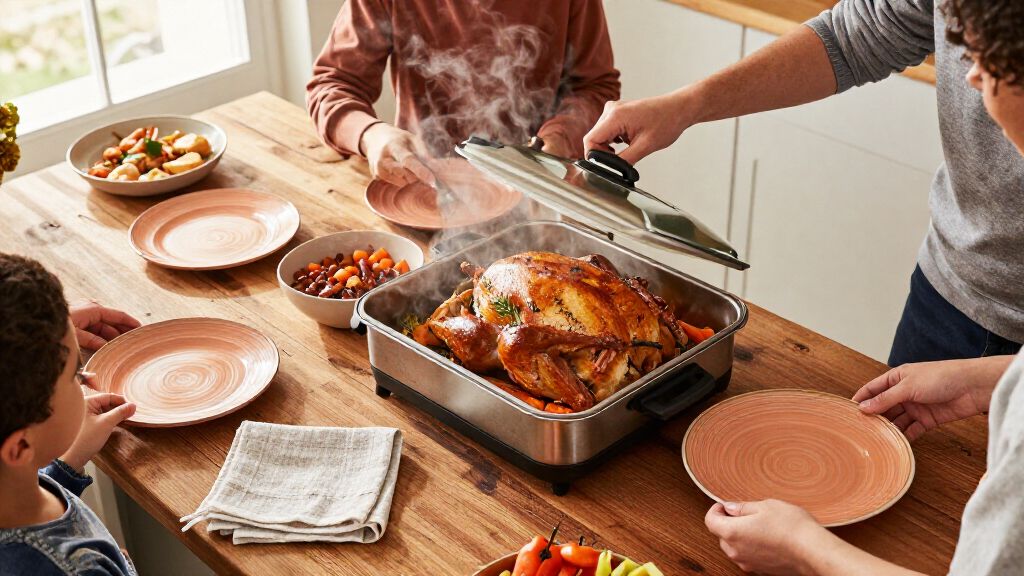
Electric roasting pans for Thanksgiving cook a turkey or another large dish on the countertop, leaving your main oven open for sides, pies, and rolls. The appliance has a heating element controlled by a thermostat, a removable pan, and a lid; many models also include a rack and adjustable temperature control. That gives you a second cooking space without changing the Thanksgiving menu.
The extra cooking space matters most when dishes need different temperatures or have to finish close together. Imagine your oven is set for a casserole while your turkey cooks in the roaster nearby. You can bake the casserole on schedule, then slide in a pie while the turkey rests. This separates the turkey’s long cooking time from the oven’s shorter jobs, giving you more control over when each dish is ready. In a small kitchen, that extra capacity can feel like adding another burner to a crowded stove: suddenly, the meal has room to move.
A countertop roaster can also help when your full-size oven is unavailable or too small for a large holiday meal. It’s portable, but only use it where you have a suitable grounded outlet, a stable heat-resistant surface, and the clear space required by the manual. These placement details affect both safety and convenience: you need space to open the lid and lift out a hot bird without reaching over guests or moving other cookware. Keep the cord and appliance away from foot traffic, dish towels, and anything that could catch heat.
Some cooks also use the roaster to hold prepared food warm. That can be useful between dinner and the second helping, but the setting alone does not tell you whether the food is staying hot enough; the appliance temperature and the food temperature can differ. Check the food itself with a thermometer: keep hot food at 140°F (60°C) or above. A low setting is helpful only if the food actually stays at a safe temperature.
Products Worth Considering

Dyson V11 Torque Drive Cordless Vacuum Cleaner

Sony 65 Inch BRAVIA 3 LED 4K HDR Smart Google TV (K-65S30)

Shark HydroVac MessMaster Wet Dry Vacuum & Mop Combo (AW261)
As an affiliate, we earn on qualifying purchases.
Choose a roaster that fits your turkey and kitchen
An electric roaster is the right size for your Thanksgiving turkey only if the bird fits inside the insert and the lid closes without touching it. Quart capacity gives you a rough sense of volume, but it doesn’t account for the turkey’s shape or the space needed above it. A broad breast or raised drumsticks can use up clearance even when the bird’s weight seems suitable. Check the manufacturer’s maximum turkey-size guidance before you buy.
Picture your shopping cart holding a roaster listed by capacity, while your actual turkey has a broad breast and high drumsticks. The numbers may sound right and the fit may still be wrong. Look at the insert’s dimensions and check whether the product manual lists a maximum bird weight; if your turkey is near that limit, leave room for the rack and lid clearance. A lid that presses against the bird can make it harder to close securely and can interfere with the intended cooking setup, so a little extra space is useful even when the stated weight limit appears to allow a close fit.
Here are the details to compare before choosing a model:
- Turkey-size guidance: Does the manual say the bird you plan to cook will fit? A clear limit is more useful than capacity alone because it accounts for how the maker expects the appliance to be used.
- Rack and insert: Is a rack included, and can the removable insert come out for cleaning? A rack can keep the bird above the juices, while a removable insert can make cleanup easier; both details affect how the roaster fits into your cooking and cleanup routine.
- Controls: Are the temperature settings clear and easy to use? Straightforward controls help you follow the manual, though the dial still cannot tell you whether the turkey has reached a safe internal temperature.
- Placement: Do you have a stable, heat-resistant counter with the required clearance around the appliance? The roaster needs room for safe operation, the lid to open, and hot food to be handled without crowding.
- Care instructions: Can the insert go in the dishwasher or on the stovetop? Use either only if the manufacturer says it’s safe. That can determine whether you can make gravy directly in the insert or need to transfer the drippings to a saucepan.
Trends such as digital controls, timers, and larger capacities vary by model; don’t assume every roaster has them. Compare current manuals and independent reviews, and think about whether you’ll use the appliance beyond one holiday. The decision is partly about price and partly about storage and effort: a model that solves an annual oven bottleneck may earn its cupboard space, while a bulky appliance used once can be an inconvenient long-term trade. If Thanksgiving is the only occasion, borrowing or renting may be more sensible than storing a bulky extra pan all year.
Cook the turkey safely with a thermometer, not the clock
Use a food thermometer to tell when your Thanksgiving turkey is done: check that the thickest part of the breast and the innermost part of the thigh reach 165°F (74°C), avoiding the bone. Time, color, and the roaster’s temperature dial cannot reliably confirm that the center has reached a safe temperature. The dial describes the appliance’s setting, while the thermometer measures the food itself; that distinction matters because birds and appliances vary.
Cooking time varies with the bird’s size, starting temperature, appliance calibration, and preheating instructions. The manual is your guide to preheating, rack use, temperature settings, and suggested timing, but the thermometer makes the final call. For instance, if your turkey looks golden before the expected time, keep cooking until the right spots reach 165°F (74°C). If the scheduled time arrives and the meat is still below that temperature, give it more time. Building a little flexibility into the meal schedule helps: the oven-side dishes may be ready before the turkey, so plan a safe way to keep them hot or arrange their cooking order around the turkey’s actual finish.
Use this straightforward sequence on the day:
- Read the manual and prepare the roaster as directed. Preheat only if the instructions call for it.
- Set the turkey on the rack if the manufacturer recommends one. A rack lifts the bird above the juices collecting below.
- Keep the lid closed as much as you can. Each opening releases heat and adds cooking time, which can make timing less predictable.
- Check two places with a food thermometer: the thickest part of the breast and the innermost thigh, without touching bone. Checking both helps catch uneven cooking instead of assuming one reading represents the whole bird.
- Wait for 165°F (74°C) in both locations before serving.
Cooking stuffing separately is usually safer and simpler. A stuffed bird takes longer because heat must reach the center of the stuffing as well as the meat, which can complicate timing. If you do stuff the bird, the center of the stuffing must also reach 165°F (74°C), and it can take longer to get there than the meat. Treat it as its own temperature check, not an optional extra.
Expect tender meat and less-crisp skin
A covered electric roaster holds moisture around the turkey, so the meat can cook well while the skin browns or crisps less than it might in an uncovered oven. The lid reduces how quickly moisture escapes, and a moist cooking environment is less suited to drying the skin’s surface for crispness. That difference comes from the cooking environment, not necessarily a mistake in your recipe. Think of the covered roaster as a warm, steamy room: it’s good at holding moisture, but less suited to drying the skin into a crisp shell.
If golden skin matters to your guests, check the appliance manual for browning guidance. Some cooks finish the bird briefly in a hot oven to brown the skin. That can work, but it adds a transfer step and uses the oven just when you may be finishing sides, so reserve oven space and time for it in your plan. Handle the bird carefully; don’t let it sit out for an extended stretch while you reorganize pans and preheat the oven.
Also plan for the drippings. The juices in a roaster can make flavorful gravy, though the amount and concentration may differ from oven roasting. The covered environment can leave less browned material in the pan, which may change the gravy’s depth of flavor. Before making gravy in the insert, confirm that the manufacturer says it’s safe to use on your stovetop. If it isn’t, transfer the drippings to a suitable saucepan. For example, you might find plenty of savory juices but little browning in the pan; a separate saucepan gives you control as you thicken the gravy.
Don’t add water unless the manual or your recipe calls for it. Water can affect browning and dilute the juices you hoped to use for gravy. Since covered cooking already traps moisture, an extra splash may not solve the problem you think it will.
Set up the roaster safely and avoid holiday snags
A roaster needs a stable, heat-resistant surface, suitable power, and the clearances listed in its manual to operate safely. Placement also determines whether you can use it comfortably once it is hot: the lid needs room to open, and you need a clear path to lift out the turkey or move dishes. Place it where the lid can open without hitting a wall or cabinet, and where people carrying hot dishes won’t bump it. A clear counter and a planned route to the table make a crowded kitchen calmer.
For example, if your only open counter is beside a sink, look for a dry spot with enough room around the appliance instead of squeezing it into the gap. Keep the appliance away from dish towels and paper decorations. Avoid overloading an extension cord or outlet, and follow the manual’s power instructions rather than improvising with a cord that was meant for a lamp. If the counter space or power arrangement does not meet the manual’s requirements, plan to use another location before Thanksgiving rather than discovering the problem while cooking.
Make cleanup and storage part of your buying decision. Many models have a removable insert, but the insert, rack, and lid may have different care rules. Don’t put a part in the dishwasher or on the stovetop unless the manufacturer confirms it’s safe. A removable pan can make gravy and cleanup easier; the wrong cleaning method can damage a finish or component. Checking these instructions ahead of time also tells you whether the appliance will make the post-meal cleanup easier or add another hand-washing job.
Finally, treat “keep warm” as a setting to check, not a promise about food safety. The heat setting describes what the appliance is doing, but the dish itself may not reach or maintain the same temperature. Use a thermometer to confirm that hot dishes stay at or above 140°F (60°C). If the roaster can’t hold that temperature for your food, use another safe hot-holding method and serve the dish promptly.
Decide whether an electric roaster earns its storage space
An electric roasting pan is most useful when you regularly cook large meals, need extra oven capacity, or don’t have a convenient full-size oven. Its value depends on your kitchen and holiday routine: a busy host may welcome a second cooking space every year, while someone who cooks a turkey once may prefer to borrow one. The practical question is whether the time and oven space it frees up across repeated meals are worth the cost and the cupboard space it occupies between them.
Imagine your Thanksgiving menu: turkey, two casseroles, roasted vegetables, and a pie. If the oven can handle only one or two of those dishes at a time, the roaster may take pressure off the schedule. You can cook the turkey independently while the oven handles dishes with shorter or different cooking times. If your oven is roomy and the appliance would sit untouched until next November, that counter and cupboard space may matter more.
Some electric roasters may use less energy than heating a large oven, but actual use depends on the appliance, cooking time, and whether the main oven would have been running anyway. Don’t count on a guaranteed energy saving from the appliance alone. A practical comparison starts with how many dishes you can cook at once and how often you expect to use the roaster. For a purchase decision, repeat use and schedule flexibility are more dependable reasons than an assumed energy saving.
Think through these questions before deciding:
- Do you regularly cook meals larger than your oven can manage?
- Will the turkey fit the model you’re considering?
- Can you store the appliance without sacrificing useful kitchen space?
- Would borrowing or renting meet this year’s needs?
A clear yes to extra capacity and repeat use makes a purchase easier to justify. For a one-time meal, borrowing a neighbor’s roaster can deliver the same open oven without adding another large appliance to your cupboards.
Frequently Asked Questions
Can an electric roaster cook a whole Thanksgiving turkey?
Yes, if the turkey fits the model’s stated capacity and you use the appliance as its manual directs. Check the manufacturer’s size guidance and confirm the lid closes without touching the bird.
How long does a turkey take in an electric roaster?
There isn’t one dependable cooking time for every turkey. Bird size, starting temperature, appliance calibration, and preheating all affect the timing, so use a thermometer to check for 165°F (74°C) in the breast and innermost thigh.
Do I need to add water to an electric roasting pan?
Usually not, unless the manual or recipe calls for it. Adding water can change browning and dilute the drippings you may want for gravy.
Will the turkey skin get crispy in an electric roaster?
It may brown or crisp less than turkey cooked in an uncovered oven because the roaster’s lid traps moisture. Check the manual for browning advice; some cooks briefly finish the bird in a hot oven.
Can I keep Thanksgiving sides warm in the roaster?
Often, but follow the manual and check the food with a thermometer. Keep hot food at 140°F (60°C) or above rather than assuming the keep-warm setting holds a safe temperature.
Can I use the removable insert on my stovetop or in the dishwasher?
Only if the manufacturer says the insert is safe for that use. Insert materials and care instructions vary, so check the manual before cleaning it in the dishwasher or using it to make gravy on the stove.
Conclusion
An electric roasting pan earns its place on Thanksgiving when it solves a real kitchen bottleneck: a turkey cooking on the counter leaves room in the oven for the dishes that make the meal yours. Check the bird’s fit, follow the manual, and let a thermometer—not the clock—tell you when dinner is ready.
Remember the tradeoff: more cooking space, softer skin. Plan for it, and your crowded kitchen can feel less like a traffic jam and more like a table coming together.