TL;DR

Get home appliances delivered free with Prime
- Fast, free delivery on millions of items
- Prime Video, Amazon Music and more included
- Member-only deals all year
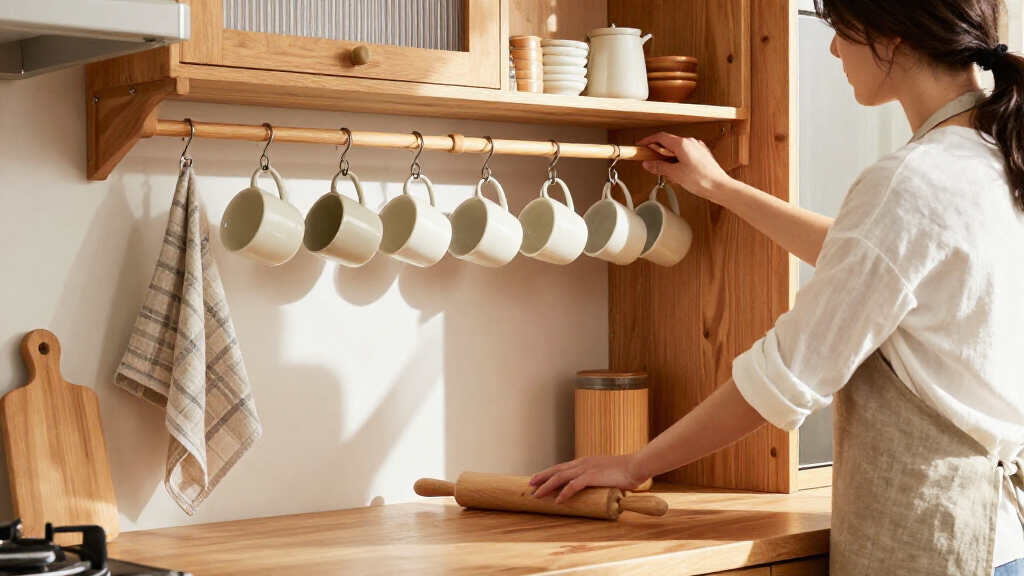
Hunker reported on creator Reilly Taylor’s DIY project that turns a wooden rolling pin into a hanging kitchen rack. The design can hold towels or aprons, and small hooks can be added for utensils; the source does not provide load limits or tested installation guidance.
Hunker has highlighted a DIY kitchen-storage project by creator Reilly Taylor, who repurposed a wooden rolling pin into a suspended rack for kitchen towels, aprons or utensils. The idea offers a decorative alternative to a plain wall rack, though the source does not give a tested weight limit or detailed installation specifications.
Taylor’s design, as described by Hunker, uses a wooden rolling pin sourced at a vintage market, along with eye hooks and chain or twine to hang it. The basic supply list also includes sandpaper, a drill or screwdriver, a screw and a wall anchor where needed. The finished rack creates a place to hang items and move them off the countertop.
To make a similar version, the report advises cleaning the rolling pin and sanding it if its surface needs smoothing. The maker then measures the barrel, drills two evenly spaced holes near its ends and installs an eye hook in each. Twine or chain is threaded through the hooks to suspend the pin from a wall screw; a wall anchor may be needed depending on the wall and installation.
The design can be customized with stain or paint, but Hunker says a wood sealant should be applied if the surface is stained or painted. Small hooks can be attached along the underside for hanging utensils or aprons. For a ceramic or metal rolling pin, the report suggests tying the suspension material around the handles rather than drilling into the body.
A Decorative Alternative to Standard Racks
The project combines small-scale storage with a visible decorative feature, making it an option for kitchens where countertop space is limited or a standard rack does not suit the room’s style. Reusing a vintage rolling pin also gives an existing household object a different function instead of leaving it unused.
Its usefulness depends on the items hung from it and how securely it is mounted. The source presents the rack as suitable for towels, aprons and utensils, but does not report weight testing or specify which wall types, fasteners or pin sizes are appropriate. Readers should treat those details as installation decisions, not as established performance claims.
Products Worth Considering

Dyson Cyclone V10 Origin Cordless Vacuum

Bose TV Speaker Compact Soundbar with Bluetooth and HDMI-ARC, Black

Roborock F25 Ultra Steam Wet Dry Vacuum Mop
As an affiliate, we earn on qualifying purchases.
From Vintage Market Find to Wall Rack
The source report describes Taylor sharing the project on TikTok and using a rolling pin she found at a vintage market. Hunker says thrift stores and vintage markets are possible places to find one; it also names IKEA as a budget-friendly place to look for a new option. The report does not identify a specific product model or provide a price comparison.
The underlying method is a simple suspended-bar arrangement: the rolling pin serves as the crosspiece, while eye hooks and chain or twine connect it to a wall fastener. The styling choices—such as keeping the original wood tone, adding stain, or choosing leather or ribbon for suspension—are presented as options rather than requirements.
““Thrift stores and vintage markets are a great place to browse for one.””
— Hunker’s report on sourcing a rolling pin
Load Limits and Mounting Details
The report does not say how much weight the rack can safely hold, whether Taylor tested it, or what dimensions and materials were used for the wall screw and anchor. It also does not specify how to assess a wall before drilling or whether the hanging method suits every surface. Those omissions mean the project should not be taken as a tested storage product or a universal installation guide.
It is also unclear whether Taylor’s exact design included extra hooks for utensils; Hunker describes underside hooks as an optional addition. The source does not provide a full demonstration, a cost estimate or a confirmed list of tools used in the original build beyond the general materials it recommends.
Check the Wall Before Hanging
Anyone copying the idea will need to choose a rolling pin, decide what it will hold and select suspension hardware suited to both the object and the wall. Before drilling, check for hidden wiring or plumbing and use eye protection while drilling or sanding. For uncertain wall conditions or a heavy intended load, consult a qualified professional rather than relying on the report’s general instructions.
The source describes no scheduled follow-up or further project update. The next practical step for readers is to adapt the design to their kitchen and verify that the mounting method is appropriate; the article does not establish a tested capacity or guarantee that any particular version will hold a given load.
Key Questions
What does the rolling-pin rack hold?
Hunker describes it as a place for kitchen towels and aprons. Small hooks can be added underneath for utensils, although the report gives no weight limit.
What supplies are suggested for the wooden version?
The report lists a rolling pin, sandpaper, two eye hooks, chain or twine, a drill or screwdriver, and a screw with a wall anchor if needed. It also recommends wood sealant if the pin is painted or stained.
Can a ceramic or metal rolling pin be used?
Hunker says those materials can be used, with the suspension tied around the handles instead of installing eye hooks in the barrel.
How much weight can the rack support?
The source does not provide a tested load limit. Capacity will depend on the rolling pin, hooks, fasteners and wall, so the project should not be treated as rated storage.
Source: hunker.com