TL;DR

Get home appliances delivered free with Prime
- Fast, free delivery on millions of items
- Prime Video, Amazon Music and more included
- Member-only deals all year
Ideal Home contributor Ammarah Hasham recommends five elements for a coffee table that feels personal and works for daily life: an oversized focal point, books, hidden-but-accessible remote storage, a natural object and clear space. The advice comes from a personal home-decorating column, not a reported study or a formal design standard.
Home decorator Ammarah Hasham, writing as an Ideal Home Open House contributor, has shared five elements she uses to make a coffee table feel lived-in without sacrificing its everyday function. Her suggestions combine a prominent decorative object and books with practical remote storage, a natural detail and enough open surface for family activities.
Hasham’s list draws on her experience furnishing a rental home and living with three children. Before buying her current Anthropologie waterfall coffee table, she used two wooden pallets bought through Facebook Marketplace. She recalls that the low-cost arrangement suited her industrial-interiors phase, but became difficult to live with: her children treated the pallets as indoor play equipment, and gaps between the planks made it tricky to set down mugs without spilling.
Her first recommendation is an oversized vase or other substantial object that can anchor the display. Hasham favors pieces with irregular shapes or textured finishes, and says stems can add color or connect with colors elsewhere in the room. She also suggests using coffee-table books to reflect personal interests, start conversations and provide a raised base for a smaller decorative object. She recommends checking beneath dust jackets, which can conceal attractive book covers.
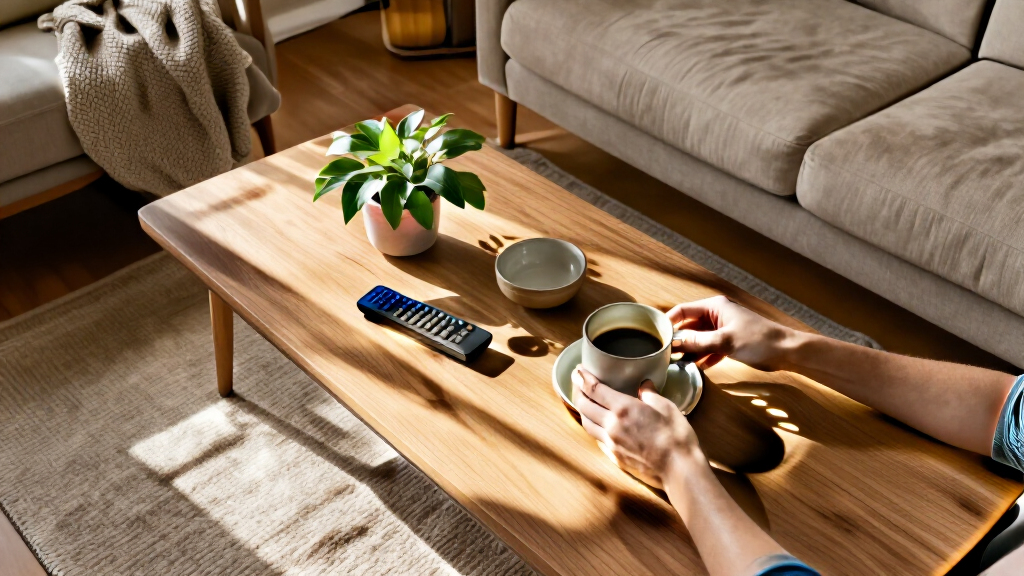
For the practical parts of the arrangement, Hasham proposes giving remotes a dedicated container, such as an old jewellery box, tin, wooden box or rattan basket. She pairs that with an organic element—a flower, shell, inherited bowl or another personal natural detail—and argues for leaving clear space for everyday use. The table, she writes, should still accommodate takeaways, board games and controllers rather than being treated as a display that family members cannot touch.
Style That Leaves Room for Daily Life
Hasham’s advice addresses a familiar tension in home styling: a carefully arranged table can look finished in a photograph but be inconvenient in a room people actually use. Her emphasis on accessible remotes and open surface space makes function part of the styling, rather than an afterthought. That is especially relevant to households with children or frequent shared activities, where objects are regularly moved to make room.
The recommendations are personal guidance, not tested rules or a guarantee that a particular arrangement will suit every home. Their value is in offering a flexible framework: choose a focal point, add objects that have meaning, contain everyday clutter and keep the surface usable. Readers can adapt the ideas to the size of their table, their household and the items they need close at hand.
large textured vase for coffee table
As an affiliate, we earn on qualifying purchases.
As an affiliate, we earn on qualifying purchases.
From Pallet Table to Family Room
Hasham describes the pallet arrangement as an improvised response to a rental home that came semi-furnished, including a sofa and a coffee table she disliked. The pallets were inexpensive and supplied the organic look she wanted at the time, but the gaps and their use as children’s play equipment presented practical problems. She says she eventually replaced them with a conventional coffee table and began thinking more deliberately about how to style it.
That personal history shapes the column’s central point: a coffee table is both a place for decorative objects and a working surface. Hasham’s examples are grounded in her own home, including her use of an old jewellery box to store remotes and her children’s use of the table for games and other activities. The source does not report a product launch, survey or wider industry development.
“A coffee table should never become SO beautifully styled that everybody is frightened to touch it.”
— Ammarah Hasham, Ideal Home Open House contributor
As an affiliate, we earn on qualifying purchases.
Advice, Not a Universal Design Rule
The article presents Hasham’s personal preferences and experience; it does not establish that these five elements are necessary for every coffee table or that they produce a measurable design outcome. The source also does not specify a publication date, give measurements for arranging objects, or compare different table sizes, materials or household needs. Readers may need to adjust the suggestions for safety, available space and their own routines.
As an affiliate, we earn on qualifying purchases.
How Readers Can Adapt the Five Ideas
Hasham’s column offers no scheduled follow-up or next milestone. Readers can apply the ideas by choosing one substantial focal object, adding books that reflect their interests, placing remotes in an easy-to-reach container, including a natural or personally meaningful detail and preserving enough clear surface for normal use. The practical test is whether the arrangement still works when people sit down to eat, play a game or reach for the remote.
natural decorative object for living room
As an affiliate, we earn on qualifying purchases.
As an affiliate, we earn on qualifying purchases.
Key Questions
What five things does Ammarah Hasham recommend?
She recommends an oversized focal object, coffee-table books, a container for remotes, an organic or personal detail, and open space for everyday activities.
How does Hasham suggest storing remote controls?
She uses an old jewellery box and suggests alternatives such as a tin, wooden box or rattan container. The aim is to keep remotes accessible but contained.
Why did Hasham stop using wooden pallets as a coffee table?
She says her children used the pallets for indoor play and the gaps between the planks made setting down mugs difficult, increasing the risk of spills.
Does Hasham say every coffee table needs all five items?
No. The source presents the list as her personal approach, not a universal rule. The suggestions can be adapted to a household’s space and needs.
Source: rss
Cold & flu season Picks
humidifiers
As an affiliate, we earn on qualifying purchases.