

A UV water purifier system for hard water can disinfect water, but UV treatment does not remove hardness minerals such as calcium and magnesium. My best overall pick is the iSpring UVF55FS for its 12 GPM capacity and whole-house design; the 120W 24 GPM system stands out for higher flow and included replacement parts, while the Aquasana WH-1000-CS-UVS-B suits buyers who want UV integrated with a broader filtration system. The main tradeoffs are flow capacity, plumbing fit, monitoring features, and whether you need a separate softener or scale-control stage. A high-flow UV unit may suit a large household, while a lower-flow model can be easier to match to modest demand. Read on for the full comparison and guidance on choosing a system that fits both your water and plumbing.

Get home appliances delivered free with Prime
- Fast, free delivery on millions of items
- Prime Video, Amazon Music and more included
- Member-only deals all year
Complete the kit



Key Takeaways
- UV treats microorganisms, not hardness. None of these UV systems should be treated as a water softener; hard-water homes may need separate softening or scale control.
- The iSpring UVF55FS is the balanced whole-house pick among standalone systems, while its 12 GPM capacity may be limiting for simultaneous high-demand use.
- Several listed units advertise 24 GPM flow and include spare lamps or sleeves, but buyers should check the exact connection, monitoring, and replacement-part details before choosing one.
- Aquasana’s two options are broader system choices rather than simple UV-only comparisons, making their fit depend on the water-treatment stages included in the complete configuration.
- Connection size separates practical choices: 1-inch and 3/4-inch ports may require different plumbing changes, even when a unit’s treatment capacity appears suitable.




| rated uv water purifier system for hard water | Flow rate | Dimensions | Inlet/outlet | Weight |
|---|---|---|---|---|
| iSpring UVF55FS Whole House UV | 12 GPM | 40 x 8 x 8 inches | 1 inch MNPT | 7.5 pounds |
| 120W Whole House UV Water Puri | 24 GPM | — | 1 inch MNPT | 18 pounds |
| UV Water Filter Whole House Pu | 24 GPM | 24 x 4 x 4 inches | 3/4 inch MNPT | — |
| Whole House UV Water Filter Sy | 24 GPM | 44 x 8 x 8 inches | 1 inch NPT | — |
| HQUA TWS-12 Ultraviolet Water | 12 GPM | 21 x 3.5 x 3.5 inches | 3/4 inch MNPT | 4.38 kg |
| iSpring UVF50 Whole House LED | — | 12.6 × 2.42 × 2.42 inches | 1-inch NPT | 5 pounds |
| Aquasana Whole House Water Fil | 14.6 GPM | 46 × 9 × 69 inches | — | — |
| Aquasana Whole House Well Wate | 14.7 GPM | 67 × 11 × 57 inches | — | 116 pounds |
| iSpring UVF20 Whole House LED | 12 GPM | 3.3 × 5.5 × 14.2 inches | 3/4-inch MNPT | 3.4 pounds |
More Details on Our Top Picks
iSpring UVF55FS Whole House UV Water Filter, 1″ MNPT Inlet/Outlet, 12 GPM
The iSpring UVF55FS is the balanced pick for households that want whole-house UV treatment without stepping up to a 24 GPM unit. Its 12 GPM capacity suits many homes, while the smart flow sensor turns the lamp on when water is moving, rather than running it continuously. The stainless steel chamber and 1-inch connections make it a practical fit for compatible plumbing. Compared with the HQUA TWS-24F, it takes up less space and calls for less flow capacity, but it cannot match that model’s higher throughput. UV treatment does not soften hard water or remove dissolved minerals, so pair it with a suitable softener or scale-control setup if hardness is the concern. Tradeoffs include periodic lamp replacement, DIY installation demands, and a sensor that may not activate at very low flow.
Pros:- 12 GPM capacity fits many residential water-use patterns
- Flow sensor switches UV operation on with water flow
- Stainless steel chamber
- Chemical-free treatment does not change water chemistry
Cons:- UV lamp needs routine replacement
- Installation may require plumbing DIY skills
- Very low flow may not activate the sensor
Best for: Households with compatible 1-inch plumbing that want a moderate-flow, whole-house UV unit with automatic flow sensing.
Not ideal for: Large homes with simultaneous high water demand, or buyers expecting UV to reduce hardness, scale, sediment, or dissolved chemicals.
- Flow rate:12 GPM
- Power:55W
- Inlet/outlet:1 inch MNPT
- Dimensions:40 x 8 x 8 inches
- Weight:7.5 pounds
- Chamber material:Stainless steel
- Capacity:17,280 gallons per day
- Warranty:30-day money-back period; 1-year manufacturer warranty
Our verdict“Choose the iSpring UVF55FS for moderate household demand and flow-triggered UV operation, but add separate treatment for hard-water minerals.”
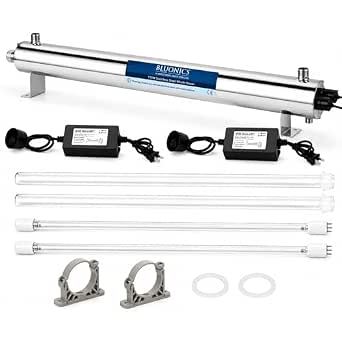
120W Whole House UV Water Purifier – 24 GPM Ultraviolet Water Filter with Cooling Fan, 120V, 1” MNPT Inlet/Outlet, Includes Spare UV Lamp & Quartz Sleeve
For homes where several fixtures may run at once, the HQUA TWS-24F offers 24 GPM flow capacity, double the stated throughput of the iSpring UVF55FS. Its stainless steel and quartz chamber is paired with an active cooling fan, and the included spare lamp and quartz sleeve give owners replacement parts on hand. UV treatment leaves water taste and chemistry unchanged; it does not remove hardness minerals, so this is a disinfection-focused component rather than a hard-water solution by itself. Compared with the Bluonics 24 GPM system, this model highlights active cooling, while Bluonics lists alarm indicators and backup ballasts. The HQUA’s higher capacity comes with an 18-pound unit, 1-inch connection requirements, electrical needs, and installation that may be better handled by a plumber.
Pros:- 24 GPM capacity supports high concurrent demand
- Active cooling fan is included
- Spare UV lamp and quartz sleeve are supplied
- Stainless steel and quartz construction
Cons:- Professional installation may be needed
- Requires ongoing lamp maintenance and electrical power
- 1-inch MNPT connections limit plumbing compatibility
Best for: Large households or light-commercial users with compatible 1-inch plumbing and high simultaneous water demand.
Not ideal for: Small homes, buyers seeking a compact DIY setup, or anyone expecting UV to soften hard water or remove dissolved contaminants.
- Flow rate:24 GPM
- UV lamp power:80W
- Cooling fan power:10W
- Power supply:120V
- Inlet/outlet:1 inch MNPT
- Materials:304 stainless steel and quartz glass
- Maximum operating pressure:125 psi
- Maximum temperature:122 °F
- Weight:18 pounds
Our verdict“Pick the HQUA TWS-24F when high flow and included replacement parts matter more than compact size or simpler installation.”
UV Water Filter Whole House Purifier System, 110W, High Flow 24 GPM, Includes 2 Extra Bulbs, for Well & City Water, Under Sink, Home Kitchen, RV Use
This 24 GPM system is a practical choice for buyers who want high flow and replacement lamps included from the outset. The two extra bulbs reduce the need to source replacements immediately, while 3/4-inch MNPT connections may suit plumbing that does not match the 1-inch fittings on the HQUA TWS-24F or Bluonics system. Its listed pressure range is 40–125 psi, and the product data specifies support for TDS up to 1,000 ppm; neither figure means it removes hardness minerals. Against the iSpring UVF55FS, this model offers much greater stated flow, but it is a larger-capacity setup that may be more than a low-use household needs. The listing also describes a 24-gallon capacity, so clarify what that figure refers to before relying on it for system sizing.
Pros:- 24 GPM stated flow capacity
- Two extra replacement bulbs included
- 3/4-inch MNPT connections
- Stainless steel construction and DIY-oriented threaded fittings
Cons:- High capacity may be unnecessary for small households
- Bulb replacement remains part of routine upkeep
- Listed 24-gallon capacity is unclear alongside the 24 GPM flow specification
Best for: DIY-minded owners of well or city-water homes who need high throughput and prefer to keep spare bulbs available.
Not ideal for: Small households with low demand, plumbing that requires 1-inch fittings, or buyers seeking a softener or mineral-removal filter.
- Power:110W
- Flow rate:24 GPM
- Inlet/outlet:3/4 inch MNPT
- Operating pressure:40–125 psi
- Maximum temperature:100 °F
- Supported TDS:Up to 1,000 ppm
- Dimensions:24 x 4 x 4 inches
- Material:Stainless steel
- Included bulbs:Two extra bulbs
Our verdict“Choose this system for high-flow UV treatment with spare bulbs and 3/4-inch connections, after confirming its capacity details and adding separate hard-water treatment.”
Whole House UV Water Filter System 24 GPM – 110W Stainless Steel UV Light – 1″ NPT – LED Indicator & Audible Alarm – for Well & City Water – Includes 2 Ballasts – Bluonics
The Bluonics system puts operating alerts and backup components ahead of a compact footprint: it includes LED indicators, an audible alarm, two lamps, two quartz sleeves, and two ballasts. That set of included parts is useful for owners who want replacement components close at hand, while the alarm can make a lamp or system issue easier to notice. Like the HQUA TWS-24F, it is rated for 24 GPM, but the HQUA listing adds an active cooling fan; Bluonics instead emphasizes alerts and spare ballasts. Its listed dimensions are 44 x 8 x 8 inches, so measure the installation area before choosing it. UV does not remove calcium or magnesium, making a separate softener necessary when the goal is hard-water control. Setup and maintenance may feel involved for first-time owners.
Pros:- 24 GPM stated flow rate
- LED indicators and audible alarm provide operating alerts
- Includes two lamps, quartz sleeves, and ballasts
- Stainless steel chamber
Cons:- Large listed dimensions can complicate installation
- 110W power draw is higher than the 55W iSpring UVF55FS
- Setup and maintenance may be complex for beginners
Best for: Owners of larger well- or city-water homes who want status alerts and backup lamps, sleeves, and ballasts.
Not ideal for: Buyers short on installation space, those wanting a simpler first UV system, or anyone seeking hardness reduction from UV alone.
- Flow rate:24 GPM
- Power:110W
- Inlet/outlet:1 inch NPT
- Chamber material:Stainless steel
- Operating pressure:40–125 psi
- Maximum temperature:100 °F
- Supported TDS:Up to 1,000 ppm
- Dimensions:44 x 8 x 8 inches
- Included components:Two UV lamps, two quartz sleeves, two ballasts, gloves, and manual
Our verdict“Choose Bluonics when alerts and a broad set of backup parts are priorities and you have room for its long chamber.”
HQUA TWS-12 Ultraviolet Water Purifier Filter for Whole House Water Purification, 12 GPM, 120V, Includes Extra UV Lamp and Quartz Sleeve
The HQUA TWS-12 is the compact alternative for homes that do not need the 24 GPM throughput of the HQUA TWS-24F or Bluonics unit. It handles a stated 12 GPM and measures 21 x 3.5 x 3.5 inches, making it easier to place in a tighter utility area than the much longer Bluonics system. An extra UV lamp and quartz sleeve are included, which gives owners replacement parts without moving to a larger model. The tradeoff is a 3/4-inch MNPT connection and a stated 9,000-hour bulb life, so buyers should plan for electrical access and eventual maintenance. UV treatment does not reduce calcium or magnesium; for hard water, this purifier needs to sit alongside a softener or other mineral-control method.
Pros:- Compact 21-inch chamber
- Extra lamp and quartz sleeve included
- 12 GPM capacity suits moderate household flow
- UV treatment does not alter water taste or chemistry
Cons:- 3/4-inch MNPT connections may not match existing plumbing
- Bulb life is listed as 9,000 hours, requiring eventual replacement
- UV does not filter particulates, chemicals, or hardness minerals
Best for: Owners of smaller or moderate-demand homes who need a compact 12 GPM UV unit and have 3/4-inch plumbing.
Not ideal for: Large households with heavy concurrent demand, buyers without nearby 120V power, or anyone expecting UV to remove hard-water minerals.
- Flow rate:12 GPM
- Power supply:120V
- UV bulb life:9,000 hours
- Dimensions:21 x 3.5 x 3.5 inches
- Material:Stainless steel
- Weight:4.38 kg
- Maximum temperature:140 °F
- Inlet/outlet:3/4 inch MNPT
Our verdict“Choose the HQUA TWS-12 for space-conscious, moderate-flow UV treatment, not as a standalone fix for hard water.”
iSpring UVF50 Whole House LED UV Water Filter, 1″ NPT Inlet/Outlet, 13 GPM
The iSpring UVF50 suits buyers who want a standalone UV stage for whole-house treatment and prefer LED technology to a conventional lamp. Its automatic flow activation runs the unit when water moves, while the stated 13.2 GPM maximum gives it a little more headroom than the 12 GPM iSpring UVF20. The UVF50 also has 1-inch NPT connections, which may fit larger plumbing better than the UVF20’s 3/4-inch ports. Its compact body is easier to accommodate than the large Aquasana Rhino system, but it does not provide the Rhino’s multi-stage filtration or salt-free scale prevention. For hard water, that distinction matters: UV treatment addresses microorganisms, not hardness minerals. Plan on suitable pretreatment and enough installation skill to connect it correctly; flow can vary with household water pressure.
Pros:- LED service life is listed as over 8,000 hours, with up to 11 years of use at two hours daily.
- Automatic flow activation avoids running the UV unit when water is not moving.
- Mercury-free and ozone-free design.
- 1-inch NPT connections and a stated maximum flow of 13.2 GPM suit many whole-house installations.
Cons:- UV treatment does not soften hard water or remove hardness minerals.
- Installation requires plumbing knowledge and adequate space.
- Actual flow may vary with incoming water pressure.
Best for: Homeowners with compatible 1-inch plumbing who want a compact, mercury-free LED UV stage and already have a plan for hardness treatment.
Not ideal for: Households seeking one system to reduce scale and filter multiple water contaminants, or DIY beginners uncomfortable modifying whole-house plumbing.
- Maximum flow rate:13.2 GPM
- Inlet/outlet:1-inch NPT
- Capacity:19,008 gallons
- LED service life:Over 8,000 hours; up to 11 years at two hours daily
- Dimensions:12.6 × 2.42 × 2.42 inches
- Weight:5 pounds
- Material:Metal
- Connection type:1-inch NPT inlet/outlet
Our verdict“Choose the UVF50 for long-life LED UV treatment with 1-inch connections, but pair it with separate filtration or conditioning if hard water is the problem.”
Aquasana Whole House Water Filter System | 1 Million Gallons | UV | WH-1000-CS-UVS-B
Among these four, the Aquasana Rhino WH-1000-CS-UVS-B is the most complete match for buyers dealing with hard-water scale alongside concerns about microbial contamination. It combines multi-stage filtration, UV treatment, and salt-free scale prevention, unlike the standalone iSpring UVF50 and UVF20, which provide UV treatment but no scale control. The system is rated for up to 1 million gallons or 10 years, and its 14.6 GPM flow rate is slightly higher than either iSpring LED unit’s stated maximum. That broader treatment comes with a substantial installation footprint: at 46 × 9 × 69 inches, it needs far more room than a compact UV unit. Salt-free conditioning is not water softening, and the listed TDS limit is 500 ppm, so this is not a fit for every water profile.
Pros:- Combines multi-stage filtration, UV sterilization, and salt-free scale prevention.
- Rated for up to 1 million gallons or 10 years of filter life.
- 14.6 GPM flow rate exceeds the stated maximums of the iSpring UVF50 and UVF20.
- Listed certifications include NSF/ANSI 42, 55 Class B, and 61.
Cons:- Large dimensions require substantial installation space.
- Salt-free scale prevention does not soften water or reduce TDS.
- Initial setup may be complex for DIY installers.
Best for: Households wanting whole-house filtration, UV treatment, and salt-free scale control in one system, with room for a large installation.
Not ideal for: Small homes with limited utility space, buyers who need true water softening or TDS reduction, and households whose water exceeds the stated 500 ppm TDS limit.
- Capacity:1,000,000 gallons
- Filter life:Up to 10 years
- Flow rate:14.6 GPM
- Dimensions:46 × 9 × 69 inches
- Maximum temperature:90 °F
- Maximum pressure:100 psi
- Supported water TDS:Up to 500 ppm
- Certifications:NSF/ANSI 42, 55 Class B, and 61
Our verdict“Pick the Rhino when you want UV, filtration, and salt-free scale control together and can accommodate its large footprint.”
Aquasana Whole House Well Water Filter, 500,000 Gallons, UV, Model WH-Well-CT-UVS-B
The Aquasana WH-Well-CT-UVS-B targets whole-house well-water treatment rather than offering UV alone: its listed media include carbon, KDF, and UV, along with salt-free conditioning for scale control. That makes it a broader well-water option than the compact iSpring UVF20, which is a UV stage without the same listed filtration or scale-control components. Its 14.7 GPM flow rate is also higher than the UVF20’s 12 GPM, but the Aquasana demands far more space and weighs 116 pounds. The stated service life is 500,000 gallons or five years, half the Rhino system’s gallon capacity and listed lifespan. It is described for moderate hardness; very hard water may need additional treatment, and its supported TDS level is listed at 250 ppm.
Pros:- Combines carbon, KDF, UV treatment, and salt-free conditioning.
- 14.7 GPM flow rate is higher than the standalone iSpring UVF20’s 12 GPM.
- Designed for whole-house well-water treatment.
- Published replacement interval is five years or 500,000 gallons.
Cons:- Large dimensions and 116-pound weight make placement and installation demanding.
- Designed for moderate hardness; very hard water may need additional treatment.
- Its listed 250 ppm TDS support is lower than the Rhino’s 500 ppm.
Best for: Well-water households seeking combined filtration, UV treatment, and salt-free scale control, especially where moderate hardness is the main concern.
Not ideal for: Homes with very hard water, limited installation space, or water exceeding the listed 250 ppm TDS support.
- Capacity:500,000 gallons
- Filter life:Up to 5 years
- Flow rate:14.7 GPM
- Dimensions:67 × 11 × 57 inches
- Weight:116 pounds
- Maximum temperature:90 °F
- Maximum pressure:100 psi
- Supported water TDS:250 ppm
- Filtration media:Carbon, KDF, and UV
Our verdict“Choose this Aquasana for multi-stage well-water treatment and moderate scale control, but look elsewhere if your water is very hard or installation space is tight.”
iSpring UVF20 Whole House LED UV Water Filter, 3/4″ MNPT Inlet Outlet
The iSpring UVF20 is the compact, lower-flow alternative to the UVF50: it measures 3.3 × 5.5 × 14.2 inches, weighs 3.4 pounds, and uses 3/4-inch MNPT connections. Its 12 GPM maximum can suit a smaller household or a plumbing layout sized for that connection, while the UVF50 offers a higher stated flow and 1-inch ports. Like the UVF50, the UVF20 uses a mercury-free LED module with automatic flow sensing, so it is a UV treatment stage rather than a hardness solution. That makes it much less comprehensive for hard water than either Aquasana system, which adds filtration and salt-free scale prevention. Choose it when a small footprint and simpler UV-only setup matter more than integrated scale control; check plumbing compatibility before buying.
Pros:- Compact 3.4-pound design takes less space than either Aquasana whole-house system.
- Automatic flow sensor activates treatment as water moves.
- Mercury-free LED design produces no ozone or odor.
- 12 GPM stated flow suits many smaller whole-house setups.
Cons:- 3/4-inch MNPT connections may not match larger household plumbing.
- Lower stated flow than the UVF50 and both Aquasana systems.
- UV treatment does not remove hardness minerals or provide the Aquasana systems’ scale-control stage.
Best for: Owners of smaller homes with 3/4-inch plumbing who want a compact, mercury-free UV stage and will address hardness separately.
Not ideal for: Large households needing higher flow, buyers with 1-inch-only plumbing, or anyone seeking integrated filtration and scale prevention.
- Flow rate:12 GPM
- Inlet/outlet:3/4-inch MNPT
- Dimensions:3.3 × 5.5 × 14.2 inches
- Weight:3.4 pounds
- Material:Aluminum
- Capacity:17,280 gallons
- Power source:Electric
- UV technology:Mercury-free LED
Our verdict“Choose the UVF20 for compact UV treatment on compatible 3/4-inch plumbing, not as a standalone fix for hard-water scale.”

How We Picked
I compared these systems on the details that affect a whole-house purchase: stated flow capacity, inlet and outlet size, whether UV is a standalone treatment stage or part of a larger filtration setup, and the availability of replacement lamps, sleeves, or monitoring features. For hard-water use, I gave particular weight to how clearly each option fits alongside separate hardness treatment, since UV disinfection does not remove dissolved minerals or stop scale buildup.
The ranking favors a clear balance of household flow, practical installation information, and a distinct use case rather than the highest advertised capacity alone. That puts the iSpring UVF55FS first as a straightforward 12 GPM whole-house choice, while higher-flow 24 GPM products rank well for larger demand but require careful verification of build and service details. Aquasana models are included for buyers seeking UV within a wider treatment system; their position reflects that broader-system role, not an assumption that UV alone addresses hard water.
Factors to Consider When Choosing Rated Uv Water Purifier System For Hard Water
Choosing a UV unit for hard water starts with separating two jobs: disinfection and hardness control. The following checks can help prevent a mismatch between the water problem you have and the equipment you buy.
Match the treatment to the water problem
UV light is used to inactivate susceptible microorganisms; it does not remove calcium, magnesium, sediment, or dissolved chemicals. If your goal is fewer scale deposits on fixtures and heaters, a UV-only purchase will not deliver that result. Check a recent water test for hardness and any microbial concerns before selecting equipment. A softener addresses hardness, while a suitable sediment filter can reduce particles that interfere with UV exposure. Some homes need several treatment stages, and their order should follow the equipment maker’s installation instructions. Avoid treating “hard water” as a synonym for unsafe water, since those are different conditions.
Size flow for real household demand
Advertised gallons per minute are useful for comparing systems, but they do not tell you how much water your household uses at every moment. Think about simultaneous uses such as showers, laundry, and kitchen taps, then compare that demand with the unit’s stated capacity. A 12 or 13 GPM model may fit a smaller household, while a 24 GPM unit may better accommodate heavier concurrent use. Do not choose solely by the largest flow number: confirm the rating applies to the intended installation and operating conditions. A system that is too restrictive can affect supply, while oversizing can add cost and space without a clear benefit. Ask the manufacturer or installer to help reconcile peak demand with the product specification.
Check plumbing connections before ordering
These models include 1-inch connections as well as a 3/4-inch option, so port size can shape installation effort. Measure the pipework where the UV chamber will go and identify the connection type before buying. A mismatch may call for adapters or plumbing changes, which can add complexity and create extra joints. Also leave enough clearance to remove the lamp and quartz sleeve for service. Whole-house equipment typically needs a suitable position on the incoming water line and access to power. If you are unsure about the layout, confirm placement with a qualified plumber rather than relying on a product photo.
Plan for scale, sediment, and water clarity
Hard water can leave mineral scale on surfaces, and accumulated deposits may complicate maintenance of treatment equipment. Sediment and cloudiness can also reduce the effectiveness of UV treatment by shielding microorganisms from light. A water test can show whether pretreatment is needed and help distinguish hardness from suspended particles. Do not assume every system includes a softener or sediment stage just because it is marketed for whole-house water. Compare the complete configuration and follow its specified pretreatment requirements. Buyers with variable well-water quality may need more testing and filtration planning than households on a consistent municipal supply.
Compare maintenance and service access
UV systems rely on a working lamp and a clean quartz sleeve, so routine service is part of ownership rather than an occasional surprise. Included spare lamps or sleeves can reduce the need for an immediate parts order, but they do not remove future replacement needs. Check the recommended service interval, compatible replacement part numbers, and how the unit signals a lamp or system issue. An LED indicator or audible alarm can help users notice a problem, though it cannot replace scheduled maintenance. Consider whether you can reach the lamp housing without disrupting nearby plumbing. Before choosing a model, confirm that replacement parts are available for the exact product version.
Decide when an integrated system is worth it
A standalone UV chamber can be a sensible fit when other treatment stages are already in place or when the main goal is adding UV disinfection. A broader system may appeal when you want several treatment functions packaged together, but its stages should match your test results rather than a general promise. Read the configuration details closely: product-family names can cover different media, capacities, or intended water sources. Compare ongoing filter changes and maintenance across the full system, not just the UV component. Paying more for an integrated setup makes sense only when its included stages solve needs you actually have. If hardness is the main concern, verify that the system includes a genuine hardness-treatment method rather than UV alone.
Frequently Asked Questions
Will a UV purifier soften hard water or prevent scale?
No. UV treatment targets susceptible microorganisms and does not remove dissolved calcium or magnesium, the minerals that cause hardness. It also does not act as a scale-control device. If scale is your main concern, look into a water softener or another treatment specifically intended for hardness, guided by a water test. You can still pair that treatment with UV when disinfection is also needed.
Should I choose a 12–13 GPM unit or a 24 GPM model?
Base the choice on peak simultaneous household use, not only the number of people in the home. A lower-capacity model may suit modest demand, while a higher-flow unit can provide more headroom when several fixtures operate at once. Check how the manufacturer defines its flow rating and whether it matches your installation conditions. Also compare connection size and maintenance needs, since higher stated flow alone does not settle whether a model fits your plumbing. A plumber can help estimate peak demand when you are unsure.
Do I need sediment filtration before a UV system?
That depends on the source water and the system’s installation requirements. Suspended particles or cloudy water can interfere with UV exposure, so pretreatment may be needed to make the water suitable for disinfection. Well water can vary, which makes testing especially useful before selecting a filter sequence. Check the product instructions for required clarity or pretreatment specifications instead of assuming a UV chamber handles sediment. If tests show both sediment and hardness, those may call for different treatment stages.
Is a system with spare lamps or an alarm automatically the better choice?
Not automatically. Spare parts can make early maintenance easier, and an alarm or indicator may help you notice a service issue, but neither changes the fact that the unit must be sized and installed correctly. Confirm the replacement parts fit the exact model and check how the alarm works. Compare the complete service schedule and the availability of future parts, not just what comes in the box. A simpler unit may suit a buyer who already has a maintenance routine and values a straightforward setup.
Should I choose a standalone UV unit or an Aquasana whole-house system?
Choose based on which treatment stages your water needs. A standalone unit can be a direct way to add UV when filtration or hardness treatment is already handled elsewhere. An Aquasana configuration may make more sense when its included whole-house stages match your water test and you prefer a combined setup. Verify the exact model configuration, capacity, replacement schedule, and whether hardness treatment is actually included. Do not infer that a broader filtration system softens water unless its specifications say so.
Conclusion
For a balanced standalone whole-house choice, I would start with the iSpring UVF55FS, while recognizing that its 12 GPM capacity may not suit every high-demand home. The 24 GPM models are better candidates for buyers who need more flow and are comfortable checking connection, monitoring, and service details closely; the 120W option is a standout for its listed spare lamp and sleeve. For a buyer seeking a broader treatment setup, compare the Aquasana WH-1000-CS-UVS-B and WH-Well-CT-UVS-B against a water test and their exact included stages. Beginners should favor a clearly documented installation and service plan, while buyers with 3/4-inch plumbing may find the iSpring UVF20 worth checking for fit. My final rule is simple: choose UV for a verified disinfection need, and add a separate hardness solution if scale control is the goal.