

If you’re searching for a UV water purifier system under your sink, the real decision isn’t whether UV works — it’s how much filtration you want around it. My top pick is the iSpring RCC7AK-UV, a 7-stage reverse osmosis system with an LED UV stage and a patented top-mounted faucet that makes installation far less painful than typical under-sink RO units. The APEC ROES-PHUV75 is the stronger choice if you want higher daily output and a more established filtration pedigree, while the iSpring UVF11A is the best pick for anyone who already owns a filter system and just needs to add UV sterilization. The main tradeoff in this category: all-in-one RO+UV systems purify the most but cost more and waste water, while standalone UV add-ons are cheap and simple but do nothing for chemicals, sediment, or taste. Keep reading for the full breakdown of all nine systems.

Get home appliances delivered free with Prime
- Fast, free delivery on millions of items
- Prime Video, Amazon Music and more included
- Member-only deals all year
Complete the kit


Key Takeaways
- Three of the nine products (iSpring UVF11A, APEC UG-UVSET-1-4-SS, and the 1GPM LED unit) are UV add-on kits rather than complete purifiers — they only make sense if you already have sediment and carbon filtration in place.
- Systems pairing UV with reverse osmosis (iSpring RCC7AK-UV, APEC ROES-PHUV75, Express Water ROALKUV10D) dominated the top of my ranking because RO physically removes what UV leaves behind, and vice versa.
- The alkaline remineralization stages found in the iSpring, APEC, and Express Water systems matter most for RO buyers, since RO water otherwise tastes flat and slightly acidic.
- The whole-house 55W UV unit is the only pick that treats every faucet, but it requires professional-grade plumbing and does not improve taste or remove contaminants — a different job entirely from under-sink purifiers.
- The Bluevua countertop RO unit made the list for renters and anyone who cannot plumb an under-sink system, trading permanent installation for flexibility and slower output.
| LCF 0.01μm Ultra-Filtration Under Sink Water Filter System with UV-C |  | Best No-Waste Under-Sink Pick | Filtration: 3-stage 0.01μm ultra-filtration with alkaline boost | UV Type: LED UV-C (mercury-free, flow-activated) | Contaminants Targeted: 30+, including chlorine, PFAS, heavy metals, microplastics | VIEW ON AMAZON | See Our Full Breakdown |
| Bluevua RO100ROPOT Countertop Reverse Osmosis Water Filter System |  | Best No-Install Countertop Option | Filtration: 6-stage RO (0.0001μm) with UV and remineralization | Installation: Countertop, plug-and-play | Container: Borosilicate glass carafe, 1700 ml | VIEW ON AMAZON | See Our Full Breakdown |
| Express Water ROALKUV10D, 11-Stage RO Water Filter System, Alkaline & UV | 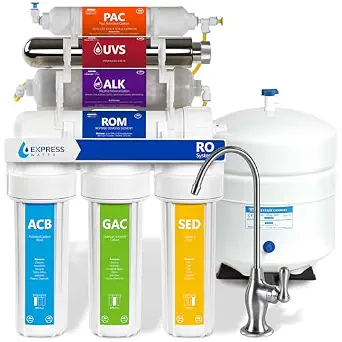 | Best High-Capacity Alkaline RO System | Filtration: 11-stage RO with UV sterilizer and alkaline minerals | Capacity: 100 gallons per day | Flow Rate: 0.8 gpm | VIEW ON AMAZON | See Our Full Breakdown |
| Whole House UV Water Filter System, 1″ MNPT, 55W, 12 GPM, 120V |  | Best Whole-House UV Coverage | UV Power: 55W | Flow Rate: 12 GPM | Connection: 1″ MNPT inlet/outlet | VIEW ON AMAZON | See Our Full Breakdown |
| APEC Water ROES-PHUV75, 7-Stage Under Sink RO System, Alkaline & UV, 75 GPD |  | Best Premium Long-Term Under-Sink System | Filtration: 7-stage RO with UV and calcium alkaline | Capacity: 75 gallons per day | Flow Rate: 0.07 gpm | VIEW ON AMAZON | See Our Full Breakdown |
| UV Water Filter – LED UV Water Purifier for Under Sink, 1GPM |  | Best Maintenance-Free Pick | Technology: UVC-LED, 270–280nm wavelength | Disinfection Rate: Up to 99.999% of bacteria, viruses, protozoa | Flow Rate: 1 GPM | VIEW ON AMAZON | See Our Full Breakdown |
| iSpring UVF11A UV Water Filter for Under Sink Water Filter & RO Systems |  | Best Value UV Add-On | UV Lamp: 11W germicidal, made in Poland | Chamber: Stainless steel with quartz sleeve | Flow Rate: 1.0 GPM | VIEW ON AMAZON | See Our Full Breakdown |
| iSpring RCC7AK-UV, NSF 58&372 Certified, 7-Stage Reverse Osmosis Water Filter System with Alkaline and LED UV Filter |  | Best Complete System | Stages: 7 (sediment, GAC, CTO, RO membrane, carbon, alkaline, UV) | Certification: NSF/ANSI 58 & 372 | RO Capacity: 75 gallons per day | VIEW ON AMAZON | See Our Full Breakdown |
| APEC Water UG-UVSET-1-4-SS UV Sterilizer Water Filtration Kit |  | Best Heavy-Duty Add-On | Chamber Material: Polished 304 stainless steel | Sleeve: Natural quartz | Disinfection Rate: Up to 99.99% of bacteria, viruses, microorganisms | VIEW ON AMAZON | See Our Full Breakdown |
| uv water purifier system under | Installation | Flow Rate |
|---|---|---|
| LCF 0.01μm Ultra-Filtration Un | DIY, 1/2-inch or 3/8-inch pipes, ~15 minutes | — |
| Bluevua RO100ROPOT Countertop | Countertop, plug-and-play | 0.26 L/min |
| Express Water ROALKUV10D | Under sink, DIY | 0.8 gpm |
| Whole House UV Water Filter Sy | — | 12 GPM |
| APEC Water ROES-PHUV75 | Under sink, DIY with guided instructions | 0.07 gpm |
| UV Water Filter | Under sink / point-of-use add-on | 1 GPM |
| iSpring UVF11A UV Water Filter | — | 1.0 GPM |
| iSpring RCC7AK-UV | — | — |
| APEC Water UG-UVSET-1-4-SS UV | Two water connections, one electrical connection | — |
More Details on Our Top Picks
LCF 0.01μm Ultra-Filtration Under Sink Water Filter System with UV-C
This option stands out for pairing a 0.01μm ultra-filtration membrane with a flow-activated LED UV faucet, all without producing a drop of wastewater. Compared with the Express Water ROALKUV10D, which sends water down the drain as part of reverse osmosis, the LCF keeps your water bill untouched and skips the drain-pipe plumbing entirely. The tradeoff is fundamental: ultra-filtration will not lower TDS, so dissolved solids like fluoride reduction claims are limited versus a true RO membrane. The twist-and-lock filter swaps without shutting off water, and the filter-life indicator removes the guesswork the standalone UV units like the iSpring UVF11A leave you to manage yourself. The LED UV approach also means no mercury lamp replacements, though its 99.9% bacteria reduction is only rated under 2L/min flow.
Pros:- Zero wastewater and no drain line required
- Mercury-free LED UV activates only with water flow
- Tool-free twist-and-lock filter changes
- Built-in filter life reminder on the faucet
Cons:- Does not reduce TDS, so it’s weaker than RO for dissolved contaminants
- UV bacteria reduction only rated at flow rates under 2L/min
Best for: Eco-conscious homeowners who want under-sink UV protection without wastewater or a drain connection
Not ideal for: Buyers with high-TDS tap water who want measurable dissolved-solids reduction — ultra-filtration plus alkaline minerals won’t lower TDS
- Filtration:3-stage 0.01μm ultra-filtration with alkaline boost
- UV Type:LED UV-C (mercury-free, flow-activated)
- Contaminants Targeted:30+, including chlorine, PFAS, heavy metals, microplastics
- Wastewater:None
- Faucet Material:Lead-free SUS304
- Installation:DIY, 1/2-inch or 3/8-inch pipes, ~15 minutes
- Filter Replacement:Twist-and-lock, no tools, no shutoff needed
Our verdict“The right pick if you want low-maintenance UV protection at the sink and don’t need the deep contaminant removal of reverse osmosis.”
Bluevua RO100ROPOT Countertop Reverse Osmosis Water Filter System
Where the Bluevua RO100ROPOT-UV earns its spot is installation-free operation: plug it in, fill it, and drink. That’s a category the under-sink systems like the Express Water ROALKUV10D and APEC ROES-PHUV75 simply can’t compete in, since both demand cabinet space, a faucet hole, and plumbing work. The borosilicate glass carafe is a genuine differentiator against plastic-reservoir rivals, cutting the risk of secondary contamination, and the 2:1 pure-to-drain ratio is far thriftier than traditional tank-based RO. The built-in TDS meter lets you verify performance in real time — something no other pick here offers. The compromise is capacity: a 1.7L carafe and 0.26L/min flow mean this can’t serve a family the way a 100 GPD tank system can, and it occupies permanent counter real estate.
Pros:- Zero installation or plumbing required
- RO membrane (0.0001μm) plus UV plus remineralization in six stages
- Glass carafe avoids plastic contact with purified water
- 2:1 pure-to-drain ratio saves water versus typical RO
Cons:- Small 1.7L carafe capacity and 0.26L/min flow rate
- Occupies over a foot of counter space permanently
- Max input TDS of 500 PPM limits use with very poor source water
Best for: Renters, RV owners, and anyone who can’t or won’t modify plumbing but still wants true RO plus UV
Not ideal for: Large households doing daily cooking and filling bottles — the carafe capacity and slow dispense rate become bottlenecks fast
- Filtration:6-stage RO (0.0001μm) with UV and remineralization
- Installation:Countertop, plug-and-play
- Container:Borosilicate glass carafe, 1700 ml
- Pure-to-Drain Ratio:2:1
- Flow Rate:0.26 L/min
- Filter Life:12–24 months
- Certifications:WQA (NSF/ANSI/CAN 372), SGS tested
- Dimensions:10.9″L x 15.4″W x 14.3″H
Our verdict“The obvious choice for renters and travelers who want RO-grade purification with UV without touching a single pipe.”
Express Water ROALKUV10D, 11-Stage RO Water Filter System, Alkaline & UV
The Express Water ROALKUV10D is the volume play in this lineup. At 100 GPD with a pressurized tank, it out-produces the APEC ROES-PHUV75’s 75 GPD and keeps alkaline mineral stages in the mix, so a household can fill pots and bottles without waiting. Its 11-stage design layers RO, UV sterilization, and active mineral beads — the most elaborate chain here — and a warning light flags when UV output drops, a safeguard the LCF system’s LED approach handles differently through automatic flow activation. The emergency leak-stop detector is a thoughtful touch the countertop Bluevua doesn’t need but every under-sink system should have. Tradeoffs are real: more stages mean more filters to buy and track, the traditional mercury UV bulb needs periodic replacement, and like all tank RO systems it generates wastewater.
Pros:- 100 GPD capacity with storage tank for instant dispensing
- UV warning light alerts when sterilization power drops
- Emergency leak detector shuts off water automatically
- Alkaline mineral stages add calcium, magnesium, and potassium
Cons:- Eleven stages means an ongoing carousel of replacement filters
- Mercury UV bulb requires periodic replacement
- Produces wastewater like all traditional RO systems
Best for: Busy households that want tank-fed, mineralized alkaline water on tap at high volume
Not ideal for: Small-cabinet kitchens or minimalists — the tank and multi-stage manifold eat space and demand frequent filter inventory
- Filtration:11-stage RO with UV sterilizer and alkaline minerals
- Capacity:100 gallons per day
- Flow Rate:0.8 gpm
- Installation:Under sink, DIY
- Tank:Included pressurized storage tank
- Safety Features:Leak-stop detector, UV warning light
- Certification:NSF Certified 372 (lead-free)
- Dimensions:15″L x 5″W x 17″H, 31 lb
Our verdict“Best suited to families who prioritize volume and minerals and don’t mind the maintenance load of an 11-stage system.”
Whole House UV Water Filter System, 1″ MNPT, 55W, 12 GPM, 120V
This is the only pick here that treats every drop entering the house, not just the kitchen sink. At 12 GPM through a 55W lamp, it can keep pace with simultaneous showers and laundry — something the point-of-use units like the LCF ultra-filtration system or iSpring UVF11A can’t attempt, being limited to a single faucet. Because it’s chemical-free, it leaves taste, odor, and pH untouched, which matters if you dislike what chlorination does to shower water. The stainless housing feels built for decades, and the included spare bulb softens the first replacement cycle. But be clear about what UV alone does: nothing else. No sediment, no chlorine, no heavy metals — so a pre-filter is effectively mandatory, and the 1,500-hour lamp life means annual-to-biannual bulb swaps depending on usage.
Pros:- 12 GPM flow rate covers whole-house residential or light commercial demand
- Chemical-free purification preserves taste, odor, and pH
- Durable stainless steel housing
- Extra replacement bulb included in the box
Cons:- Removes no sediment or chemical contaminants — requires pre-filtration to be effective
- UV lamp rated only ~1,500 hours, so recurring bulb costs add up
Best for: Well-water homeowners or anyone wanting microbiological protection at every tap, shower included
Not ideal for: City-water users mainly worried about chlorine, lead, or taste — UV addresses none of that on its own
- UV Power:55W
- Flow Rate:12 GPM
- Connection:1″ MNPT inlet/outlet
- Voltage:120V
- UV Lamp Lifespan:Up to 1,500 hours
- Housing Material:Stainless steel
- Included Extras:1 extra UV bulb
- Coverage:Whole house, residential or commercial
Our verdict“The pick when your concern is bacteria and viruses throughout the entire home, provided you pair it with proper pre-filtration.”
APEC Water ROES-PHUV75, 7-Stage Under Sink RO System, Alkaline & UV, 75 GPD
The APEC ROES-PHUV75 plays the quality-over-quantity card against the Express Water ROALKUV10D: fewer stages (7 vs 11), but with APEC’s reputation for premium long-lasting filters and US-based design, which typically translates to fewer cartridge swaps and better long-term taste consistency. Its calcium-based remineralization uses food-grade material to raise pH, and the 100% lead-free designer faucet with certified John Guest tubing means the entire water path is quality-controlled, not just the filters. The continuous UV stage targets living impurities in well water — a real advantage over the LCF’s flow-rate-limited LED. The honest tradeoff: 75 GPD is a step down in output from the Express Water, the 0.07 gpm faucet flow demands patience, and this is a premium-priced system with a multi-hour DIY install that’s less forgiving than the plug-and-play Bluevua.
Pros:- Premium long-life filters reduce replacement frequency
- Food-grade calcium remineralization for safe pH elevation
- Lead-free designer faucet and certified JG food-grade tubing
- Effective for both tap and well water sources
Cons:- Slow 0.07 gpm dispensing flow rate
- Longer and more involved DIY install than cartridge or countertop rivals
- 75 GPD output trails the Express Water’s 100 GPD
Best for: Homeowners (especially on well water) willing to invest once for a durable, mineral-enhanced RO system they won’t fuss over
Not ideal for: Budget-limited buyers or those wanting high-volume dispensing — the 0.07 gpm faucet flow is slow for big fills
- Filtration:7-stage RO with UV and calcium alkaline
- Capacity:75 gallons per day
- Flow Rate:0.07 gpm
- Operating Pressure:40–85 psi
- Installation:Under sink, DIY with guided instructions
- Certification:NSF Certified 372 (lead-free)
- Faucet:100% lead-free designer faucet
- Dimensions:15.5″L x 5.25″W x 18.5″H
Our verdict“A buy-it-right-once under-sink system for well-water households that value filter longevity and build quality over raw output.”
UV Water Filter – LED UV Water Purifier for Under Sink, 1GPM
This option stands out for swapping the traditional mercury UV lamp for a UVC-LED rated to last up to 10 years, which means no lamp swaps at all — a real advantage over the iSpring UVF11A, whose bulb needs replacing after 8,000 hours. The 270–280nm wavelength destroys microbial DNA on contact, and the flow sensor activates the LED only when water is running, cutting energy use dramatically. Compared with the APEC UG-UVSET, it’s far more compact and better suited to tight under-sink cabinets. The tradeoff: LED output is lower than an 11W mercury lamp, so households on heavily contaminated well water may want the stronger dose a traditional lamp provides.
Pros:- Up to 10-year LED life with no lamp replacements
- Flow-sensor activation saves up to 90% energy
- Chemical-free disinfection with no added taste or odor
- Compact size fits crowded under-sink setups
Cons:- Lower UV intensity than traditional 11W mercury lamps
- Point-of-use only — not suitable for whole-house applications
Best for: Apartment dwellers and RO system owners who want a set-and-forget UV add-on with zero lamp replacements
Not ideal for: Rural users with heavily microbe-laden well water — a lower-output LED may not match a full 11W mercury lamp
- Technology:UVC-LED, 270–280nm wavelength
- Disinfection Rate:Up to 99.999% of bacteria, viruses, protozoa
- Flow Rate:1 GPM
- LED Lifespan:Up to 10 years
- Activation:Automatic flow sensor
- Installation:Under sink / point-of-use add-on
- Best Placement:After RO system as final stage
Our verdict“Buy this if you already have an RO or filtration system and want UV protection you never have to think about again.”
iSpring UVF11A UV Water Filter for Under Sink Water Filter & RO Systems
The UVF11A earns its value spot by pairing an 11W germicidal lamp in a stainless steel chamber — nearly double the power of the 6W lamps common in this class — at an accessible price point. The smart flow switch powers the lamp only when water moves, stretching the 8,000-hour lamp life considerably. Compared with the LED-based unit above, you get stronger UV output for problem water, but you accept a recurring lamp replacement cycle. It’s a tighter, simpler package than the APEC UG-UVSET and slots neatly as a final stage on most RO systems via 1/4-inch quick-connect fittings. One placement note: with a storage tank, install it after the tank where flow is adequate.
Pros:- 11W lamp in stainless steel housing outpowers typical 6W competitors
- Flow sensor switch saves power and extends lamp life
- Quick-connect fittings make DIY installation straightforward
- Effective for well water and other problem sources
Cons:- Lamp needs replacement after 8,000 hours of use
- 1 GPM flow rate limits it to single-faucet point-of-use applications
Best for: Budget-conscious owners of existing RO or under-sink systems who want proven lamp-based UV protection as a final stage
Not ideal for: Buyers who want zero maintenance — the lamp requires replacement roughly annually with regular use
- UV Lamp:11W germicidal, made in Poland
- Chamber:Stainless steel with quartz sleeve
- Flow Rate:1.0 GPM
- Lamp Life:8,000 hours
- Fittings:1/4-inch quick-connect inlet/outlet
- Power:110V with electronic ballast
- Operating Pressure:5–115 psi
Our verdict“The smart pick if you want industrial-style UV disinfection added to an existing system without paying for a full replacement rig.”
iSpring RCC7AK-UV, NSF 58&372 Certified, 7-Stage Reverse Osmosis Water Filter System with Alkaline and LED UV Filter
Unlike the UVF11A or the LED UV add-on, this is a complete 7-stage RO system with UV built in — you’re buying the whole filtration chain, not bolting a stage onto something else. What separates it from similar multi-stage rigs like the Express Water ROALKUV10D is the NSF/ANSI 58&372 whole-system certification, verified reductions of lead (98.9%), fluoride (97.4%), and more, plus an alkaline remineralization stage that puts spring-like minerals back into RO water. The 75 GPD membrane handles a large family, and the top-mounted faucet design spares you from tightening fittings in a dark cabinet. Tradeoffs are real: this is a bigger install with a storage tank, more filters to replace on a schedule, and it wastes some water like all tank-based RO systems.
Pros:- Whole-system NSF/ANSI 58&372 certification, not just component claims
- Alkaline stage restores minerals and balances pH after RO
- Mercury-free LED UV with smart flow activation
- Transparent first-stage housing lets you see when filters need changing
Cons:- Multi-stage maintenance means recurring filter replacements across several cartridges
- Larger footprint with 3.2-gallon storage tank crowds small cabinets
- Needs at least 45 psi feed pressure or a booster pump
Best for: Households starting from scratch who want certified RO filtration, mineral alkalinity, and UV in one coordinated package
Not ideal for: Renters or anyone wanting a quick add-on — this requires a dedicated faucet, storage tank, and a half-day installation
- Stages:7 (sediment, GAC, CTO, RO membrane, carbon, alkaline, UV)
- Certification:NSF/ANSI 58 & 372
- RO Capacity:75 gallons per day
- Tank Capacity:3.2 gallons
- UV Stage:11W UV with LED design in newer units
- Feed Water Pressure:40–95 psi
- Max TDS:2000 ppm
- Dimensions:15″L x 8″W x 18″H
Our verdict“The right choice if you want one purchase that covers sediment, chemicals, dissolved solids, minerals, and microbes end to end.”
APEC Water UG-UVSET-1-4-SS UV Sterilizer Water Filtration Kit
This kit plays the durability card. The polished 304 stainless steel reactor chamber and natural quartz sleeve are built to commercial-grade standards, letting maximum UV rays reach the water while standing up to years of pressure cycling. Where the iSpring UVF11A targets residential under-sink setups, the APEC unit is rated for both commercial and residential use, making it the stronger choice for demanding well-water situations where non-chlorinated sources breed microorganisms. Installation stays simple — just two water connections and one electrical hookup. The catch: there’s no flow sensor here, so unlike the UVF11A or the LED unit, the lamp runs continuously rather than on demand, which eats lamp hours and energy. It’s also a heftier, less compact piece of hardware.
Pros:- Commercial-grade 304 stainless steel chamber for long service life
- Quartz sleeve maximizes UV penetration and lamp protection
- Eliminates up to 99.99% of microbes common in untreated well water
- Simple three-connection installation
Cons:- No flow-activated switch, so the lamp runs continuously
- Bulkier than compact LED alternatives for tight under-sink spaces
Best for: Well-water households and light-commercial users who need rugged, high-output UV sterilization built to survive daily use
Not ideal for: Energy-conscious buyers or occasional-use sinks — without a flow sensor, the lamp runs even when no water is flowing
- Chamber Material:Polished 304 stainless steel
- Sleeve:Natural quartz
- Disinfection Rate:Up to 99.99% of bacteria, viruses, microorganisms
- Fittings:1/4-inch connections
- Installation:Two water connections, one electrical connection
- Use Case:Residential and light commercial, well water
Our verdict“Pick this when raw durability and raw UV output matter more than smart features — especially on untreated well water.”

How We Picked
I evaluated each system on four factors that actually change the buying decision. First, filtration completeness: does the system combine UV with meaningful pre-filtration, or is it a UV lamp expecting you to bring your own filters? UV only neutralizes microorganisms — it does nothing for lead, chlorine, or dissolved solids — so systems that paired it with RO or multi-stage carbon scored higher for most buyers. Second, installation and fit: under-sink space is tight, and faucet compatibility, tank vs. tankless design, and plumbing requirements separated the easy installs from weekend-long projects.
Third, I weighed maintenance reality — UV lamps need replacement every 12 months and RO membranes every 2–3 years, so I favored systems with accessible lamp housings and clearly documented replacement cycles. Fourth, output and household scale: a 75 GPD under-sink system serves a family of four very differently than a 12 GPM whole-house sterilizer. Products were then ranked by how well they match the most common buyer situations, which is why a complete RO+UV system leads the list while capable add-on kits sit lower — not because they’re worse products, but because they serve a narrower audience.
| uv water purifier system under | Installation |
|---|---|
| LCF 0.01μm Ultra-Filtration Un | DIY, 1/2-inch or 3/8-inch pipes, ~15 minutes |
| Bluevua RO100ROPOT Countertop | Countertop, plug-and-play |
| Express Water ROALKUV10D | Under sink, DIY |
| Whole House UV Water Filter Sy | — |
| APEC Water ROES-PHUV75 | Under sink, DIY with guided instructions |
| UV Water Filter | Under sink / point-of-use add-on |
| iSpring UVF11A UV Water Filter | — |
| iSpring RCC7AK-UV | — |
| APEC Water UG-UVSET-1-4-SS UV | Two water connections, one electrical connection |
Factors to Consider When Choosing Uv Water Purifier System Under
Before choosing a UV water purifier system for under your sink, it helps to understand what UV can and cannot do, and where the hidden costs and mismatched expectations usually creep in. These are the factors I’d weigh before spending anything.Know What UV Actually Treats
UV sterilization is a microbiological treatment only — it disables bacteria, viruses, and cysts, but it removes nothing physical from your water. No chlorine, no lead, no microplastics, no dissolved solids. The single most common mistake I see is buyers purchasing a standalone UV unit expecting better-tasting water, then being disappointed when nothing changes at the tap. If your water is microbiologically suspect (well water is the classic case), UV is exactly right. If your concern is municipal chlorine taste or heavy metals, UV alone solves neither. This is why the combined RO+UV systems ranked higher for general buyers: they cover both classes of contamination. Match the technology to your actual water problem — ideally after a water test — rather than buying the most stages for the money.
UV Lamp Flow Rate and Dosage
Every UV sterilizer is rated for a maximum flow rate — the 1GPM under-sink units, for example, treat roughly one gallon per minute, which is fine for a single drinking faucet but would be overwhelmed by a whole-home demand. Exceeding the rated flow means water passes the lamp too quickly to receive a full dose, and the purification silently fails with no visible warning. For under-sink use, 1 GPM is adequate because drinking faucets rarely exceed it. The 12 GPM whole-house unit exists precisely because showers, dishwashers, and laundry all draw simultaneously. Check the rated flow against where the unit will actually sit in your plumbing, and if you’re on well water, also check your water’s turbidity — cloudy water shields organisms from UV light, so a sediment prefilter isn’t optional, it’s part of the UV system doing its job.
Tank vs. Tankless and Under-Sink Footprint
Under-sink cabinets are smaller than most buyers expect, and traditional RO systems with storage tanks consume most of one. The tankless and countertop designs in this lineup trade a small buffer of instant water for a compact footprint and fresher water that hasn’t sat in a bladder. If you fill large pots or multiple bottles at once, a tank system delivers immediate volume; tankless units make you wait as they produce. Also measure your faucet situation before ordering — most RO systems need a dedicated hole for their own faucet, and renters often can’t drill one. That’s the specific gap countertop units like the Bluevua fill, and why it earns a slot despite not being an under-sink product in the strict sense.
The Real Cost Is Replacement, Not Purchase
UV lamps degrade even when unused and need annual replacement regardless of condition; RO membranes last 2–3 years; sediment and carbon filters every 6–12 months. Across a five-year ownership period, consumables on a multi-stage RO+UV system can approach or exceed the original purchase price. When comparing systems, look up the cost and availability of proprietary replacement cartridges before buying — some manufacturers lock you into expensive annual kits, while others use standard-sized filters you can source from multiple brands. A cheaper system with proprietary cartridges often costs more over time than a pricier system with universal 10-inch filters. Also check how the lamp is accessed: a tool-free lamp housing turns a 10-minute annual swap into an afternoon project.
Wastewater Ratio and Water Pressure
Reverse osmosis systems send a portion of your water down the drain as concentrate — commonly three or four gallons wasted per gallon produced on older designs, versus closer to 1:1 on newer ones. If you’re on a metered water supply, this quietly affects your bill. RO systems also need adequate incoming pressure (typically 40–60 PSI); low-pressure homes may need a booster pump, which adds cost and an outlet requirement. If your water pressure is marginal or you’re eco-conscious about waste, a UV-plus-ultrafiltration system like the LCF — which wastes no water — is a legitimate alternative to RO, sacrificing some contaminant removal for efficiency. This tradeoff is one of the least discussed and most consequential in the category.
Frequently Asked Questions
Do I need UV if I’m on city water?
Usually not, but it depends on your risk tolerance. Municipal water in most developed areas is already disinfected with chlorine or chloramine, which handles the organisms UV targets, so UV adds a redundancy layer rather than essential protection. UV becomes genuinely valuable if your municipality has had boil-water notices, if you’re at the end of a long distribution line, or if you use a carbon filter that removes chlorine — because once chlorine is stripped out, your water loses its residual protection and becomes vulnerable to any contamination introduced downstream. Well water is the clearest case for UV, since untreated groundwater can carry coliform bacteria, giardia, and other pathogens. If you’re buying an RO system anyway and want maximum protection for immunocompromised household members, the UV stage is inexpensive insurance at that point.
Can I add a UV unit to my existing under-sink filter instead of buying a whole new system?
Yes, and that’s exactly what the iSpring UVF11A, APEC UG-UVSET-1-4-SS, and the 1GPM LED units in this lineup are built for. These install on the filtered-water line after your existing carbon or RO system, adding sterilization without replacing what you own. Before buying, check two things: your filter system’s outlet fitting size (these kits are not universally compatible) and your available under-sink space plus an electrical outlet, since all UV units need power. The add-on route typically costs far less than a combined system and takes under an hour to install. The limitation is flow — a 1 GPM unit works for a drinking faucet but shouldn’t feed an icemaker and faucet simultaneously. If your current system already removes chemicals and tastes fine, an add-on UV kit is the smarter spend.
How often do I really need to replace the UV lamp?
Annually, and this is non-negotiable for actual protection. UV lamps don’t burn out like regular bulbs — they continue glowing while their UV output drops below the dose needed to kill organisms, usually after about 9,000 hours (roughly one year of continuous operation). This failure mode is invisible: the light looks fine, the water looks fine, but organisms may be passing through unharmed. Some higher-end units include a lamp-life indicator or alarm, which is worth having if you don’t trust yourself to track it. Skipping a replacement to save money defeats the entire purpose of buying UV protection, so factor the lamp cost into your yearly ownership budget from day one. Mark the installation date on the housing with a marker when you install it.
Is a UV add-on kit worth it compared to an all-in-one RO+UV system?
It depends entirely on what’s already under your sink. If you own a functioning carbon or RO system you’re happy with, a UV add-on delivers the microbiological protection for a fraction of the cost and effort of a full replacement — that’s why the iSpring UVF11A ranks well despite being a simpler product. If you’re starting from nothing, the all-in-one systems win on economics and plumbing simplicity: buying stages separately means separate housings, separate fittings, more leak points, and usually a higher total cost. The all-in-one route also guarantees the stages are ordered correctly, with UV positioned last after water is already clarified — critical because sediment blocks UV light. My rule: add-on kits for existing systems, integrated systems for new installations.
Does UV water purification change the taste of water?
No — UV produces no taste, odor, or chemical change whatsoever, and this surprises many buyers. The systems in this lineup that improve taste do so through their other stages: carbon filters remove chlorine, and the alkaline remineralization stages in the iSpring RCC7AK-UV, APEC ROES-PHUV75, and Express Water systems add back calcium and magnesium that reverse osmosis strips out, which also raises pH slightly. If your goal is better-tasting water, prioritize carbon filtration and remineralization, not UV. If your goal is safe water from a well or a questionable supply, UV is the star and taste is secondary. Buyers wanting both outcomes are exactly who the multi-stage RO+UV+alkaline systems are designed for, which is a big reason they dominate the top of this ranking.
Conclusion
The right pick here depends less on which system is best and more on what’s already under your sink. For best overall, the iSpring RCC7AK-UV delivers the most complete package — RO, UV, and alkaline remineralization with a genuinely easier faucet installation than its peers. For best premium, the APEC ROES-PHUV75 justifies its higher cost with higher output and a longer-established filtration track record, making it the pick for larger households or heavy water users. The Express Water ROALKUV10D earns best value among complete systems with its 11 stages at a lower total cost of entry. For beginners — and especially renters who can’t plumb anything — the Bluevua RO100ROPOT countertop unit removes the installation barrier entirely. If you already own a filter system, skip the all-in-ones: the iSpring UVF11A is the smartest add-on purchase in the lineup. And if your need is whole-house protection on well water, the 55W whole-house UV sterilizer is the only option here that fits the job — just don’t expect it to touch taste or chemicals.
Halloween Picks
halloween
As an affiliate, we earn on qualifying purchases.