

For Thanksgiving, the choice between an electric roasting pan and a conventional oven is less about which can roast a turkey and more about where your kitchen gets crowded. A countertop electric roaster gives the bird its own cooking space, leaving the oven available for stuffing, casseroles, and pies. The conventional oven wins on versatility, familiar temperature control, and the ability to cook multiple dishes together.

Get home appliances delivered free with Prime
- Fast, free delivery on millions of items
- Prime Video, Amazon Music and more included
- Member-only deals all year

Sunvivi 28-Quart Electric Roaster Oven with Removable Pan and Self-Basting Lid, Silver
- ✔ Capacity: 28 quarts
- ✔ Turkey fit: Up to 30 lb, according to the product description
- ✔ Wattage: 1450 watts

Hamilton Beach 28 lb 22-Quart Roaster Oven with Self-Basting Lid – Stainless Steel
- ✔ Capacity: 22 quarts
- ✔ Stated turkey fit: Up to 28 lb
- ✔ Wattage: 1450 watts
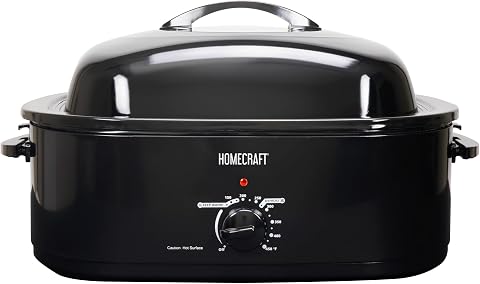
Homecraft Electric Roaster Oven – 18-Quart, Full-Range Temperature Control, Lift-Out Rack & Removable Enamel Pot, Black
- ✔ Capacity: 18 quarts
- ✔ Temperature range: Up to 450°F
- ✔ Control: Knob with three settings
Neither option is automatically better for every holiday kitchen. An electric roaster can be a useful extra cooking station if oven space is your bottleneck and you have a suitable counter and outlet. The oven is the stronger default for cooks who already have enough room, want one appliance to handle varied dishes, or rely on established recipes. The comparisons below focus on turkey capacity, oven availability, cooking control, sides, space, and overall value.
At a Glance
| Criteria | Electric Roasting Pan | Conventional Oven | Winner |
|---|---|---|---|
| Turkey and batch capacity | Capacity depends on the model; check its stated turkey size and interior dimensions. | Usually accommodates a range of turkey sizes, subject to oven dimensions and pan fit. | Depends |
| Freeing oven space | Excellent: cooks on the counter, leaving the oven free. | Low: the turkey occupies the oven during roasting. | A |
| Temperature control and familiarity | A dedicated thermostat and manual may require practice; results vary by model and setup. | Familiar to most cooks, with established recipes and known oven behavior. | B |
| Cooking sides and multiple dishes | Limited to the roaster’s single cooking vessel; sides may need another appliance. | Strong: can cook multiple dishes across racks, subject to space and timing. | B |
| Counter and storage space | Takes counter space while in use and needs storage the rest of the year. | No extra appliance to store, though the oven itself is a fixed kitchen fixture. | B |
| Value for occasional holiday use | Worthwhile when oven capacity is a recurring holiday problem. | Best value if the existing oven meets holiday needs. | Depends |
Sunvivi 28-Quart Electric Roaster Oven with Removable Pan and Self-Basting Lid, Silver
When the holiday centerpiece is a particularly large turkey, the Sunvivi’s 28-quart capacity is the clearest advantage in this lineup. Its description says it can accommodate a bird up to 30 pounds, giving it more stated headroom than the 22-quart Hamilton Beach and 18-quart Homecraft. That makes it the strongest fit for a large guest list, especially when freeing the main oven for sides is part of the plan.The self-basting lid is designed to help distribute moisture during cooking, and the 1450-watt heating element is paired with a 150–450°F range. A dedicated thaw function is another unusual holiday-oriented feature: it may help with thawing logistics, though the product information does not quantify how much time it saves or replace safe thawing practices. Against the Hamilton Beach, Sunvivi offers more capacity and the thaw setting; Hamilton Beach gives up some room but has a tempered glass lid and a lower listed minimum temperature.We would plan around two practical drawbacks. At roughly 23.45 inches deep and 15.4 inches wide, this is a substantial appliance to store, and the supplied details say the liner must be used below 350°F to prevent sticking. That instruction adds attention during setup and may constrain how we use the liner at higher settings. For smaller meals or limited cabinets, the Homecraft is an easier-capacity match. For a large Thanksgiving turkey, however, Sunvivi earns the top position by pairing the largest stated chamber with features aimed at holiday preparation.
Pros:
- 28-quart capacity is the largest among these three options.
- Described as fitting turkeys up to 30 pounds.
- Self-basting lid and dedicated thaw function address two holiday cooking needs.
- Cool-touch handles and non-skid feet are specified for safer handling and placement.
Cons:
- Bulky dimensions may make storage difficult in a small kitchen.
- The liner must be used below 350°F to prevent sticking.
- Knob control is less specific than a digital interface, which is not offered.
Best for: Hosts cooking a large turkey for a sizable Thanksgiving gathering who have counter and storage room for a full-size roaster.
Not ideal for: Small households, kitchens with limited storage, or cooks who want to use the liner above 350°F without an extra restriction to manage.
Bottom line: For a large Thanksgiving centerpiece, Sunvivi offers the most capacity and holiday-specific features, provided we can accommodate its size and liner instruction.
“For a large Thanksgiving centerpiece, Sunvivi offers the most capacity and holiday-specific features, provided we can accommodate its size and liner instruction.”
Hamilton Beach 28 lb 22-Quart Roaster Oven with Self-Basting Lid – Stainless Steel
The Hamilton Beach 22-quart roaster sits between Sunvivi’s oversized chamber and Homecraft’s more modest capacity. That middle position makes it a practical choice when we want substantial room for a Thanksgiving bird but do not need the largest stated capacity in the group. Its description calls out a 28-pound turkey fit, giving buyers a concrete reference point that is close to Sunvivi’s stated 30-pound maximum.Like Sunvivi, it has a self-basting lid intended to help retain moisture, plus a removable pan and rack for serving and cleanup. Its 125–450°F range extends lower than either competitor’s stated minimum, which can give more flexibility for lower-temperature use. The tempered glass lid also offers a view inside without lifting the cover, whereas the other listings do not specify a glass lid. Compared with Homecraft, Hamilton Beach has more stated capacity and a wider temperature range; Homecraft counters with an enamel pot and more explicit lift-out rack details.There are tradeoffs. At 14.2 pounds, the listed weight makes it less appealing if we expect to carry it frequently between storage and counter, and its knob controls do not provide digital precision. The dimensions are also presented as 10.5 inches deep by 17.5 wide by 24 high, a tall profile worth checking against available cabinet space. We rank it second because it retains many of the holiday-relevant conveniences of the larger Sunvivi while reducing capacity, though the supplied information does not establish that it will fit every turkey shape at the stated weight.
Pros:
- 22-quart capacity and stated 28-pound turkey fit suit many large meals.
- Self-basting lid is designed to help retain moisture.
- Removable pan and rack support serving and cleanup.
- 125–450°F range starts lower than the other two listed ranges.
Cons:
- The 14.2-pound listed weight may make frequent moving cumbersome.
- Knob controls may feel less precise than digital controls.
- Its listed 24-inch height deserves a cabinet and counter clearance check.
Best for: Thanksgiving hosts who want a substantial turkey capacity with a removable pan, rack, and self-basting lid, but do not require the largest chamber.
Not ideal for: Anyone prioritizing light weight, digital temperature adjustment, or a compact appliance that is easy to move and store.
Bottom line: Hamilton Beach is the balanced middle choice for hosts who want meaningful turkey capacity and serving conveniences without stepping up to Sunvivi’s 28-quart size.
“Hamilton Beach is the balanced middle choice for hosts who want meaningful turkey capacity and serving conveniences without stepping up to Sunvivi’s 28-quart size.”
Homecraft Electric Roaster Oven – 18-Quart, Full-Range Temperature Control, Lift-Out Rack & Removable Enamel Pot, Black
Homecraft is the capacity-conscious choice here: its 18-quart chamber is smaller than the Hamilton Beach and Sunvivi, so it makes more sense for a smaller turkey, chicken, or roast than for a host who needs the lineup’s maximum bird capacity. Its description says it handles whole turkeys, but does not give a weight limit. We would therefore avoid assuming it can accommodate the same birds specified for the other two models.What it gives up in chamber size, it makes up in a straightforward serving setup. The removable enamel pot and stainless-steel lift-out rack separate the food from the appliance body, which can help with carrying the roast to the table and washing the cooking vessel. The cool-touch lid and handles are also useful during a crowded holiday meal. Compared with Hamilton Beach, Homecraft has less capacity and lacks a stated glass lid, but its removable enamel pot is a clear cleanup detail. Against Sunvivi, it avoids the liner temperature instruction and takes a lower-capacity approach.Its temperature dial reaches 450°F, yet the product details say it has only three settings. That is a meaningful limitation for cooks who want finer adjustments, especially since the label “full-range” could otherwise suggest more control than the supplied control description supports. Its footprint is also not especially tiny: at 23.43 inches deep and 15.35 inches wide, it is close to Sunvivi in those dimensions, though it is shorter. We place it third for broad Thanksgiving use because capacity matters for the centerpiece, but for smaller gatherings its removable pot and rack may be more useful than extra quart capacity.
Pros:
- Removable enamel pot and lift-out stainless-steel rack simplify serving and cleaning.
- 18-quart capacity covers smaller roasts and gatherings.
- Temperature range reaches 450°F.
- Cool-touch lid and handles are useful around a busy meal.
Cons:
- Only three temperature settings limit adjustment granularity.
- No turkey weight limit is provided in the supplied details.
- Its depth and width still require meaningful storage space.
Best for: Smaller holiday gatherings or cooks who value an enamel cooking pot and lift-out rack for serving and cleanup.
Not ideal for: Hosts planning a large turkey or cooks who want many precise temperature increments.
Bottom line: Choose Homecraft when a smaller centerpiece and easy pot removal matter more than the extra turkey capacity of Hamilton Beach or Sunvivi.
“Choose Homecraft when a smaller centerpiece and easy pot removal matter more than the extra turkey capacity of Hamilton Beach or Sunvivi.”
As an Amazon Associate we earn from qualifying purchases.
Key Differences
The electric roaster’s clearest advantage is separation: the turkey cooks outside the oven, and the main oven remains available for other parts of the meal. That can change the timing of Thanksgiving cooking when the oven is already booked with casseroles or when several dishes need different temperatures. This advantage matters most in a kitchen where the turkey is the main source of oven congestion. It does not create extra capacity for side dishes inside the roaster, which is generally one cooking chamber dedicated to the bird.
The conventional oven is the safer all-purpose choice. Most cooks already know how it behaves, many recipes are written for it, and it can handle more than a single roasting task. The electric model’s real value depends on whether its particular size and heating performance suit the bird and the counter setup. Check the manufacturer’s capacity guidance and instructions, and use a food thermometer to confirm the turkey reaches a safe temperature. For an occasional holiday meal in a kitchen with adequate oven space, buying a roaster may add storage and setup work without solving a real problem.
Detailed Comparison
Turkey and batch capacity (moderate difference)
Neither option wins across all kitchens because capacity depends on fit. An electric roaster’s advertised capacity is model-specific, and the turkey must fit with room for the lid to close as directed. The oven also has limits: check the bird, roasting pan, and available rack clearance together. This is a moderate, practical difference when cooking a large bird. Measure before buying a roaster, and check the oven before committing to a turkey size.
Freeing oven space (Electric Roasting Pan wins — major)
The electric roasting pan wins by a major margin on this criterion: it operates on the counter, so the oven can be used for other dishes while the turkey cooks. That can make a crowded holiday schedule easier to manage. The tradeoff is that the roaster itself only frees space; it does not make the oven cook faster or eliminate the need to coordinate cooking times. If oven access is the recurring constraint, this is the strongest reason to choose A.
Temperature control and familiarity (Conventional Oven wins — moderate)
The conventional oven has a moderate advantage for most home cooks because its controls and recipe expectations are familiar. An electric roaster has its own thermostat, instructions, and heating environment, so cooks should not assume a recipe’s oven temperature and timing transfer perfectly. Actual performance varies by model. Follow the appliance manual and verify doneness with a thermometer; do not rely on a stated cooking time alone.
Cooking sides and multiple dishes (Conventional Oven wins — major)
The conventional oven wins by a major margin for flexibility. It can hold multiple dishes on different racks when their temperatures and timing are compatible. The roaster usually reserves one vessel for the turkey, so side dishes still need the oven, stovetop, or another appliance. A roaster can solve the turkey-versus-sides conflict, but it will not prepare the full meal by itself.
Counter and storage space (Conventional Oven wins — moderate)
The conventional oven wins by a moderate margin because it requires no additional appliance purchase or off-season storage. An electric roaster needs a stable, heat-safe counter location, an appropriate outlet, and room to store it afterward. For someone with limited counter or cupboard space, the occasional convenience may not justify the footprint. For a frequent host with a suitable setup, that cost in space may be acceptable.
Value for occasional holiday use (moderate difference)
This is a genuine tradeoff, so the winner depends on how often the oven becomes a bottleneck. The existing oven is the better value when it can roast the turkey and accommodate the rest of the menu with reasonable scheduling. An electric roaster earns its cost when it repeatedly prevents a timing or space problem, especially for a host who cooks large holiday meals. Paying more for a second cooking appliance is hard to justify for one meal if the main oven already works.
Electric Roasting Pan: Pros and Cons
Pros:
- Keeps the turkey out of the oven and opens space for sides.
- Adds a separate cooking station for busy holiday meal preparation.
- May suit hosts whose main oven is too small or already heavily scheduled.
Cons:
- Uses counter space and needs storage between holidays.
- Capacity and cooking behavior depend on the specific model.
- Does not provide the oven’s flexibility for cooking several different dishes.
Conventional Oven: Pros and Cons
Pros:
- Uses familiar controls and recipe methods for most cooks.
- Can handle the turkey and, when space and timing allow, multiple side dishes.
- Requires no additional appliance purchase or storage.
Cons:
- The turkey occupies the oven for much of the roasting period.
- Can make timing difficult when several dishes need oven heat at once.
- Capacity is still limited by oven dimensions, rack clearance, and pan fit.
Who Should Choose What
Choose Electric Roasting Pan if:
- Your oven is consistently occupied by side dishes while the turkey needs to roast.
- You host large meals often enough to use a second cooking station beyond a single holiday.
- You have counter space, a suitable outlet, and a model whose stated capacity fits your turkey.
Choose Conventional Oven if:
- Your oven has adequate capacity and you can schedule the turkey and sides without major conflicts.
- You prefer familiar recipes and want one appliance that handles varied dishes.
- You do not want another bulky appliance to store for most of the year.
Skip both if: Neither option fits if you lack both oven capacity and a suitable safe space and outlet for a countertop roaster; consider a smaller turkey or a different meal plan.
Value for Money
Buying an electric roaster is worth the added cost when it solves a recurring problem: the oven cannot comfortably serve the turkey and the rest of the menu in the same cooking window. In that case, the appliance buys scheduling flexibility, and that benefit can matter more than its purchase price for a frequent host. Check capacity, dimensions, and the manufacturer’s instructions before buying; a low-cost model that cannot fit your usual bird may be poor value.
If Thanksgiving is the only occasion when the oven feels crowded, the conventional oven is usually the better value. It is already available, supports a wider range of dishes, and avoids extra storage. Pay for a roaster only when freeing the oven will materially simplify how you cook or let you serve a menu your existing setup cannot manage comfortably.
Final Verdict
For most households with a capable conventional oven, use the oven: it is familiar, flexible, and the better value when the meal can be scheduled around its capacity. Choose an electric roasting pan when oven space is the specific problem and you have verified that a model fits your turkey and counter setup. The deciding factor is whether keeping the turkey out of the oven changes your holiday cooking in a meaningful way. If it does, the roaster earns its place; if it does not, the oven is the more sensible choice.
Frequently Asked Questions
Is an electric roasting pan better than an oven for Thanksgiving turkey?
It is better for preserving oven space; a conventional oven is generally more versatile and familiar. The right choice depends on whether oven congestion is your main problem and whether the specific roaster can fit your bird.
Does an electric roaster cook a turkey as well as a conventional oven?
Results depend on the appliance, setup, and recipe. Follow the roaster’s manual, and check the turkey’s internal temperature with a food thermometer rather than relying only on timing or appearance.
Can I cook Thanksgiving side dishes in an electric roaster?
Some models and recipes may accommodate side dishes, but the roaster is generally one cooking vessel and may be occupied by the turkey. Plan to use the oven or stovetop for the rest of the menu unless the model’s instructions support your intended use.
Is an electric roasting pan worth buying for one holiday meal?
Usually only if the oven is too crowded to prepare the meal on time or if you expect to use the roaster for other large meals. If your oven already handles the turkey and sides, buying and storing another appliance is unlikely to add enough value.