TL;DR

Get home appliances delivered free with Prime
- Fast, free delivery on millions of items
- Prime Video, Amazon Music and more included
- Member-only deals all year
A CNET reporter tested Apple’s HomeView during a hands-on event in New York and came away persuaded by its approach to managing compatible smart-home devices through Apple Home. The demonstration showed quick device pairing, Face ID-based profiles and a 7-inch display, but the report did not establish how the product performs in everyday use or confirm details such as pricing and availability.
CNET reporter Ajay Kumar said a hands-on demonstration of Apple’s HomeView changed his view of the smart-home screen, after he watched an Apple representative pair a device through Apple Home and saw personalized profiles demonstrated. The report describes an event demonstration, not an independent test in a home, so the product’s everyday performance and several features remain unverified.
At Apple’s Welcome Home event in New York City, Kumar spent more than an hour viewing and interacting with HomeView in staged settings. He said the most compelling moment was watching a representative find, pair and register a smart-home device through the Apple Home app, without opening a separate app during the demonstration. Kumar compared the apparent process to setting up AirPods or a HomePod, but said he did not have time to examine it closely.
The report says HomeView is intended to work with the new Apple Home collection, including devices from LG and Schneider Electric, as well as Matter and Apple Home accessories. Kumar expected that many devices associated with Amazon and Google would also work, but the source does not confirm compatibility across those product ranges. Apple’s demonstrated pairing process should not be treated as proof that every device can be set up without a separate account or app.
Kumar also saw Face ID recognition select a user profile and display information such as a calendar and scheduled events. Apple representatives demonstrated different access on devices in a simulated home, including a security-camera view outside and limited guest access to features such as temperature control or Safari. The report says HomeView can recognize up to six people. Kumar speculated that family and child profiles might offer parental controls, but said Apple had not confirmed that detail.
A Simpler Route Into Smart Homes
The report focuses on a common barrier to smart-home use: devices from different manufacturers often require separate apps, accounts and troubleshooting. Kumar described managing more than 10 third-party apps for devices in his own home, despite using an Alexa-enabled Echo Show as an integration point. He characterized the arrangement as functional, but difficult to maintain.
If HomeView’s setup works across a broad range of products as shown, bringing device management into one Apple Home interface could reduce friction for people who are reluctant to assemble a smart home. That is a potential benefit, not a result established by the demonstration: the report does not test setup across multiple brands or show how the system handles connection failures. Face-based profiles could also make a shared screen more convenient, while limiting what guests can access, but the report offers no extended privacy or reliability testing.
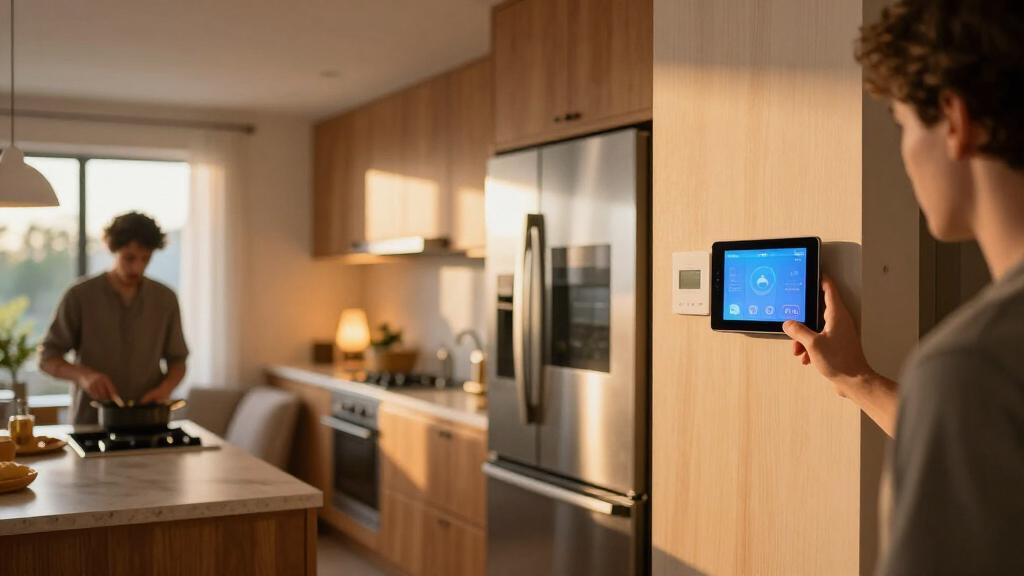
The display’s form factor may matter for buyers with limited counter space. HomeView has a 7-inch square Liquid Retina display on a tilting base. Kumar considered the size useful for a narrow kitchen, where recipes and timers might be easier to view than on a larger screen. Other attendees reportedly thought the screen was too small, underscoring that the design’s appeal will depend on how people plan to use it.
As an affiliate, we earn on qualifying purchases.
What the New York Demo Showed
Kumar writes that he tests smart-home equipment and described his own setup as a mixture of Philips Hue bulbs, Govee lamps, Dreo fans, TP-Link plugs, Eufy cameras, a smart litter box and robot vacuums, among other devices. Those products are linked through an Amazon Echo Show 8 and Alexa, but he said the result still requires managing a collection of manufacturer apps. That experience frames his positive response to HomeView, but it is his account rather than a comparative product test.
At the event, Apple showed the screen in several staged environments. In a kitchen display, it sat beside an espresso setup and was used for recipes and timers. The report says recipes could be shared from an iPhone by tapping it against HomeView, or accessed using Siri or Safari, and that the cooking instructions appeared in step-by-step screens. The device was also shown in a bedroom and near an exterior camera view. All these examples were event demonstrations; the report does not describe testing them in a working household.
Kumar also discussed the placement of a smart screen, noting that he and his wife find their kitchen devices take up too much counter space and do not like wall mounting them. He said HomeView’s base kept the display off the counter surface and allowed it to tilt. These observations explain his preference for the design, but do not establish how it compares with other screens across different rooms or household needs.
“functional, which is the highest praise I can offer it”
— CNET reporter Ajay Kumar
smart home device pairing Apple Home
As an affiliate, we earn on qualifying purchases.
As an affiliate, we earn on qualifying purchases.
Everyday Use Still Untested
The source is a hands-on event report, not a review based on long-term use. Kumar did not complete a detailed setup or test the device across a household’s range of products, and the report does not provide independent evidence about connection reliability, speed over time or what happens when an accessory stops working.
Apple’s broad compatibility with third-party products is also not fully established in the report. Kumar said Matter and Apple Home accessories should work and expected many Amazon- and Google-associated devices to work, but that expectation was not confirmed by Apple in the account. The report does not give pricing, release timing or retail availability, and it does not confirm whether profiles will include parental controls. It also leaves open how the face-recognition feature handles privacy and access in everyday household use.
As an affiliate, we earn on qualifying purchases.
Details Needed Beyond the Demo
The next useful evidence will come from full product specifications and independent testing outside Apple’s staged environments. Buyers will need clear information about price and availability, supported devices, setup requirements and the limits of guest and family profiles. Testing across brands would show whether the promised central control reduces the need for manufacturer apps in practice.
Until those details are available, the report supports a narrower conclusion: HomeView’s demonstration showed Apple’s intended approach to pairing, profile selection and kitchen use, and persuaded one experienced smart-home tester of its potential. It does not establish that the device will work seamlessly in homes with varied equipment or resolve the maintenance problems Kumar described.
As an affiliate, we earn on qualifying purchases.
Key Questions
What is Apple HomeView?
HomeView is a smart-home screen demonstrated by Apple at its Welcome Home event. CNET’s report describes a 7-inch square Liquid Retina display intended to work with Apple Home and compatible smart-home devices.
What did the CNET reporter see at the event?
Ajay Kumar watched an Apple representative pair a smart-home device through Apple Home and saw demonstrations of Face ID profile selection, a kitchen recipe and timer display, and different access for guests. These were demonstrations rather than extended household tests.
Will HomeView work with Amazon and Google devices?
The report says HomeView is expected to support Matter and Apple Home accessories, but it does not confirm compatibility with every Amazon- or Google-associated product. Kumar said he expected many such devices to work; that expectation was not verified in the source.
How many people can HomeView recognize?
The report says HomeView can recognize up to six people and show personalized profiles. It does not confirm whether those profiles include parental controls.
Are price and release date confirmed?
No. The source report does not provide a price or release date, so those details remain unclear based on the material available.
Source: rss
Cold & flu season Picks
humidifiers
As an affiliate, we earn on qualifying purchases.