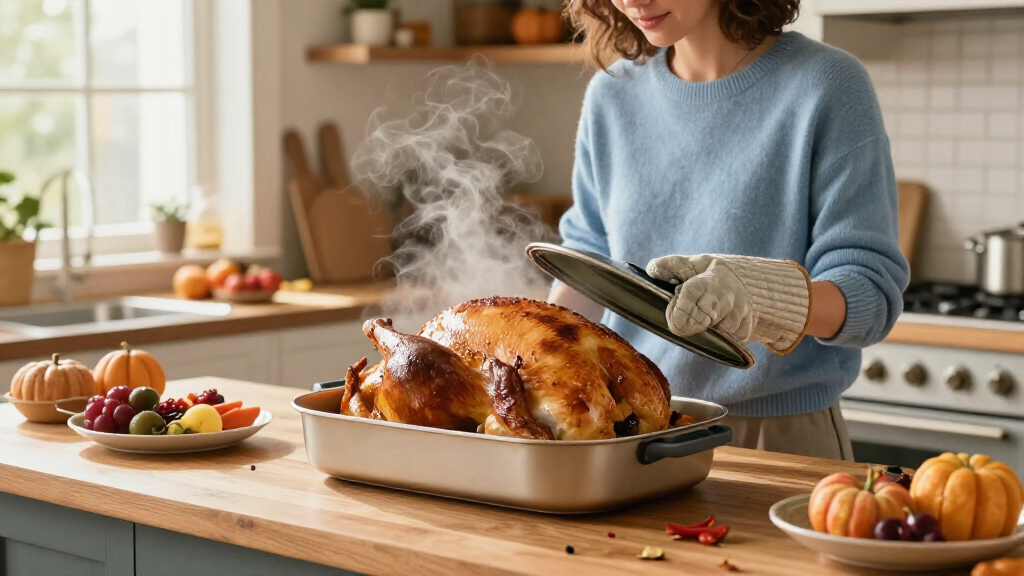
Use an electric roasting pan to cook a Thanksgiving turkey and check that it is safe to serve. This guide is for first-time and occasional roaster users who can handle basic kitchen tasks. Allow about 3–5 hours for setup, cooking and resting; the turkey may need several days to thaw in the refrigerator before cooking.

Get home appliances delivered free with Prime
- Fast, free delivery on millions of items
- Prime Video, Amazon Music and more included
- Member-only deals all year

Sunvivi 28 Quart Electric Roaster Oven
- ✔ Capacity: 28 quarts
- ✔ Stated turkey capacity: Up to 30 pounds
- ✔ Wattage: 1450 watts

Hamilton Beach 22-Quart Roaster Oven with Self-Basting Lid
- ✔ Capacity: 22 quarts
- ✔ Stated turkey capacity: 28 pounds
- ✔ Wattage: 1450 watts
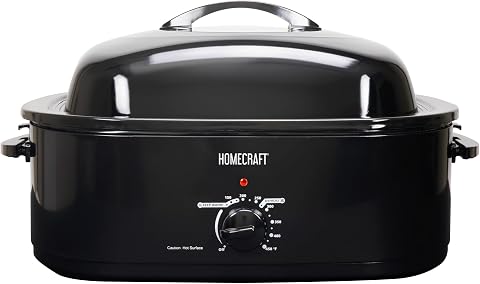
HomeCraft 18-Quart Electric Roaster Oven
- ✔ Capacity: 18 quarts
- ✔ Temperature range: Full-range control up to 450°F
- ✔ Controls: Temperature control dial
Difficulty: Beginner | Time: 3–5 hours, depending on turkey size, plus thawing time
What You’ll Need
Tools & Materials:
- Electric roasting pan with lid and rack
- Meat thermometer, preferably an instant-read model
- Roasting pan instructions
- Kitchen tongs or oven mitts
- Paper towels and a clean cutting board
- Food-safe container for storing leftovers
Knowledge:
- Basic handwashing and raw poultry handling
- How to read a meat thermometer
Choose a turkey that fits the roaster with the lid closed and has space for heat to circulate. Check the appliance manual for its capacity, setup and cleaning instructions. Thaw a frozen turkey in the refrigerator, allowing about 24 hours for each 4–5 pounds (1.8–2.3 kg). Keep raw turkey refrigerated until preparation.
Sunvivi 28 Quart Electric Roaster Oven
When the guest list is long, the Sunvivi’s 28-quart capacity gives it the clearest advantage in this lineup. The listing says it can fit a turkey up to 30 pounds, exceeding the stated capacities of both the 22-quart Hamilton Beach and 18-quart HomeCraft. It is the natural first choice when we need a separate cooking space for the centerpiece while the main oven handles sides.Its Thanksgiving-specific extras broaden that advantage: a thaw function and warming setting address two common scheduling problems, and the self-basting lid is designed to circulate moisture during roasting. The visible lid can also make it easier to monitor progress without lifting the cover. Compared with Hamilton Beach, Sunvivi offers more room and more explicit temperature-management modes; compared with HomeCraft, it is better equipped for a large meal. The tradeoff is its substantial footprint—listed at 23.45 inches deep, 15.4 inches wide, and 15.6 inches high—and a use note that its clear liner should stay below 350°F and be used with water to avoid sticking it to the pan. That caveat means we should check the liner instructions before relying on it for high-heat roasting.
Pros:
- Largest stated capacity here at 28 quarts
- Listing specifies turkey capacity up to 30 pounds
- Thawing and warming settings support holiday meal timing
- Visible self-basting lid and 150°F–450°F temperature control
Cons:
- Listed dimensions make it a substantial appliance to store
- Clear liner has temperature and water-use instructions
- More functions may be unnecessary for occasional small meals
Best for: Hosts cooking for a large group who want a high-capacity roaster with explicit thawing and warming functions.
Not ideal for: Small households with limited counter or storage space, or buyers seeking a simple liner-free setup without extra use instructions.
Bottom line: Choose Sunvivi when Thanksgiving scale and timing flexibility matter more than compact storage.
“Choose Sunvivi when Thanksgiving scale and timing flexibility matter more than compact storage.”
Hamilton Beach 22-Quart Roaster Oven with Self-Basting Lid
Hamilton Beach occupies the useful middle ground: its 22-quart capacity is roomier than HomeCraft’s 18-quart pot without reaching the bulkier 28-quart class represented by Sunvivi. The supplied title specifies a 28-pound turkey capacity, so it is aimed at a substantial holiday bird while remaining the more moderate-capacity pick in this comparison. We would shortlist it when a full-size Thanksgiving centerpiece matters, but the very largest stated turkey capacity is not essential.The self-basting lid, removable pan, and rack make the feature set straightforward for roasting and serving. Its 125°F–450°F temperature range starts lower than Sunvivi’s stated 150°F minimum, and its 1450-watt rating matches Sunvivi’s. Compared with HomeCraft, Hamilton Beach explicitly includes a self-basting lid and lists a removable pan and rack; compared with Sunvivi, it gives up the stated thawing and warming functions and four quarts of capacity. The tempered glass lid offers visibility, though the product title also calls it self-basting. Product dimensions are listed as 10.5 inches deep by 17.5 inches wide by 24 inches high, an unusual shape that buyers should measure against their storage space before ordering. The available description is brief, so details such as finish care are less fully documented here than for the other two models.
Pros:
- 22-quart capacity and stated 28-pound turkey capacity
- Self-basting tempered glass lid
- Removable pan and rack support serving and cleanup
- 1450 watts with a 125°F–450°F range
Cons:
- Smaller capacity than the Sunvivi 28-quart model
- No thawing or warming setting is specified in the supplied details
- Listed dimensions should be checked carefully for storage fit
Best for: Thanksgiving hosts who want a mid-sized roaster with a self-basting lid and removable cooking components.
Not ideal for: Those who need Sunvivi’s stated 30-pound turkey capacity or want clearly listed thawing and warming settings.
Bottom line: Hamilton Beach is the sensible middle pick when we want a turkey-focused roaster without moving up to the largest capacity.
“Hamilton Beach is the sensible middle pick when we want a turkey-focused roaster without moving up to the largest capacity.”
HomeCraft 18-Quart Electric Roaster Oven
HomeCraft is the small-meal specialist in this group. Its 18-quart capacity is the smallest of the three, which can be an advantage if our Thanksgiving gathering is modest or we have little storage room for a large appliance. The removable enamel pot and lift-out rack keep the setup familiar: we can lift the roast out and remove the pot for cleaning, while the rack can be taken out when we need the available space. Its 12.21-inch listed height is lower than the Sunvivi’s 15.6 inches, though the supplied measurements are not directly comparable in every dimension.The full-range dial reaches 450°F and the high-dome lid is described as fitting tightly, giving HomeCraft the core controls for roasting, slow cooking, and keeping food warm according to the product description. Unlike the other two models, its supplied details do not identify a self-basting lid, and it lacks an explicit thaw function. That makes it a more basic Thanksgiving choice than Sunvivi and a less turkey-specialized proposition than Hamilton Beach. Its listed materials include aluminum and stainless steel, with a plated aluminum lid. We would choose it for a smaller bird and a straightforward meal plan, but skip it if we are feeding a large crowd or want the dedicated timing features found on the Sunvivi.
Pros:
- Smallest capacity in this comparison for a more modest meal
- Removable enamel pot and stainless-steel lift-out rack
- Temperature dial reaches 450°F
- Cool-touch lid and handles are specified
Cons:
- 18 quarts is less roomy than either competing model
- No self-basting lid is specified in the supplied details
- Thawing and dedicated warming settings are not listed
Best for: Smaller households seeking an 18-quart roaster with a removable enamel pot and lift-out rack.
Not ideal for: Hosts cooking a very large turkey or wanting explicit self-basting, thawing, or warming settings.
Bottom line: Pick HomeCraft for a smaller Thanksgiving where manageable capacity and removable parts matter more than extra turkey-focused features.
“Pick HomeCraft for a smaller Thanksgiving where manageable capacity and removable parts matter more than extra turkey-focused features.”
As an Amazon Associate we earn from qualifying purchases.
Before You Start
Keep the roaster on a stable, heat-resistant surface with open space around its vents. Do not place it near curtains, under low cabinets or where its cord can be pulled. Follow the manual for electrical requirements and whether the unit needs preheating. Do not use an extension cord unless the manual permits it.
Electric roasters can cook turkey differently from conventional ovens, and browning varies by model. Use the manual’s turkey guidance as a starting point, but rely on thermometer readings rather than time or appearance. Do not stuff the turkey; cook stuffing separately so it heats evenly and safely.
Step-by-Step Instructions
Step 1: Check the turkey and roaster size
Confirm that the turkey is fully thawed and fits on the rack with the lid closed. Remove the neck and giblets from the cavity, then pat the turkey dry with paper towels. Wash your hands and clean surfaces that touched raw poultry.
Tip:If the bird presses against the lid or blocks vents, use a smaller turkey. Do not force the lid shut.
Check: The empty cavity has no packaging or giblets, and the turkey sits on the rack without touching the lid.
Step 2: Set up the electric roaster
Place the roaster on a level, heat-resistant surface away from water and nearby objects. Fit the rack inside the cooking well, then plug the roaster directly into an appropriate outlet. Set the temperature according to the appliance manual; preheat only if the manual directs you to.
Tip:Keep the cord routed where nobody can snag it. The exterior and lid may become hot during cooking.
Check: The roaster is stable, the rack is in place, and the control is set as directed by the manufacturer.
Step 3: Season the turkey
Rub the turkey with a small amount of oil or softened butter, then season the skin and cavity with salt, pepper and any herbs you like. Do not rinse the bird; splashing water can spread poultry bacteria around the sink.
Tip:For more even cooking, avoid packing the cavity with aromatics. If you add onion or herbs, leave plenty of open space inside.
Check: The turkey is dry on the surface and seasoned, with no stuffing packed into the cavity.
Step 4: Place the turkey in the roaster
Set the turkey breast-side up on the rack. Pour liquid into the cooking well only if the manual or your recipe calls for it; adding liquid does not replace checking the turkey’s temperature. Put on the lid and keep it closed during cooking.
Tip:Opening the lid releases heat and can lengthen cooking time. Avoid lifting it repeatedly to baste.
Check: The turkey is centered on the rack, the lid closes fully, and the roaster is heating without obstruction.
Step 5: Cook and monitor the temperature
Cook at the temperature and approximate timing recommended by the roaster manual. Begin checking before the estimated finish time. Insert a clean meat thermometer into the thickest part of the breast and the innermost part of the thigh, avoiding bone. Check the thickest part of the wing area as well.
Continue cooking until every checked area reaches at least 165°F (74°C). If a spot is below that temperature, replace the lid and continue cooking, then check again with a clean thermometer.
Tip:Do not use the pop-up timer, skin color or clear juices as proof that the turkey is done. A thermometer gives the useful reading.
Check: The breast, inner thigh and wing area each measure at least 165°F (74°C).
Step 6: Rest and carve the turkey
Turn off and unplug the roaster. Using oven mitts and sturdy utensils, transfer the turkey to a clean cutting board. Let it rest for about 20 minutes before carving so it is easier to handle and slice. Keep the hot roaster away from children and traffic.
Tip:Use caution when removing the lid: hot steam can escape toward your hands and face.
Check: The turkey has rested, the meat is fully cooked at the checked areas, and carving can proceed without handling the hot appliance.
Step 7: Store leftovers promptly
Refrigerate leftover turkey within two hours of cooking. Divide large portions into shallow containers so they cool promptly, and refrigerate at 40°F (4°C) or below. Use leftovers within three to four days, or freeze them for longer storage. Unplug the roaster and let it cool before cleaning it as the manual directs.
Tip:Do not leave the turkey or leftovers sitting out while the meal continues for several hours.
Check: Leftovers are covered and refrigerated promptly, and the appliance is unplugged and cooling.
Common Mistakes to Avoid
- Starting with a partly frozen turkey. — Thaw it completely in the refrigerator before cooking; a frozen center makes cooking uneven and timing unreliable.
- Opening the lid often to check or baste. — Keep the lid closed and use the manual’s timing as an estimate. Check temperature near the expected finish.
- Judging doneness by browned skin or a pop-up timer. — Check the breast, inner thigh and wing area with a meat thermometer; each must reach 165°F (74°C).
- Putting a turkey that is too large into the roaster. — Check the stated capacity and test that the lid closes with space around the bird before seasoning.
Troubleshooting
Problem: The turkey is not at 165°F (74°C) when the estimated time ends.
Solution: Keep cooking with the lid closed and check again periodically in the thickest areas. Do not serve until all checked areas reach 165°F (74°C).
Problem: The breast is done, but the thigh is below 165°F (74°C).
Solution: Continue cooking and recheck the thigh, taking care not to touch bone. If needed, shield the breast loosely with foil only if the appliance manual permits it and the foil will not contact a heating element.
Problem: The turkey skin is pale.
Solution: Roaster models vary in browning. If browned skin matters, follow the manual’s directions for browning; some recipes finish the turkey briefly in a conventional oven. Transfer it safely and verify the internal temperature remains at least 165°F (74°C).
Problem: The roaster does not heat or the indicator stays off.
Solution: Turn the control off, check that the plug is fully seated and the outlet works, then consult the manual. Do not use the appliance if the cord or plug is damaged.
What Success Looks Like
The turkey fits and cooks in the roaster without the lid being forced shut. A thermometer reads at least 165°F (74°C) in the thickest breast, inner thigh and wing area. After resting, the turkey can be carved, and leftovers are refrigerated within two hours.
Next Steps
After the roaster has cooled, remove the rack and cooking well if the manual allows, then wash and dry each part as directed. Store the appliance with its cord and accessories safely arranged. For future meals, note the turkey’s weight, cooking time and temperature checks for your specific model; use those notes as planning help, while still checking every turkey with a thermometer.
Frequently Asked Questions
Can I cook stuffing inside the turkey in an electric roaster?
Cooking stuffing separately is the safer and more predictable choice. Stuffing inside a bird can heat slowly; if you do prepare it inside, the center of the stuffing must also reach 165°F (74°C).
Should I add water to the electric roasting pan?
Follow the appliance manual and recipe. Some models or recipes call for liquid, while others do not. Water does not make the turkey cook safely by itself, and it does not replace thermometer checks.
How long does a turkey take in an electric roaster?
Time depends on turkey weight, starting temperature and the roaster model. Use the manual for an estimate, start checking early, and cook until the breast, thigh and wing area reach 165°F (74°C).
Will the turkey brown in an electric roaster?
It may brown less than in a conventional oven, and results vary by model. Check your manual for browning guidance; judge doneness with a thermometer, not skin color.