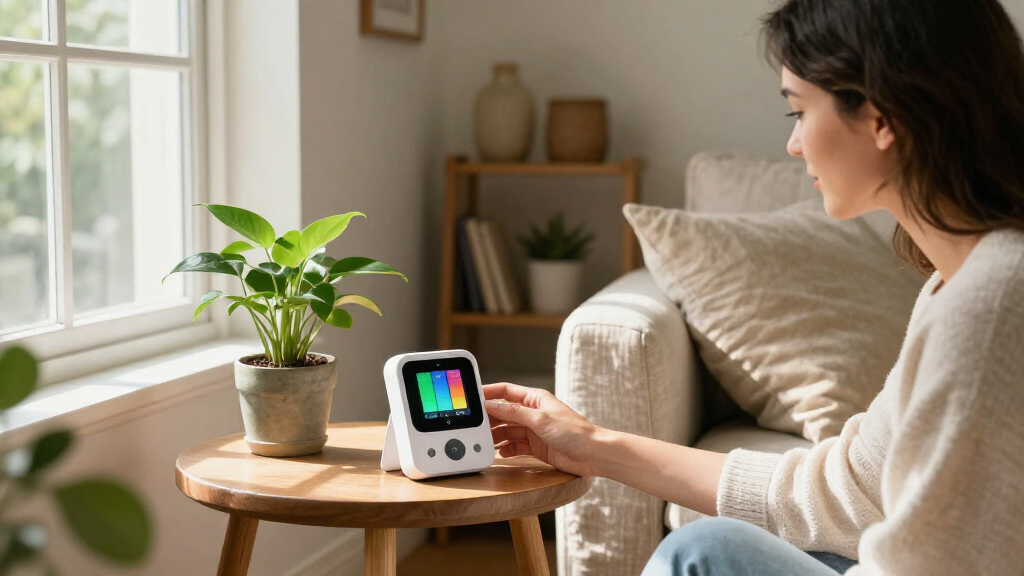

The best indoor air quality monitor overall is the Airthings View Plus for buyers who want radon monitoring alongside a broader view of household air. The Aranet4 is a strong alternative when accurate, easy-to-read CO₂ tracking is the priority, while the Amazon Smart Air Quality Monitor suits Alexa households seeking simple readings and alerts. The key tradeoff is between specialized monitoring and broad sensor lists: more measurements do not automatically mean better accuracy or more useful guidance. Display size, app support, portability, and the pollutants each device actually detects also shape the choice. Read on for a comparison of all 14 indoor air quality monitors and guidance on which type fits your home.

Get home appliances delivered free with Prime
- Fast, free delivery on millions of items
- Prime Video, Amazon Music and more included
- Member-only deals all year
Complete the kit


Key Takeaways
- Airthings View Plus is the clearest fit for radon-focused buyers: it tracks radon alongside other air indicators, a capability that distinguishes it from the lineup’s CO₂-centered and general-purpose options.
- Aranet4 prioritizes CO₂ clarity over breadth: its wireless CO₂-focused approach suits people monitoring ventilation, but it is not a substitute for a multi-pollutant monitor.
- The amazon.com/dp/B08W8KS8D3?tag=koldfaste-20&ascsubtag=dc-1291066″ target=”_blank” rel=”nofollow sponsored noopener”>Amazon Smart Air Quality Monitor stands out for Alexa households: its smart-home connection offers a simpler path to alerts than choosing a device based only on a long sensor list.
- Many of the 16-in-1 models compete on display and stated measurement count: compare the exact pollutants, sensor details, and data features rather than assuming matching counts mean matching performance.
- The Amazon two-pack changes room coverage, not sensor capability: it can make sense for comparing two locations, while a single specialized device may be a better match for one specific concern.
| YNAK AK22A 16-in-1 Indoor Air Quality Monitor with 7-Inch Display |  | Best for At-a-Glance Room Monitoring | Brand and model: YNAK AK22A | Display: 7-inch LED with three brightness settings | Measurements: CO2, PM1.0, PM2.5, PM10, HCHO, TVOC, temperature, humidity, AQI, and time | VIEW LATEST PRICE | See Our Full Breakdown |
| BREATHE Airmonitor Plus Gen 2 Indoor Air Quality Monitor |  | Best for App-Based Tracking | Brand and model: BREATHE BTL40001 | Measurements: CO2, PM1, PM2.5, PM10, TVOC, HCHO, temperature, and humidity | CO2 sensor: NDIR | VIEW LATEST PRICE | See Our Full Breakdown |
| Amazon Smart Air Quality Monitor |  | Best for Alexa Households | Measurements: PM2.5, VOCs, carbon monoxide, humidity, and temperature | Dimensions: 65 × 65 × 45 mm | Weight: 120 g without cable or adapter | VIEW LATEST PRICE | See Our Full Breakdown |
| Aranet4 Indoor Air Quality Monitor with Wireless CO₂ Detector |  | Best for Long-Term CO2 Monitoring | Measurements: CO2, temperature, relative humidity, and atmospheric pressure | CO2 sensor: NDIR | Display: E-ink with color alerts | VIEW LATEST PRICE | See Our Full Breakdown |
| AQItech 16-in-1 Indoor Air Quality Monitor with Color Display |  | Best for Fast On-Screen Updates | Brand and model: AQItech AK16C | Measurements: PM1.0, PM2.5, PM10, CO2, TVOC, HCHO, temperature, and humidity | Update interval: 1.5 seconds | VIEW LATEST PRICE | See Our Full Breakdown |
| Amazon Smart Air Quality Monitor (2-Pack) | | Best for Alexa-Based Home Automation | Pack size: 2 monitors | Sensors: Temperature, humidity, carbon monoxide (CO), PM2.5, and VOCs | Connectivity: Alexa app and compatible Echo devices | VIEW LATEST PRICE | See Our Full Breakdown |
| 16-in-1 Indoor Air Quality Monitor with Color Screen |  | Best for Fast, Broad On-Screen Readings | Measurements: PM1.0, PM2.5, PM10, CO2, TVOC, HCHO, temperature, and humidity | Sampling interval: 1.5 seconds | Battery runtime: 4–5 hours | VIEW LATEST PRICE | See Our Full Breakdown |
| Lwyinp MT13S 10-in-1 Indoor Air Quality Monitor |  | Best for Flexible Room-to-Room Use | Brand: Lwyinp | Model: MT13S | Measurements: CO2, HCHO, TVOC, AQI, PM2.5, PM1.0, PM10, temperature, and humidity | VIEW LATEST PRICE | See Our Full Breakdown |
| Heouakc 10-in-1 Indoor Air Quality Monitor with Color Display |  | Best for App-Free Portable Monitoring | Model: MT13 | Monitored measurements: PM0.3, PM2.5, PM10, CO2, CO, HCHO, TVOC, AQI, temperature, and humidity | Update interval: 1.2 seconds | VIEW LATEST PRICE | See Our Full Breakdown |
| 16-in-1 Indoor Air Quality Monitor with Color Display | | Best for Simple, Powered-Location Monitoring | Model: AK16C | Measured parameters: PM1.0, PM2.5, PM10, TVOC, HCHO, carbon dioxide, temperature, and humidity | Update interval: 1.5 seconds | VIEW LATEST PRICE | See Our Full Breakdown |
| YNAK 16-in-1 Indoor Air Quality Monitor with 5.5-Inch HD Display | 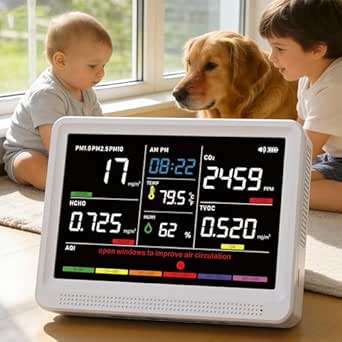 | Best for a Large Readout | Monitored parameters: CO2, PM2.5, PM1.0, PM10, HCHO, TVOC, temperature, humidity, AQI, and time | AQI alerts: 7 alert functions | Display: 5.5-inch HD LED | VIEW LATEST PRICE | See Our Full Breakdown |
| Airthings View Plus Battery-Powered Radon and Air Quality Monitor |  | Best for Radon and Long-Term Trends | Sensors: Radon, PM2.5, CO2, VOCs, humidity, temperature, and air pressure | Connectivity: Wi-Fi | Power: Battery-powered | VIEW LATEST PRICE | See Our Full Breakdown |
| AirWhisper 16-in-1 Indoor Air Quality Monitor |  | Best for Fast Portable Spot Checks | Measurements: PM1.0, PM2.5, PM10, TVOC, HCHO, temperature, and humidity | Update interval: 1.5 seconds | Display: HD color screen with color-coded readings | VIEW LATEST PRICE | See Our Full Breakdown |
| QXZFFF 10-in-1 Portable Air Quality Monitor with CO2 Detection |  | Best for Longer Cord-Free Use | Measurements: CO2, HCHO, TVOC, benzene, AQI, PM1.0, PM2.5, PM10, temperature, and humidity | Measurement error margin: Less than ±5% | Display: HD color screen | VIEW LATEST PRICE | See Our Full Breakdown |
| indoor air quality monitor | Display | Measurements |
|---|---|---|
| YNAK AK22A 16-in-1 Indoor Air | 7-inch LED with three brightness settings | CO2, PM1.0, PM2.5, PM10, HCHO, TVOC, temperature, humidity, AQI, and time |
| BREATHE Airmonitor Plus Gen 2 | — | CO2, PM1, PM2.5, PM10, TVOC, HCHO, temperature, and humidity |
| Amazon Smart Air Quality Monit | — | PM2.5, VOCs, carbon monoxide, humidity, and temperature |
| Aranet4 Indoor Air Quality Mon | E-ink with color alerts | CO2, temperature, relative humidity, and atmospheric pressure |
| AQItech 16-in-1 Indoor Air Qua | HD color screen with color-coded air-quality readings | PM1.0, PM2.5, PM10, CO2, TVOC, HCHO, temperature, and humidity |
| Amazon Smart Air Quality Monit | — | — |
| 16-in-1 Indoor Air Quality Mon | HD color screen | PM1.0, PM2.5, PM10, CO2, TVOC, HCHO, temperature, and humidity |
| Lwyinp MT13S 10-in-1 Indoor Ai | Color display | CO2, HCHO, TVOC, AQI, PM2.5, PM1.0, PM10, temperature, and humidity |
| Heouakc 10-in-1 Indoor Air Qua | — | — |
| 16-in-1 Indoor Air Quality Mon | HD color screen | — |
| YNAK 16-in-1 Indoor Air Qualit | 5.5-inch HD LED | — |
| Airthings View Plus Battery-Po | Customizable eInk screen | — |
| AirWhisper 16-in-1 Indoor Air | HD color screen with color-coded readings | PM1.0, PM2.5, PM10, TVOC, HCHO, temperature, and humidity |
| QXZFFF 10-in-1 Portable Air Qu | HD color screen | CO2, HCHO, TVOC, benzene, AQI, PM1.0, PM2.5, PM10, temperature, and humidity |
More Details on Our Top Picks
YNAK AK22A 16-in-1 Indoor Air Quality Monitor with 7-Inch Display
The YNAK AK22A suits buyers who want a broad set of readings visible without opening an app. Its 7-inch display presents CO2, three particle sizes, HCHO, TVOC, temperature, humidity, and AQI, making it easier to scan a room’s conditions than with the compact Amazon Smart Air Quality Monitor. Audible alerts can flag changing air quality, while the mute button gives you control over noise.
The tradeoff is that this is a display-first, short-runtime monitor: battery life is up to eight hours, so regular use away from an outlet may require frequent charging. Strong odors or perfumes may affect sensors, and the stated accuracy figure lacks a defined measurement or unit. Choose it for a prominent readout, not for clearly documented sensor precision.
Pros:- Large 7-inch display shows multiple air and comfort readings together
- Measures PM1.0, PM2.5, PM10, CO2, HCHO, and TVOC
- Audible alerts include a mute button
- USB-C rechargeable with up to eight hours of runtime
Cons:- Up to eight hours of battery life may mean frequent charging for portable use
- Perfumes and other strong odors may affect sensor readings
- The listed accuracy figure is not tied to a specific measurement or unit
Best for: Households that want a large, always-visible display with particle, gas, and comfort readings in one room.
Not ideal for: Buyers who need long battery operation, app-based historical graphs, or clearly specified sensor accuracy.
- Brand and model:YNAK AK22A
- Display:7-inch LED with three brightness settings
- Measurements:CO2, PM1.0, PM2.5, PM10, HCHO, TVOC, temperature, humidity, AQI, and time
- Alerts:Seven AQI alert functions; mute button
- Battery runtime:Up to 8 hours
- Charging:USB-C; AC adapter included
- Warranty:12 months
Our verdict“Choose the YNAK AK22A if a large, detailed room display matters more to you than extended battery life or app history.”
BREATHE Airmonitor Plus Gen 2 Indoor Air Quality Monitor
The BREATHE Airmonitor Plus Gen 2 is the strongest fit here for people who want to track patterns, not just check a live reading. It measures eight indicators, including CO2, particulate matter, TVOC, and formaldehyde, and pairs them with app alerts, graphs, and up to 90 days of history. CSV export gives data-focused buyers a way to work with the readings beyond the app. By contrast, the YNAK AK22A puts more emphasis on a large on-device display.
The BREATHE’s practical limits are its 2.4 GHz Wi-Fi requirement and battery life of up to six hours. It can run continuously over USB-C, but that reduces its appeal for untethered monitoring. Its NDIR CO2 and laser particle sensors are specified, while buyers seeking a simple, no-app monitor may prefer the Aranet4’s long battery life and focused CO2 readings.
Pros:- Tracks eight air-quality and environmental measurements
- App provides alerts, graphs, and up to 90 days of history
- CSV export supports use of readings outside the app
- Can operate on battery or continuously through USB-C
Cons:- App connectivity requires a 2.4 GHz Wi-Fi network
- Battery runtime is limited to up to six hours
- Continuous operation requires a USB-C power connection
Best for: People who want indoor air data over time, app alerts, and exportable readings for comparing rooms or routines.
Not ideal for: Buyers without 2.4 GHz Wi-Fi or those who want a monitor to run untethered for long periods.
- Brand and model:BREATHE BTL40001
- Measurements:CO2, PM1, PM2.5, PM10, TVOC, HCHO, temperature, and humidity
- CO2 sensor:NDIR
- Particle sensor:Laser
- Connectivity:2.4 GHz Wi-Fi
- Data history and export:Up to 90 days; CSV export
- Battery and power:Up to 6 hours on battery; continuous USB-C operation
- Warranty:2 years
Our verdict“Pick the BREATHE if app history and export matter more than a large standalone screen or long battery life.”
Amazon Smart Air Quality Monitor
The Amazon Smart Air Quality Monitor makes the most sense for an existing Alexa household that wants air readings to trigger useful actions. It tracks PM2.5, VOCs, carbon monoxide, humidity, and temperature, then reports conditions through a multicolor LED and the Alexa app. Phone alerts, Echo announcements, and routines can connect a change in air quality to other smart-home responses. That integration is its distinction: the BREATHE Airmonitor Plus Gen 2 offers more measurements and data export, but is built around its own app-based tracking.
This Amazon model is less measurement-heavy than monitors that include CO2, multiple particle sizes, or formaldehyde. It also needs 2.4 GHz Wi-Fi and an Alexa-compatible device or app, and its compact readout gives less detail on the unit itself than the YNAK AK22A’s large display. Skip it if you want a stand-alone monitor or detailed readings without Alexa.
Pros:- Monitors PM2.5, VOCs, carbon monoxide, humidity, and temperature
- Shows air quality through a multicolor LED and Alexa app
- Can send alerts, make Echo announcements, and trigger Alexa routines
- Includes power adapter and Micro-USB cable
Cons:- Does not list CO2, formaldehyde, or PM1 and PM10 measurements
- Requires 2.4 GHz Wi-Fi and Alexa app or compatible Echo devices
- Provides less on-device measurement detail than the YNAK AK22A
Best for: Alexa users who want air-quality alerts and readings to feed into existing Echo devices and smart-home routines.
Not ideal for: Buyers who need CO2, formaldehyde, multiple particle-size readings, or a detailed display that works independently of Alexa.
- Measurements:PM2.5, VOCs, carbon monoxide, humidity, and temperature
- Dimensions:65 × 65 × 45 mm
- Weight:120 g without cable or adapter
- Connectivity:2.4 GHz Wi-Fi and Bluetooth LE 4.2
- Compatibility:Echo devices and Alexa app version 2021.16 or later
- Power:5 W adapter; 100–240 V AC input, 5 V/1 A output
- Operating conditions:Indoor use; 0–40 °C and 0–80% humidity
- Warranty:One-year limited manufacturer’s warranty
Our verdict“Choose this monitor if Alexa integration is your priority and its five measurements cover the readings you need.”
Aranet4 Indoor Air Quality Monitor with Wireless CO₂ Detector
The Aranet4 is a focused choice for buyers whose main question is whether a room is accumulating CO2. Its NDIR sensor tracks CO2 alongside temperature, relative humidity, and atmospheric pressure, while the e-ink screen and color alerts make the readings easy to check without keeping an app open. Compared with the BREATHE Airmonitor Plus Gen 2, it measures fewer pollutants and environmental factors, but its stated battery life of up to four years is a major advantage for cable-free placement.
The compromise is narrower coverage: there are no listed particle, TVOC, or formaldehyde readings, so it cannot provide the broad snapshot offered by the YNAK AK22A. Its app holds up to 90 days of historical data, and an optional buzzer adds an audible warning, but buyers need to supply two AA batteries once the included pair is spent. This suits ventilation checks better than all-in-one pollutant screening.
Pros:- NDIR sensor monitors CO2 in real time
- E-ink display, color alerts, and optional buzzer support quick checks
- Battery life is rated for up to four years
- App includes graphs and up to 90 days of historical data
Cons:- Does not measure particulate matter, TVOC, or formaldehyde
- Uses two AA batteries, so replacement batteries will eventually be needed
- Historical app data is limited to up to 90 days
Best for: People monitoring ventilation and CO2 in classrooms, bedrooms, meeting rooms, or other spaces where a long-running wireless device is useful.
Not ideal for: Buyers who want particle, TVOC, or formaldehyde measurements in addition to CO2 and basic comfort readings.
- Measurements:CO2, temperature, relative humidity, and atmospheric pressure
- CO2 sensor:NDIR
- Display:E-ink with color alerts
- Battery life:Up to 4 years
- Batteries:Two AA batteries included
- App history:Up to 90 days
- Dimensions:2.76 × 2.76 × 0.94 inches
- Weight:3.67 ounces
Our verdict“Choose the Aranet4 if dependable, cable-free CO2 and ventilation monitoring matters more than measuring a wider range of pollutants.”
AQItech 16-in-1 Indoor Air Quality Monitor with Color Display
The AQItech 16-in-1 is aimed at buyers who want a quick-changing, color-coded view of several indoor conditions. It measures PM1.0, PM2.5, PM10, CO2, TVOC, HCHO, temperature, and humidity, with readings updated every 1.5 seconds. That refresh cadence makes it easier to follow short-term changes on its screen than with a monitor described mainly through app history, such as the BREATHE Airmonitor Plus Gen 2. Its audio prompts can also be turned off when alerts would be distracting.
The catch is that speed is better documented than measurement precision: no sensor accuracy figures are provided. Battery life is rated at only four to five hours, shorter than the YNAK AK22A’s up-to-eight-hour runtime, and the available details do not specify app graphs or wireless history. This is a practical portable readout, but not the strongest pick for extended cordless use or buyers who need documented accuracy.
Pros:- Measures PM1.0, PM2.5, PM10, CO2, TVOC, HCHO, temperature, and humidity
- Updates readings every 1.5 seconds
- Color-coded display makes changing readings easier to scan
- Audio prompts can be turned off; Type-C cable and AC adapter are included
Cons:- Battery runtime is limited to four to five hours
- Product details do not provide sensor accuracy figures
- Product details do not list app connectivity or historical data
Best for: People who want frequently refreshed, color-coded readings across particles, gases, and comfort conditions, with occasional portable use.
Not ideal for: Buyers who need a full day of battery operation, documented sensor accuracy, or app-based historical tracking.
- Brand and model:AQItech AK16C
- Measurements:PM1.0, PM2.5, PM10, CO2, TVOC, HCHO, temperature, and humidity
- Update interval:1.5 seconds
- Display:HD color screen with color-coded air-quality readings
- Battery runtime:4–5 hours
- Charging:USB Type-C
- Item weight:14.8 ounces
- Warranty support:12 months
Our verdict“Pick the AQItech if fast on-screen updates are your priority and you can accept short battery life and unspecified accuracy.”
Amazon Smart Air Quality Monitor (2-Pack)
I’d choose this two-monitor set for an Alexa household that needs air-quality alerts and simple device automation, rather than a portable readout to carry from room to room. It tracks CO, PM2.5, VOCs, temperature, and humidity, then presents a color-coded status and score in the Alexa app. Phone notifications and Echo announcements can flag a change, while Alexa Routines can prompt compatible purifiers, fans, or dehumidifiers to respond. Compared with the Heouakc MT13, this model depends more on connected services but adds smart-home actions; the Heouakc works without an app or wireless setup. The tradeoff is that detailed readings require the Alexa app, and routines depend on compatible Alexa devices. I’d skip it if you want an independent screen or offline monitoring.
Pros:- Two monitors can cover separate rooms
- Tracks CO, PM2.5, VOCs, temperature, and humidity
- Color-coded status and an app score make readings easier to interpret
- Supports notifications, Echo announcements, and Alexa Routines
Cons:- Detailed information requires the Alexa app
- Automations require compatible Alexa devices
- No standalone screen is specified for viewing readings on the monitor
Best for: Alexa households that want two-room monitoring, phone or Echo alerts, and routines linked to compatible air-treatment devices
Not ideal for: Buyers who want a standalone display, offline operation, or smart-home controls outside the Alexa ecosystem
- Pack size:2 monitors
- Sensors:Temperature, humidity, carbon monoxide (CO), PM2.5, and VOCs
- Connectivity:Alexa app and compatible Echo devices
- Status display:Color-coded LED and air-quality score in the Alexa app
- Alerts:Phone notifications and Echo announcements
- Automation:Supports Alexa Routines
Our verdict“Choose this set if Alexa alerts and routines matter more than a self-contained display or app-free use.”
16-in-1 Indoor Air Quality Monitor with Color Screen
This AQItech model suits buyers who want a broad set of measurements on a portable screen and value frequent updates over long unplugged sessions. Its listed readings include PM1.0, PM2.5, PM10, CO2, TVOC, HCHO, temperature, and humidity, refreshed every 1.5 seconds. The HD color screen keeps data on the device, unlike the Amazon Smart Air Quality Monitor, whose detailed information is accessed through the Alexa app. USB-C charging and the included adapter support both moving it between rooms and using it near an outlet. I’d treat the “16-in-1” label cautiously: the description names only eight measurement types. Its 4–5-hour battery runtime also makes it less suited to all-day portable monitoring than the Heouakc MT13, which lists up to 96 hours.
Pros:- Lists particulate, CO2, TVOC, HCHO, temperature, and humidity readings
- Updates readings every 1.5 seconds
- HD color screen provides on-device information
- Includes USB-C cable and AC adapter
Cons:- Battery runtime is limited to a stated 4–5 hours per charge
- The description lists eight measurement types despite the 16-in-1 name
- No sensor accuracy figures are provided
Best for: Buyers who want a portable screen with particulate, gas, and comfort readings that update frequently while the monitor is powered
Not ideal for: People who need long battery operation, documented sensor accuracy, or a clearly explained basis for the 16-in-1 label
- Measurements:PM1.0, PM2.5, PM10, CO2, TVOC, HCHO, temperature, and humidity
- Sampling interval:1.5 seconds
- Battery runtime:4–5 hours
- Charging port:USB-C
- Display:HD color screen
- Item weight:12.3 ounces
- Included accessories:USB-C charging cable, AC power adapter, and user manual
- Warranty support:12 months
Our verdict“Pick this AQItech monitor for quick, broad on-screen readings near power, not for extended battery-powered use.”
Lwyinp MT13S 10-in-1 Indoor Air Quality Monitor
The Lwyinp MT13S is a flexible pick for someone who wants one portable display for different indoor settings, including home and vehicle use. It lists CO2, HCHO, TVOC, PM1.0, PM2.5, PM10, temperature, humidity, and AQI, putting gas, particle, and comfort readings together. That breadth resembles the Heouakc MT13, but the Heouakc specifies an update interval, audible alert, and battery-life figure; the MT13S description gives no runtime or accuracy data. A color display makes readings available without opening an app, while Bluetooth is mentioned for clock time calibration, not as a stated monitoring dashboard. That distinction matters for buyers expecting connected charts or remote alerts. I’d rank this below the more fully specified portable alternatives when battery endurance is a priority.
Pros:- Lists CO2, formaldehyde, TVOC, particulate matter, temperature, and humidity
- Color display shows readings on the device
- Portable design is described for home, vehicle, and other indoor settings
- Bluetooth supports automatic clock time calibration
Cons:- Battery life is not specified
- Sensor accuracy figures are not provided
- Bluetooth is described for clock calibration, with no monitoring app features specified
Best for: People who want to move a color-screen monitor among rooms or indoor vehicle spaces and value a broad mix of listed readings
Not ideal for: Buyers who need a stated battery runtime, documented accuracy, or app-based monitoring and alerts
- Brand:Lwyinp
- Model:MT13S
- Measurements:CO2, HCHO, TVOC, AQI, PM2.5, PM1.0, PM10, temperature, and humidity
- Display:Color display
- Additional feature:Clock with Bluetooth time calibration
- Power:Rechargeable design; battery life not specified
- Included items:Monitor, charging cable, and user manual
- Color:Black
Our verdict“Choose the MT13S for a portable, broad-reading display if you can accept missing runtime and accuracy details.”
Heouakc 10-in-1 Indoor Air Quality Monitor with Color Display
The Heouakc MT13 is the strongest fit here for buyers who want a portable monitor that works without Wi-Fi, Bluetooth, or an app. It lists PM0.3, PM2.5, PM10, CO2, CO, HCHO, TVOC, AQI, temperature, and humidity, with readings refreshed every 1.2 seconds. The color-coded screen and audible alert make it more self-contained than the Amazon Smart Air Quality Monitor, which routes detailed information through Alexa. It also lists up to 96 hours of battery life, a clear advantage over the AQItech AK16C models’ stated 4–5 hours. The tradeoff is a lack of accuracy and calibration details, so the wide measurement list should not be mistaken for documented precision. Its audible alert may also require manual muting, which could bother people using it in quiet spaces.
Pros:- Lists 10 air and comfort measurements, including CO and PM0.3
- Readings update every 1.2 seconds
- Color-coded screen and audible alert work without an app
- USB-C charging and stated battery life of up to 96 hours
Cons:- No accuracy figures or sensor calibration details are provided
- Audible alerts may need to be muted manually
Best for: People who want a rechargeable, app-free monitor to move between rooms and read directly from its screen
Not ideal for: Buyers who need documented sensor accuracy or calibration details, or who need alerts that can be managed without manually muting the device
- Model:MT13
- Monitored measurements:PM0.3, PM2.5, PM10, CO2, CO, HCHO, TVOC, AQI, temperature, and humidity
- Update interval:1.2 seconds
- Battery capacity:2000 mAh
- Battery life:Up to 96 hours
- Charging:USB-C
- Connectivity:No Wi-Fi, Bluetooth, or app required
- Controls:One-button control
Our verdict“Choose the Heouakc if you want long stated battery life and direct, app-free readings, while accepting limited sensor documentation.”
16-in-1 Indoor Air Quality Monitor with Color Display
This second AQItech AK16C is best for buyers who want a simple on-device display and expect to monitor near a power outlet. It lists PM1.0, PM2.5, PM10, TVOC, HCHO, CO2, temperature, and humidity, with updates every 1.5 seconds on an HD color-coded screen. One-button operation keeps interaction straightforward, and the audio prompt can be turned off. Compared with the Heouakc MT13, this AQItech offers an adjustable prompt and included AC adapter, but its stated 4–5-hour battery life falls far short of the Heouakc’s up-to-96-hour claim. The listed measurements also do not include CO, which the Heouakc specifies. No accuracy figures are provided, so I’d treat it as a convenient awareness tool rather than a documented precision instrument.
Pros:- Lists particulate, gas, temperature, and humidity readings
- Updates readings every 1.5 seconds on an HD color-coded screen
- One-button operation and adjustable audio prompt
- Includes Type-C cable and AC adapter
Cons:- Battery life is stated as only 4–5 hours
- No measurement accuracy figures are provided
- The listed measurements do not include carbon monoxide
Best for: Buyers who want frequent, on-screen readings and straightforward controls for a monitor used near an outlet
Not ideal for: People who need long battery-powered monitoring, carbon monoxide readings, or published sensor accuracy figures
- Model:AK16C
- Measured parameters:PM1.0, PM2.5, PM10, TVOC, HCHO, carbon dioxide, temperature, and humidity
- Update interval:1.5 seconds
- Battery life:4–5 hours
- Charging:Type-C
- Display:HD color screen
- Weight:14.4 ounces
- Included accessories:Type-C charging cable, AC power adapter, and user manual
Our verdict“Choose this AQItech model for simple on-screen monitoring near power, not for extended portable use or CO readings.”
YNAK 16-in-1 Indoor Air Quality Monitor with 5.5-Inch HD Display
The 5.5-inch HD display and three brightness settings make the YNAK a good fit for checking readings from across a room, while its measurements cover CO2, three particle sizes, HCHO, TVOC, temperature, and humidity. Seven AQI alert functions and a mute button offer a choice between noticeable warnings and quieter monitoring. Compared with the Airthings View Plus, it puts readings on a larger direct-view screen rather than centering the experience on app-based trends and radon tracking; the View Plus is the stronger match for buyers who specifically need radon data. The YNAK’s up-to-10-hour battery supports moving it between rooms, but it needs more frequent charging than the QXZFFF, which lists up to 20 hours. Sensor readings may also be affected by touching the sensors or strong odors.
Pros:- Measures CO2, PM1.0, PM2.5, PM10, HCHO, TVOC, temperature, and humidity
- Large 5.5-inch display has three brightness settings
- Seven AQI alert functions and a mute button
- USB-C charging and included AC adapter support portable or plugged-in use
Cons:- Battery runtime is listed as up to 10 hours, shorter than the QXZFFF’s stated runtime
- Sensor accuracy may be affected by touching the sensors or exposure to strong odors
Best for: People who want a large, easy-to-read screen and a broad set of common indoor air readings without relying on an app.
Not ideal for: Buyers who need radon monitoring, longer unplugged operation, or readings backed by specified sensor accuracy for its air-quality measurements.
- Monitored parameters:CO2, PM2.5, PM1.0, PM10, HCHO, TVOC, temperature, humidity, AQI, and time
- AQI alerts:7 alert functions
- Display:5.5-inch HD LED
- Brightness:3 levels
- Battery runtime:Up to 10 hours
- Charging:USB-C
- Temperature accuracy:±1 to ±3 °F
- Humidity accuracy:±2% to ±3% RH
- Warranty:12 months
Our verdict“Choose the YNAK if a large at-a-glance screen and multiple AQI alerts matter more than radon coverage or longer battery life.”
Airthings View Plus Battery-Powered Radon and Air Quality Monitor
The Airthings View Plus earns its place by adding radon and air pressure to a lineup where many portable monitors focus on particles, gases, and comfort readings. Its Wi-Fi connection sends readings and notifications to the app, while the customizable eInk screen provides a local glance at data. That mix makes it better suited to ongoing home monitoring than the AirWhisper, whose fast updates and portable design are aimed at checking conditions in different settings. The tradeoff is a more connected setup: viewing trends and receiving notifications requires an account, the Airthings app, and internet access, and data is stored in the cloud. Battery power helps with cable-free placement, but buyers who want a simple standalone monitor may prefer the YNAK’s direct display and alert controls.
Pros:- Tracks radon, PM2.5, CO2, VOCs, humidity, temperature, and air pressure
- App offers notifications and trend viewing
- Battery-powered design allows cable-free placement
- Can connect with other Airthings monitors for multi-room monitoring
Cons:- App features and notifications require an account, app, and internet access
- Stores data in the cloud
- A more connected setup may be unnecessary for buyers who only want readings on the device
Best for: Homeowners who want to track radon alongside common air-quality readings and review changes over time through an app.
Not ideal for: People who avoid accounts, cloud data storage, or internet-dependent features, or who need a simple portable monitor for quick checks.
- Sensors:Radon, PM2.5, CO2, VOCs, humidity, temperature, and air pressure
- Connectivity:Wi-Fi
- Power:Battery-powered
- Display:Customizable eInk screen
- Operating temperature:4–40°C (39–104°F)
- Sensor type:Electrochemical
- Warranty:Optional extended warranty up to five years; registration required within 30 days
Our verdict“Pick the Airthings View Plus for radon monitoring and app-based trends, but skip it if you want an offline, standalone readout.”
AirWhisper 16-in-1 Indoor Air Quality Monitor
With readings that update every 1.5 seconds, the AirWhisper is aimed at people who want to move a monitor between rooms and see changes quickly. Its listed measurements include PM1.0, PM2.5, PM10, TVOC, HCHO, temperature, and humidity, with a color-coded screen and audio prompts that can be disabled. That portable, quick-check approach differs from the Airthings View Plus, which adds radon and app-based history for longer-term home tracking. The AirWhisper’s stated range of uses includes homes, offices, cars, and schools, but the supplied details give no independent accuracy results or sensor performance data. Also, despite the 16-in-1 name, only seven measured indicators are specified, so buyers should judge it by the listed measurements rather than the headline count.
Pros:- Updates displayed readings every 1.5 seconds
- Tracks three particle sizes, TVOC, HCHO, temperature, and humidity
- Color-coded screen makes readings easier to scan
- Audio prompts can be disabled for quieter monitoring
Cons:- Product details do not provide independent accuracy or sensor performance results
- Only seven measured indicators are specified despite the 16-in-1 title
- Does not list CO2 or radon among its specified measurements
Best for: People who want a portable monitor for quick checks across rooms, offices, or vehicles and value frequent screen updates.
Not ideal for: Buyers who need radon readings, documented sensor accuracy, or a clearly specified set of 16 distinct measurements.
- Measurements:PM1.0, PM2.5, PM10, TVOC, HCHO, temperature, and humidity
- Update interval:1.5 seconds
- Display:HD color screen with color-coded readings
- Controls:One-button power and °C/°F switching; double tap disables audio prompt
- Package dimensions:6.89 × 5.24 × 1.54 inches
- Item weight:12.6 ounces
- Battery:One lithium-ion battery, included
Our verdict“Choose the AirWhisper for portable, frequently refreshed spot checks, not for radon monitoring or documented accuracy.”
QXZFFF 10-in-1 Portable Air Quality Monitor with CO2 Detection
The QXZFFF combines CO2, particle, gas, and comfort readings with voice alerts and a rechargeable battery rated for up to 20 hours per charge. That runtime gives it an advantage over the YNAK, which lists up to 10 hours, for buyers moving a monitor between rooms or using it away from an outlet. Its measurements also include benzene, alongside HCHO and TVOC, while one-touch auto-calibration is intended to simplify setup. Unlike the AirWhisper, it specifies CO2 and a less-than-±5% measurement error margin, though the description does not give sensor ranges or explain how the margin applies across readings. Voice alarms may be useful when the display is not in view, but they can be intrusive in quiet rooms; its stated battery life also depends on use and charging.
Pros:- Measures CO2, HCHO, TVOC, benzene, AQI, three particle sizes, temperature, and humidity
- Lists a measurement error margin of less than ±5%
- Rechargeable 2000mAh battery is rated for up to 20 hours per charge
- Color screen, voice alerts, and one-touch auto-calibration
Cons:- Measurement ranges are not specified
- Voice broadcast alarms may be disruptive where quiet operation is preferred
- Does not list radon among its measurements
Best for: People who want a portable monitor with CO2 detection, voice alerts, and longer stated battery runtime for use around a home, office, or vehicle.
Not ideal for: Buyers who need radon monitoring, detailed sensor ranges, or a silent monitor for bedrooms and other quiet spaces.
- Measurements:CO2, HCHO, TVOC, benzene, AQI, PM1.0, PM2.5, PM10, temperature, and humidity
- Measurement error margin:Less than ±5%
- Display:HD color screen
- Alerts:Voice broadcast alarms
- Calibration:One-touch auto-calibration
- Battery capacity:2000mAh rechargeable lithium battery
- Runtime:Up to 20 hours per charge
Our verdict“Choose the QXZFFF if you want CO2 readings and longer stated cordless runtime, provided voice alerts and unspecified sensor ranges suit your needs.”
How We Picked
I ranked these monitors by how well their stated capabilities help buyers answer practical indoor-air questions: what they measure, how readings are presented, and whether the device fits a particular room or household routine. I gave more weight to clearly differentiated monitoring needs—such as radon or CO₂ focus—and useful presentation or smart-home features than to a high advertised sensor count alone. A device that tracks fewer measures can still rank well if its specialty is clear and useful.
I also considered display readability, portability, connectivity, and whether a single unit or multi-room setup makes more sense. The ranking reflects the products and features named here, not independent lab testing; where sensor accuracy, calibration, or long-term support is not established by the supplied product information, I avoid treating those qualities as proven. That puts clearly differentiated picks ahead of similar-looking general-purpose models, while the latter remain options for shoppers who value a broad stated feature set or a particular form factor.
Factors to Consider When Choosing Indoor Air Quality Monitors
Before choosing a monitor, decide which air question you need it to answer. A device that is useful for checking ventilation may not measure radon, and a broad collection of readings may not tell you which one should guide your next step.
Match the monitor to the pollutant you care about
Start with a specific concern, such as ventilation, radon, or a wider mix of indoor-air indicators. CO₂ readings can help identify when a room may need more fresh air, but CO₂ alone does not describe every pollutant in a home. Radon calls for a monitor that explicitly measures radon; do not infer that capability from a general air-quality label. Broad sensor lists can be useful for exploration, yet check which measurements are named and whether the manufacturer explains what they indicate. If you have a defined exposure concern, compare the device’s stated capability with guidance from relevant public-health authorities or a qualified professional. This keeps a long feature list from standing in for the measurement you actually need.
Treat sensor count as a starting point, not a quality score
“10-in-1” and “16-in-1” describe a claimed set of measurements, not a shared testing standard. Before buying, look for the exact pollutants, units, operating range, and any information about calibration or sensor limitations. Some displays may include calculated scores or environmental readings alongside pollutant measurements, so count what is directly measured rather than relying on the headline number. A shorter list with a clear purpose can be easier to interpret than many values with little explanation. When details are missing, regard the monitor as a general awareness tool rather than proof that a room is safe. This distinction matters most when you plan to act on a reading.
Choose a display and alert style you will actually use
A built-in screen makes quick checks convenient, especially in a shared room where nobody wants to open an app. Larger displays can show more readings at once, but they also take more counter or wall space and may draw attention in a bedroom. App alerts are more useful when you want to spot changes while away from the room, while smart-home integration can put notifications into routines you already use. Check whether the device requires a hub, Wi-Fi, an account, or a compatible assistant before buying. A monitor with extra connectivity is not automatically better if you prefer a glanceable, standalone display. Pick the interface that fits your daily habits rather than the longest feature list.
Plan for room placement and coverage
One monitor measures conditions near its own location, so it cannot represent every floor or room in a home. A bedroom, basement, and kitchen can have different patterns, making a second unit useful when you need comparisons across locations. A two-pack can address that need more directly than buying one device with a larger screen, though it does not add new sensor types. Portable monitors are easier to move for spot checks, but frequent relocation can make trends harder to compare unless you record where readings came from. Place a device where it can sample room air without being blocked or exposed to an unusual local source. Decide whether you want a stable long-term reading or flexible checks before selecting a form factor.
Compare power, data access, and upkeep
Power choices affect where a monitor can live: a battery-powered design offers placement flexibility, while a plugged-in unit avoids routine battery changes. Check how often the manufacturer recommends calibration or maintenance and whether replacement parts or support details are available. Think about data access too: a live reading may be enough for quick ventilation decisions, while trends can help identify recurring patterns. Find out whether historical data is stored locally, in an app, or through a cloud account, and whether any service is required. A monitor that becomes inconvenient to maintain can end up ignored. These practical details often matter more over time than a small difference in the number of displayed readings.
Know when a monitor is not a diagnostic tool
Home monitors can help flag patterns, but their readings do not by themselves identify the source of a problem or confirm that a home meets a formal health standard. A sudden change may reflect room conditions, placement, or sensor behavior, so check the manual and look for repeatable readings before making major decisions. For radon or another specific concern, use a device designed for that measurement and follow the relevant testing guidance. If symptoms persist or readings suggest a serious concern, consult a qualified professional or public-health resource rather than relying on a single consumer monitor. This does not make the device useless; it sets a realistic role for it. Treat the monitor as an information aid, not a substitute for targeted testing or expert advice.
Frequently Asked Questions
Should I choose a monitor that measures many things or one focused on CO₂ or radon?
Choose based on the question you need answered, not the largest advertised measurement count. A CO₂-focused monitor is a more direct fit for ventilation awareness, while radon monitoring requires a device that explicitly lists radon detection. A broad multi-measure monitor may suit general household awareness, but verify its individual measurements and how they are explained. If you have a specific health or building concern, check authoritative testing guidance before relying on a general-purpose device. One monitor does not necessarily cover every concern.
Can one indoor air quality monitor cover my whole home?
A single unit reports conditions around its placement, not a home-wide average. Rooms differ in ventilation, occupancy, and proximity to sources, so a basement reading may not represent a bedroom upstairs. If you need to compare locations, a second monitor or a multi-unit setup can provide a more useful picture. Keep units in consistent positions when comparing trends, and note when you move a portable device. For a specific pollutant, follow the placement guidance supplied for that measurement.
Is a 16-in-1 monitor automatically better than a 10-in-1 model?
No. The number alone does not tell you which pollutants are measured directly, how readings are produced, or how useful the information will be. Compare the named measurements, sensor specifications, calibration guidance, and display or app explanations. A focused CO₂ monitor may serve a ventilation goal better than a device with more general readings, while a broad monitor may be preferable for exploratory use. If a product does not clearly explain a measurement, do not assume the headline count guarantees dependable insight.
When does a two-pack make more sense than one monitor?
A two-pack is useful when you want simultaneous readings from separate rooms or floors, such as comparing a sleeping area with a shared living space. It helps reveal differences that a single monitor would miss if moved back and forth. The tradeoff is that two units of the same type do not add a specialized capability the model lacks. If your main question is radon or another particular pollutant, first confirm that the paired device measures it. For one-room monitoring, a single unit with the right sensor focus may be the more sensible choice.
Can I use a consumer monitor instead of a professional or official test?
Not for every purpose. A consumer monitor can help you observe changes and decide when to investigate, but its readings may not meet the requirements of formal testing or diagnose a source. For radon and other targeted concerns, follow current public-health guidance on suitable test methods and interpretation. Check the monitor’s instructions for its intended use, sensor limits, and maintenance needs. When results could affect a health or property decision, confirm them through an appropriate qualified service or official testing route.
Conclusion
For most buyers, I recommend the Airthings View Plus as the best overall fit when radon monitoring and broader household readings are both priorities. Choose the Aranet4 as the best focused option if CO₂ and ventilation are your main concern, and the Amazon Smart Air Quality Monitor as the best beginner-friendly pick if Alexa integration and straightforward alerts matter most. The Amazon two-pack is the best fit for comparing rooms, while a clearly specified 16-in-1 model may appeal to buyers who want a large on-device display and a broad stated measurement set. For premium, specialized coverage, favor the Airthings option when its radon capability matches your needs rather than paying for features you will not use. Before deciding, check the exact sensors, placement guidance, data access, and upkeep for the model you choose.