
For daily cardio, I rank the SB Fitness Equipment CT400 as the best overall pick in this lineup because its self-generated design and three resistance levels keep the core experience straightforward. The Sole Fitness C80 is the premium alternative, while the 440-pound-capacity models stand out for buyers who put user capacity first. The main tradeoffs are resistance range, capacity, portability, and how much is known about each treadmill’s construction and display. A longer resistance menu may suit varied workouts, but it does not by itself establish better durability or a smoother stride. Read on for the full comparison and guidance on choosing a curved treadmill that fits your routine.

Get home appliances delivered free with Prime
- Fast, free delivery on millions of items
- Prime Video, Amazon Music and more included
- Member-only deals all year
Complete the kit


Key Takeaways
- The CT400 leads for a balanced daily-use case: its self-powered format and three resistance levels make its role clear, though its resistance range is narrower than several eight-level alternatives.
- The Sole Fitness C80 is the premium-focused option: it gives brand-specific buyers a distinct choice, but the supplied product details do not list resistance levels or capacity for direct spec comparison.
- Resistance-level counts vary widely: listed options range from three to eight levels, but the number alone does not tell you how smooth or useful the adjustment feels.
- Capacity is a standout differentiator in two listings: the 440-pound and 450-pound claims may matter more to some buyers than extra resistance settings; verify the exact model specifications before purchase.
- Several listings share similar names and features: compare the precise model, monitor, wheels, and capacity rather than assuming two eight-level treadmills are interchangeable.


| rated curved treadmill for daily cardio | Power source | Dimensions | Resistance levels |
|---|---|---|---|
| SB Fitness Equipment CT400 Sel | Self-generated | 72 x 31 x 62 inches | 3 |
| 2026 Manual Curved Treadmill w | Manual | 77.17 x 35.04 x 61.02 inches | 8 |
| Curved Treadmill with Adjustab | Self-propelled | 60 x 32 x 59 inches | Description: 6; specifications: 8 |
| 8Levels Curved Manual Treadmil | Non-electric | 77 x 35 x 61 inches | 8 |
| Curved Manual Treadmill | Self-powered, non-electric | 77 x 35 x 63 inches | 6 |
| 8 Levels Curved Manual Treadmi | Non-electric, user-powered | 78"D x 36"W x 62"H | 8 |
| Curved Manual Treadmill with 8 | Self-powered | 78.74"D x 35.43"W x 62.99"H | 8 |
| Sole Fitness C80 Curved Manual | Self-powered, non-motorized | 72"D x 32"W x 61"H | — |
| Curved Manual Treadmill with 4 | Self-powered | 79"D x 35"W x 63"H | 4 |
More Details on Our Top Picks
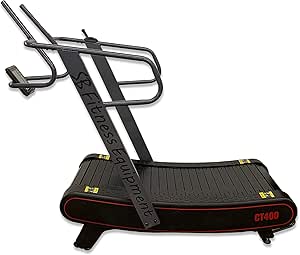
SB Fitness Equipment CT400 Self-Generated Curved Commercial Exercise Workout Treadmill with 3 Resistance Levels and Digital Display
The CT400 suits daily cardio buyers who want a straightforward self-powered machine rather than a broad menu of resistance settings. Its three resistance levels let me vary effort for walking, running, or HIIT, while shock-absorbing slats offer some impact cushioning during repeated sessions. Because it generates its own power, it needs no outlet, and its 375-pound capacity is higher than the 2026 Manual Curved Treadmill’s listed 440-pound limit? No: the CT400’s capacity is lower, so heavier users should compare carefully. It is also lighter at 145 pounds than that 354-pound model, though still substantial to reposition. The tradeoff is limited resistance choice and little stated information about connectivity or maximum speed. I’d choose it for uncomplicated home or facility cardio, not data-rich training.
Pros:- Self-generated operation does not require an electrical outlet
- Three resistance levels support basic changes in workout effort
- Shock-absorbing slats can soften repeated foot strikes
- 145-pound listed weight is lower than several other machines in this group
Cons:- Three resistance levels offer fewer adjustment options than the eight-level models
- No maximum speed is specified
- Connectivity features are not detailed
Best for: Daily cardio users who want a self-powered curved treadmill with basic resistance adjustment and a 375-pound user limit.
Not ideal for: Heavier users seeking a higher listed capacity, or buyers who want extensive resistance settings, connectivity details, or a specified speed ceiling.
- Model:CT400
- Power source:Self-generated
- Resistance levels:3
- Maximum recommended user weight:375 pounds
- Dimensions:72 x 31 x 62 inches
- Item weight:145 pounds
- Deck dimensions:60 inches long x 18 inches wide
- Frame material:Steel
Our verdict“Choose the CT400 for no-outlet daily cardio with simple resistance choices, but skip it if you need a higher user capacity or detailed training data.”
2026 Manual Curved Treadmill with Digital Display, Curved Running Belt, 8-Level Resistance, Non-Electric Home & Gym Fitness Equipment
The 2026 Manual Curved Treadmill earns its place for buyers who want eight resistance levels to shape everyday walks and harder intervals without plugging in. Its display lists time, distance, speed, calories, and heart rate, giving it broader stated workout tracking than the CT400, whose connectivity details are limited. The listed 440-pound capacity also exceeds the CT400’s 375-pound figure. But this is not a light home machine: at 354 pounds and more than 77 inches long, moving it or finding a permanent spot may be a challenge, even with transport wheels. Manual operation means pace comes from the user, rather than a motor setting the belt speed. I’d favor this model over the CT400 for resistance choice and listed tracking metrics, while buyers prioritizing easier repositioning should look at the lighter CT400 instead.
Pros:- Eight resistance levels give more adjustment range than the CT400’s three
- Display lists heart rate, speed, distance, time, and calories
- 440-pound maximum recommended user weight
- Manual power source avoids dependence on an outlet
Cons:- 354-pound item weight makes relocation difficult despite transport wheels
- 77.17-inch length and 35.04-inch width require substantial floor space
- Manual belt operation requires the user to supply the movement
Best for: Home or studio users who want several resistance settings, multiple listed workout metrics, and a 440-pound capacity.
Not ideal for: People with limited floor space or anyone who needs a lighter treadmill that is easy to move frequently.
- Power source:Manual
- Resistance levels:8
- Maximum recommended user weight:440 pounds
- Dimensions:77.17 x 35.04 x 61.02 inches
- Item weight:354 pounds
- Metrics measured:Calories, distance, heart rate, speed, and time
- Frame material:Iron frame and aluminum
- Maximum speed listing:100 revolutions per week
Our verdict“Pick this model if resistance range and listed tracking metrics matter more than easy moving or a compact footprint.”
Curved Treadmill with Adjustable Resistance and LED Display
For buyers whose first filter is user capacity, this curved treadmill stands apart: its listed 660-pound maximum is well above the CT400’s 375 pounds and the two 440-pound options in this batch. The self-propelled belt and LED display keep the basic daily-cardio setup simple, while transport wheels can help with repositioning once a suitable spot is available. Its 220-pound weight is more manageable than the 354-pound 2026 Manual Curved Treadmill, but the 60-by-32-inch footprint still calls for dedicated floor space. There is also conflicting resistance information: the description says six levels, while the specifications list eight. The stated 100 km/h maximum speed is unusual for this kind of machine, so I would not use it as a dependable buying benchmark. Warranty and support details are also absent.
Pros:- 660-pound maximum user weight is the highest listed capacity among these five products
- Self-powered operation needs no electrical connection
- LED display provides workout monitoring
- At 220 pounds, it is lighter than the 354-pound 2026 model
Cons:- Description and specifications disagree on whether it has six or eight resistance levels
- The listed 100 km/h maximum speed is not a clear or practical comparison point
- Warranty and customer support information is limited
Best for: Users who need a curved manual treadmill with a notably high listed weight capacity and have room for a permanent setup.
Not ideal for: Buyers who need confirmed resistance settings, clear speed specifications, or published warranty and support information.
- Power source:Self-propelled
- Resistance levels:Description: 6; specifications: 8
- Maximum user weight:660 pounds
- Dimensions:60 x 32 x 59 inches
- Item weight:220 pounds
- Deck dimensions:62 inches long x 16 inches wide
- Display:LED
- Materials:Aluminum, rubber, and steel
Our verdict“This is the strongest listed-capacity choice, provided you can accept unclear resistance and speed details and verify the fit for your space.”
8Levels Curved Manual Treadmill with LCD Monitor, 440 lbs Capacity, Non-Electric, Portable for Home & Gym
This 8Levels model is a practical match for buyers who need eight resistance settings and a higher listed capacity, but also want setup details that support day-to-day use. Its LCD tracks time, distance, pace, and calories, while adjustable leveling legs can help accommodate uneven flooring—an advantage not specified for the 2026 Manual Curved Treadmill. Both list a 440-pound capacity and an 8-level resistance range, so their main distinction is this model’s leveling feature rather than a clear performance lead. At 77 inches long and 35 inches wide, it still takes substantial space, and its manual operation will not provide motor-driven pacing. The stated maximum of 100 rpm is also an unusual speed measure for treadmill shopping. I’d choose it over the 2026 model when floor leveling matters; otherwise, the available information does not establish a decisive difference.
Pros:- Eight resistance levels allow varied workout intensity
- LCD monitor lists time, distance, pace, and calories
- 440-pound maximum load
- Adjustable leveling legs can help address uneven flooring
Cons:- 77 x 35-inch footprint needs considerable space
- Manual operation requires the user to drive the belt
- The 100 rpm speed specification may not clarify running pace
Best for: Home gym owners who want eight resistance levels, an LCD workout display, and leveling legs for an uneven floor.
Not ideal for: Buyers with a small workout area or those who want motor-controlled speed rather than a self-powered belt.
- Power source:Non-electric
- Resistance levels:8
- Maximum load:440 pounds
- Dimensions:77 x 35 x 61 inches
- Maximum speed listing:100 rpm
- Display metrics:Time, distance, pace, and calories
- Additional features:Adjustable leveling legs, transport wheels, shock-absorbing belt
- Material:Metal
Our verdict“Choose this model over the similar 2026 option if adjustable leveling legs suit your floor, but expect a large, manually driven machine.”
Curved Manual Treadmill – 6-Level Resistance Self-Powered Non-Electric Running Machine with Shock Absorbing Belt and Digital Monitor for Home & Light Commercial Use
The B0H3L79QGV is aimed at runners who want more workout data than the CT400’s basic digital-display description provides. Its monitor lists speed, time, distance, calories, pulse, and wattage, making it the most explicitly detailed tracking setup in this five-product group. Six resistance levels offer more steps than the CT400’s three, though fewer than the eight-level 2026 and 8Levels models. The 400-pound capacity is also above the CT400’s 375 pounds, but below those 440-pound options and far below the 660-pound figure listed for the B0HCBSG6G3. At 316 pounds, it is difficult to relocate, and its 35-inch width needs a generous space. The listing claims a 20 mph maximum, but manual operation means pace remains user-driven; I would not treat that figure like a motorized speed setting.
Pros:- Display lists speed, time, distance, calories, pulse, and wattage
- Six resistance levels provide more variation than the CT400’s three
- 400-pound maximum user weight exceeds the CT400’s listed capacity
- Self-powered design does not require electricity
Cons:- 316-pound item weight makes repositioning difficult
- 35-inch width may not suit compact workout spaces
- The listed 20 mph maximum does not function as a motor-set pace on a manual treadmill
Best for: Runners who want a self-powered curved treadmill with detailed display metrics and six resistance levels for regular training.
Not ideal for: People who need an easy-to-move machine, a narrow footprint, or the highest listed weight capacity in this group.
- Power source:Self-powered, non-electric
- Resistance levels:6
- Maximum user weight:400 pounds
- Dimensions:77 x 35 x 63 inches
- Item weight:316 pounds
- Running belt dimensions:94.5 x 16.5 inches
- Display metrics:Speed, time, distance, calories, pulse, and wattage
- Maximum speed listing:20 mph
Our verdict“Choose it for detailed workout metrics and six resistance levels, but look elsewhere if easy movement or maximum user capacity is your priority.”
8 Levels Curved Manual Treadmill with LCD Monitor, 440lbs Capacity, Non-Electric Fitness Equipment with Transport Wheels for Home & Gym
This model suits buyers who want a high-capacity, self-powered machine with resistance choices for changing daily effort. Its 440-pound maximum load is higher than the Sole Fitness C80’s 330-pound limit, while the 66.54-by-27.17-inch belt gives runners a generous surface. Eight resistance levels and an LCD monitor support varied sessions and basic workout feedback without relying on household power. The tradeoff is its substantial 371-pound weight: transport wheels can help reposition it, but they do not make routine moving easy. Compared with the four-level B0F9Y97YXJ, this treadmill offers more resistance steps, though that other model lists a higher capacity. Choose this one for adaptable home cardio, not for a compact room or motorized, low-effort workouts.
Pros:- Eight resistance levels allow more workout adjustment than the four-level B0F9Y97YXJ.
- 440-pound maximum load is higher than the Sole Fitness C80’s stated 330-pound limit.
- Wide 66.54-by-27.17-inch running belt gives runners room to move.
- LCD workout feedback and self-powered operation avoid dependence on an electrical outlet.
Cons:- At 371 pounds, it may take more than one person to position or relocate.
- Its 78-inch depth and 36-inch width can be difficult to fit in smaller rooms.
- Manual operation requires the runner to supply the motion and does not provide motorized speed control.
Best for: Home-gym users who want eight resistance settings, a wide running belt, and a higher stated weight capacity for daily self-powered cardio.
Not ideal for: People with small workout spaces or anyone who needs to move a treadmill often; its 371-pound weight and nearly 78-inch depth make placement a commitment.
- Maximum load:440 lbs
- Dimensions:78″D x 36″W x 62″H
- Running belt:66.54″ x 27.17″
- Resistance levels:8
- Maximum speed:100 rpm
- Power source:Non-electric, user-powered
- Weight:371 lbs
- Material:Metal
Our verdict“Pick this treadmill for a spacious home gym where higher capacity and adjustable manual resistance matter more than easy relocation.”
Curved Manual Treadmill with 8 Resistance Levels
For daily cardio that alternates easier runs with harder efforts, this treadmill’s eight resistance levels offer more stepping stones than the four settings on the B0F9Y97YXJ. Its alloy-steel frame, large running surface, and display for time, distance, and calories give it a practical training focus; a phone holder also keeps a device within reach. The listed 400-pound capacity is solid, but below the 440-pound B0HHK23361 and 450-pound B0F9Y97YXJ. At 418.5 pounds, it is the heaviest option in this group, so the transport wheels are more useful for careful repositioning than frequent moves. The supplied speed and horsepower figures use unusual units, so I would not rely on them to compare running performance. This is a better fit for a dedicated gym space than a flexible, shared room.
Pros:- Eight resistance levels provide more intensity options than the four-level B0F9Y97YXJ.
- LED display tracks time, distance, and calories for straightforward session monitoring.
- Alloy-steel frame and spacious running surface support regular training.
- Phone holder and transport wheels add useful convenience for a dedicated workout area.
Cons:- At 418.5 pounds, it is exceptionally heavy to move despite its transport wheels.
- Its 400-pound capacity is lower than the 440-pound B0HHK23361 and 450-pound B0F9Y97YXJ.
- Self-powered manual running offers no motorized speed control.
Best for: Runners with a permanent home-gym space who want frequent resistance changes, basic workout metrics, and a phone holder.
Not ideal for: Buyers who need a treadmill that is easy to relocate, or those who prioritize maximum user capacity over resistance range.
- Maximum weight recommendation:400 lbs
- Dimensions:78.74″D x 35.43″W x 62.99″H
- Weight:418.5 lbs
- Resistance levels:8
- Display size:6 inches
- Frame material:Alloy steel
- Power source:Self-powered
- Features:LED display, rubber belt, phone holder, transport wheels
Our verdict“Choose this model if varied resistance is your priority and you can leave a very heavy treadmill set up in one place.”
Sole Fitness C80 Curved Manual Treadmill for Home Gym Cardio Running
The Sole Fitness C80 is the most compactly listed option here, at 72 inches deep and 32 inches wide, which may make it easier to place than the roughly 79-inch-deep B0G64D33VL or B0F9Y97YXJ. Its Bluetooth LCD console tracks distance, speed, and time, adding connected metric tracking that the other listings do not specify. The motorless slat belt keeps the design self-powered, but that also means effort comes from the runner and there is no motorized pacing for steady, low-effort sessions. Its 330-pound maximum recommendation is the lowest of these four models, well below the 440- and 450-pound options. The listing also gives no resistance-level count or built-in workout programs, so buyers seeking structured intensity choices may prefer the eight-level B0HHK23361. This is the more space-conscious pick, not the highest-capacity one.
Pros:- Bluetooth LCD console tracks distance, speed, and time.
- At 72 inches deep, it is shorter than the B0G64D33VL and B0F9Y97YXJ.
- Self-powered design avoids a motor and the need for an electrical connection.
- Interlocking slat belt is specified for traction.
Cons:- 330-pound maximum recommendation is lower than the other listed models in this batch.
- No built-in workout programs are listed.
- Manual, self-propelled running requires the user to set and maintain the pace.
Best for: Home-gym runners who want Bluetooth metric tracking and a shorter listed footprint, with a user weight comfortably within its 330-pound recommendation.
Not ideal for: Buyers who need a capacity above 330 pounds, built-in workout programs, or a treadmill they can easily move between rooms.
- Maximum weight recommendation:330 lbs
- Dimensions:72″D x 32″W x 61″H
- Power source:Self-powered, non-motorized
- Connectivity:Bluetooth
- Metrics measured:Distance, speed, time
- Belt:Interlocking slat belt
- Material:Alloy steel
- Additional feature:Magnetic resistance
Our verdict“Choose the C80 for a comparatively shorter home setup and Bluetooth workout tracking, provided its 330-pound capacity suits you.”
Curved Manual Treadmill with 4 Resistance Levels and LCD Display, Non-Electric, Commercial-Grade, 450 lbs Capacity
Among these four options, the B0F9Y97YXJ has the highest stated capacity at 450 pounds, edging out the B0HHK23361 and its 440-pound limit. Its 63-by-19-inch belt and LCD metrics for speed, distance, time, calories, and heart rate make it a purposeful choice for daily cardio and harder sessions. The compromise is four resistance levels, half the count offered by the two eight-level models, so adjustments are less finely stepped. At 79 inches deep, it also takes a dedicated space, and its self-powered design leaves speed control to the runner rather than a motor. A water-bottle holder and wheels add convenience, but do not erase the footprint or the effort required for manual operation. I would rank it ahead for capacity, but behind the eight-level alternatives for workout variety.
Pros:- 450-pound maximum recommendation is the highest among these four products.
- LCD tracks calories, distance, heart rate, speed, and time.
- 63-by-19-inch belt offers a defined running area for daily cardio.
- Self-powered operation, transport wheels, and a water-bottle holder support home-gym use.
Cons:- Four resistance levels offer fewer intensity choices than the eight-level B0HHK23361 and B0G64D33VL.
- The 79-inch depth requires substantial floor space.
- Manual operation provides no motorized speed setting and asks the runner to supply the motion.
Best for: Users seeking a self-powered curved treadmill with the highest listed capacity in this group and an LCD that covers several cardio metrics.
Not ideal for: Buyers who want many resistance increments, motorized pacing, or a treadmill for a compact workout area.
- Maximum weight recommendation:450 lbs
- Dimensions:79″D x 35″W x 63″H
- Running belt:63″ x 19″
- Resistance levels:4
- Maximum speed:25 km/h
- Power source:Self-powered
- Metrics measured:Calories burned, distance, heart rate, speed, time
- Material:Alloy steel
Our verdict“Choose this model when the 450-pound capacity and broad workout metrics outweigh the need for finer resistance adjustment or a smaller footprint.”

How We Picked
I compared the nine listed treadmills against the needs of regular home cardio: self-powered operation, resistance options, stated user capacity, display details, portability, and any indications of suitability for home or light commercial use. I gave more weight to features that could help a buyer choose for a repeatable routine than to broad labels such as “commercial-grade,” which need supporting build details to carry much weight.
The ranking reflects how clearly each listing supports a daily-cardio buying decision, not an assumption that more settings mean better performance. The CT400 ranks first as a clearly identified self-generated treadmill with a defined resistance range; the C80 earns a separate premium role, while the high-capacity and eight-level models rank for specific priorities. Where construction, dimensions, or adjustment details are missing, I treat that as a comparison limit and advise checking the seller’s complete specifications before buying.
Factors to Consider When Choosing Rated Curved Treadmill For Daily Cardio
Curved treadmills can differ in ways that are easy to miss when product titles repeat the same terms. I would check the machine against your actual workout habits and the space and support available at home, rather than choosing by resistance count alone.
Match Resistance Range to Your Routine
Resistance settings affect how much control you have over workout intensity, but a larger number is not automatically a better match. If you plan to repeat a small set of steady sessions, a simpler range such as the CT400’s three levels may be easier to use than an eight-level menu. More settings can help users who want finer changes across intervals, though the listing should explain how those changes work. Do not assume that an eight-level model offers a smoother progression than a six-level one without clear adjustment information. Look for details on how resistance is changed and whether it can be adjusted while moving. Choose the range you are likely to use, not the longest one in the product title.
Treat Capacity as a Fit Check, Not a Build Guarantee
Stated user capacity is a practical screening figure, especially when a listing specifies 440 or 450 pounds. It does not tell you everything about stability, belt feel, or long-term wear, and it should not be treated as a substitute for construction details. Check the capacity on the exact model page, since similar product names may refer to different listings. Leave some margin between the stated limit and your intended use rather than choosing a machine right at its maximum. Also look for frame, belt, and warranty information if daily sessions are part of your plan. If those details are absent, ask the seller before relying on a broad “commercial-grade” label.
Check Footprint, Moving, and Storage Before Ordering
A treadmill described as portable may still be heavy or awkward to maneuver, so confirm its dimensions and assembled weight. Transport wheels can help with repositioning, but they do not mean the machine folds or stores upright. Measure the workout area and the route through doors or hallways before delivery. Leave enough room around the treadmill for safe mounting and movement, following the manufacturer’s guidance. If you expect to move it after every session, prioritize clear information about wheels, handles, and storage rather than relying on the word “portable.” A machine that fits your room but cannot be moved easily may become a poor daily-use choice.
Look Beyond the Display Name
Product listings in this group describe digital displays, LCD monitors, or LED displays, but those labels alone do not reveal what workout data appears. Decide which readouts you will actually use, such as time, distance, or pace, and check the listing or manual for confirmation. A basic display can be enough for timed cardio, while users tracking more metrics may prefer a model with explicit readout details. Do not assume a display includes saved workouts, connectivity, or heart-rate tracking unless those functions are named. Keep in mind that a treadmill’s manual operation and running feel matter more to the daily workout than a screen’s appearance. A display should support your routine, not distract from missing specifications.
Weigh Routine Frequency Against Support and Maintenance
Daily use makes service information and maintenance guidance more relevant than they may seem during the initial comparison. Check the warranty terms for the frame, belt, and other components, and confirm who handles support if a part needs attention. Ask what routine cleaning or belt care is required, particularly if the treadmill will be used by multiple people. Home and light-commercial labels do not state how the machine will hold up in your specific setting. For shared or frequent use, clear support and replacement-part information can matter more than having extra resistance levels. If the listing leaves these points unclear, treat that as a risk to resolve before purchasing.
Frequently Asked Questions
Is a three-level curved treadmill enough for daily cardio?
It can be enough if your routine focuses on steady sessions or a small number of repeatable intensity choices. The CT400’s three levels make it a straightforward option, while models listing six or eight levels offer more stated steps for varied workouts. More levels do not prove that adjustments are smoother or that the treadmill is more durable. Check how resistance is changed and whether the settings match the workouts you plan to do. If you expect to fine-tune intervals often, a broader range may be worth comparing; if not, simplicity can be a plus.
Should I choose an eight-level model over the CT400?
Choose an eight-level model if having more listed resistance steps is a priority and the exact listing explains how those settings operate. The CT400 is a clearer fit for buyers who prefer a defined, simpler range and a self-generated design. The products with eight-level names differ in other details, including monitor descriptions, transport wheels, and stated capacity, so the level count should not decide the purchase by itself. Compare the complete specifications, warranty, and dimensions for the exact model you can buy. If those details are missing, ask the seller rather than inferring quality from the title.
How much should I rely on a 440- or 450-pound capacity claim?
Use the stated capacity as a basic fit check, then confirm it on the product page for the exact model. The lineup includes listings that claim 440-pound and 450-pound capacities, but those figures do not independently establish frame stability or service life. Look for supporting information about the frame, belt, warranty, and recommended use. If you expect frequent or shared use, verify those points with the seller before buying. A higher capacity can be a useful differentiator, but it should not replace a broader check of fit and support.
Can I move a curved treadmill easily if it has transport wheels?
Transport wheels can make repositioning easier, but they do not indicate that a treadmill folds, is light, or can be carried up stairs. The eight-level listing that names transport wheels is a useful starting point, yet its assembled weight and dimensions still matter. Check the route from delivery to the workout area, including door widths and turns. If you plan to move the machine after every session, confirm which end lifts and how it is meant to roll. Do not treat “portable” in a title as a promise of easy storage.
What should I verify before choosing the Sole Fitness C80 as a premium pick?
The C80 has a distinct premium role in this lineup, but the supplied product details do not state its resistance range, capacity, display functions, or dimensions. Check those specifications against your body-size needs, workout plan, and available space before deciding. Confirm warranty coverage and service access as well, especially if the treadmill will see daily use. Compare the verified details with the CT400 and the high-capacity listings rather than relying on the premium label alone. If key specifications remain unavailable, that uncertainty is a reason to pause and ask the seller.
Conclusion
For most buyers seeking a clearly specified daily cardio option, I would start with the SB Fitness Equipment CT400 as the best overall pick; its self-generated setup and three resistance levels make its use case easy to understand. For a best-value direction, compare the simpler manual options against your must-have features and choose the listing with the clearest specifications, since no price information is part of this comparison. The Sole Fitness C80 is the best premium pick for buyers drawn to that model, provided its capacity, resistance, warranty, and dimensions check out. Beginners may prefer the CT400’s simpler three-level range over a more complex menu. For specific needs, the 440- and 450-pound-capacity listings deserve a closer look, while buyers who want more stated resistance steps can compare the eight-level models—checking their exact features before choosing.