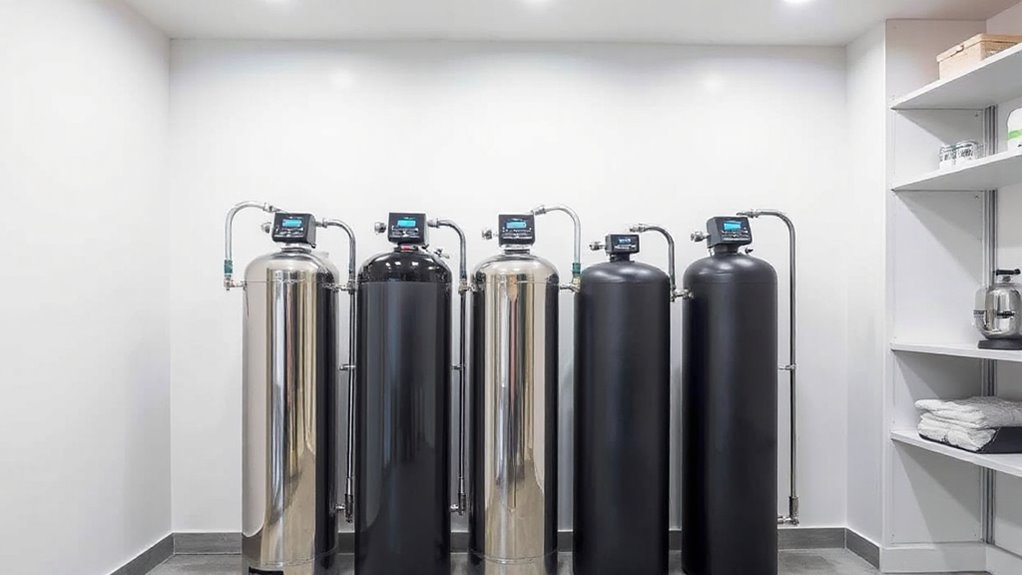

For most households seeking a water softener system for hard water, I’d put the Fleck 9100 SXT Twin Tank first because its alternating tanks can provide softened water while the other tank regenerates. The Aquasure Harmony 70,000-grain is a standout for larger homes with heavier demand, while the Kenmore Elite 520 suits buyers who want softening and whole-house filtration in one unit. The key tradeoff is between steady water availability, capacity, added filtration, and the space and maintenance each system requires. A larger grain rating is not automatically a better fit: household size and measured hardness matter just as much. Read on for the full comparison and guidance on matching a system to your water and home.

Get home appliances delivered free with Prime
- Fast, free delivery on millions of items
- Prime Video, Amazon Music and more included
- Member-only deals all year
Complete the kit



Key Takeaways
- The Fleck 9100 SXT is the standout for continuity: its twin-tank design addresses regeneration downtime better than the single-tank options in this lineup.
- Aquasure offers the broadest capacity range: its 32,000- to 72,000-grain options make it easier to match capacity to household demand instead of defaulting to the largest unit.
- Capacity and convenience are different priorities: the 70,000-grain Aquasure favors higher demand, while compact 32,000-grain models such as the Kenmore 350 fit smaller households better.
- Only a few picks combine treatment types: the Kenmore Elite 520 pairs softening with whole-house filtration, and the Aquasure bundle adds reverse osmosis and prefiltration for drinking-water needs.
- Single-tank systems dominate the field: buyers who need softened water during regeneration should weigh the Fleck twin-tank design against the greater simplicity of conventional choices.
| iSpring WCSTB45KG 45,000 Grains Whole House Water Softener with Brine Tank |  | Best for Simple, High-Capacity Softening | Grain capacity: 45,000 grains | Installation type: Whole house | Purification method: Ion exchange | VIEW ON AMAZON | See Our Full Breakdown |
| Fleck 9100 SXT Twin Tank Water Softener, 48,000 Grains, Black |  | Best for Continuous Soft Water | Grain capacity: 48,000 grains per tank | Valve model: Fleck 9100 SXT | Tank configuration: Two 10 x 54 in. mineral tanks | VIEW ON AMAZON | See Our Full Breakdown |
| Aquasana SimplySoft Whole House Water Softener 60K Grain WH-SF60-BASE |  | Best for Large Households | Capacity: 60,000 grains | Maximum flow rate: 16.6 gpm | Dimensions: 30 x 16 x 43 in. | VIEW ON AMAZON | See Our Full Breakdown |
| Kenmore Elite 520 Hybrid Water Softener & Whole House Filtration System |  | Best for Combined Softening and Filtration | Grain capacity: 31,000 grains | Hardness reduction: Up to 100 gpg | Iron reduction: Up to 3 ppm | VIEW ON AMAZON | See Our Full Breakdown |
| Aquasure Harmony Series 70,000 Grains Whole House Water Softener with Digital Control |  | Best for Very High Capacity | Capacity: 70,000 grains | Suitable home size: Four to six bathrooms | Dimensions: 13 x 13 x 57 in. | VIEW ON AMAZON | See Our Full Breakdown |
| Aquasure Harmony Series 48,000 Grains Whole House Water Softener with Digital Control Head |  | Best for Higher Hardness Loads | Capacity: 48,000 grains | Maximum flow rate: 12 gpm | Dimensions: 10 × 10 × 62 inches | VIEW ON AMAZON | See Our Full Breakdown |
| Aquasure Harmony Series 40,000 Grain Whole House Water Softener with Digital Control |  | Best for Digital-Control Simplicity | Capacity: 40,000 grains | Supported bathrooms: 3–4 | Maximum supported water TDS: 2,500 ppm | VIEW ON AMAZON | See Our Full Breakdown |
| Aquasure Whole House Water Filtration Bundle with Water Softener, 75 GPD RO System and Dual-Purpose Sediment/GAC Pre-Filter (72,000 Grains) | 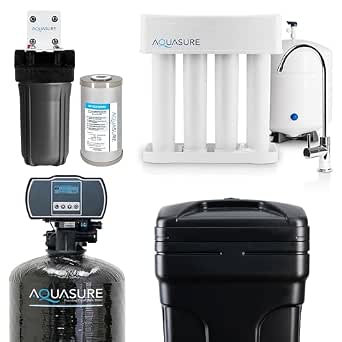 | Best Complete Water-Treatment Bundle | Hardness treatment capacity: 72,000 grains | RO production rate: 75 GPD | Supported household size: 4–6 bathrooms; up to 8 occupants | VIEW ON AMAZON | See Our Full Breakdown |
| Aquasana SimplySoft Whole House Water Softener | 40K Grain | WH-SF40-BASE |  | Best for Salt- and Water-Conscious Households | Capacity: 40,000 grains | Maximum flow rate: 15.5 gpm | Dimensions: 30 × 16 × 43 inches | VIEW ON AMAZON | See Our Full Breakdown |
| Kenmore 420 Water Softener System – 40,000 Grain Capacity with Salt Saving Technology |  | Best Compact Pick for Tighter Utility Spaces | Capacity: 40,000 grains | Maximum flow rate: 7.7 gpm | Dimensions: 20.5 × 15 × 48 inches | VIEW ON AMAZON | See Our Full Breakdown |
| Aquasure Harmony Series 32,000 Grains Whole House Water Softener with Digital Control |  | Best for Smaller Homes | Capacity: 32,000 gallons (as listed) | Installation type: Whole house | Dimensions: 8 × 8 × 52 inches | VIEW ON AMAZON | See Our Full Breakdown |
| Aquasure Harmony Series 50,000 Grain Whole House Water Softener with Digital Control | 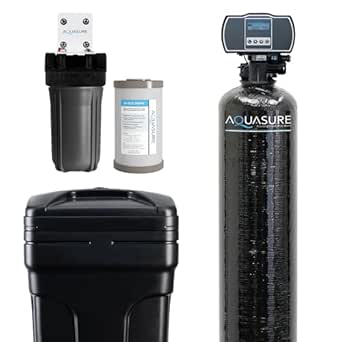 | Best for Larger Households | Capacity: 50,000 grains | Installation type: Whole house | Material: Fiberglass | VIEW ON AMAZON | See Our Full Breakdown |
| Kenmore 350 Whole House Water Softener System, 32,000 Grain, Suitable for 1-4 People | 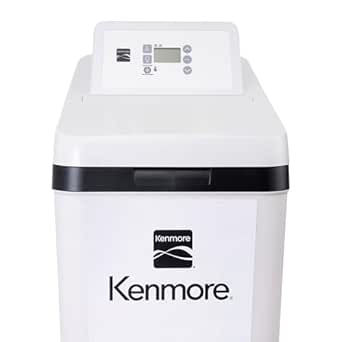 | Best for Compact Homes and Variable Water Use | Grain capacity: 32,000 grains | Suitable household size: 1–4 people | Flow rate: 7.2 GPM | VIEW ON AMAZON | See Our Full Breakdown |
| rated water softener system for hard water | Dimensions | Installation type | Capacity | Power source |
|---|---|---|---|---|
| iSpring WCSTB45KG 45,000 Grain | — | Whole house | — | Corded electric |
| Fleck 9100 SXT Twin Tank Water | 10 x 10 x 54 in. | — | — | — |
| Aquasana SimplySoft Whole Hous | 30 x 16 x 43 in. | Whole-house point of entry | 60,000 grains | — |
| Kenmore Elite 520 Hybrid Water | 20.5 x 15 x 48 in. | — | — | Corded electric |
| Aquasure Harmony Series 70,000 | 13 x 13 x 57 in. | — | 70,000 grains | — |
| Aquasure Harmony Series 48,000 | 10 × 10 × 62 inches | Freestanding | 48,000 grains | Adapter |
| Aquasure Harmony Series 40,000 | 9 × 9 × 55 inches | — | 40,000 grains | — |
| Aquasure Whole House Water Fil | — | Under-sink RO system; whole-house softener bundle | — | — |
| Aquasana SimplySoft Whole Hous | 30 × 16 × 43 inches | Whole house | 40,000 grains | Corded electric |
| Kenmore 420 Water Softener Sys | 20.5 × 15 × 48 inches | — | 40,000 grains | Water-flow-powered digital display |
| Aquasure Harmony Series 32,000 | 8 × 8 × 52 inches | Whole house | 32,000 gallons (as listed) | Corded electric |
| Aquasure Harmony Series 50,000 | 11 × 11 × 48 inches | Whole house | 50,000 grains | — |
| Kenmore 350 Whole House Water | — | Freestanding | — | Manual/gravity-fed (as listed) |
More Details on Our Top Picks
iSpring WCSTB45KG 45,000 Grains Whole House Water Softener with Brine Tank
The iSpring WCSTB45KG is a straightforward choice for households that want substantial hardness reduction without stepping up to a larger 60,000- or 70,000-grain system. Its 45,000-grain capacity and programmable automatic valve are intended to soften water throughout the house while adjusting regeneration to household use. That can help limit scale on plumbing and appliances, though the system still needs salt, electricity, and a brine tank. Compared with the Aquasana SimplySoft 60K, it has less capacity and less documented water-use efficiency, making it a better fit for homes with more moderate demand than large, busy households. The fiberglass tank and ion-exchange resin support a durable whole-house setup, but at 75.6 pounds, installation and positioning may take extra help. Choose it for capacity and automatic control, not a compact or salt-free setup.
Pros:- 45,000-grain capacity suits homes with substantial but not necessarily large-household demand.
- Programmable automatic control adjusts regeneration cycles.
- Ion exchange reduces hardness that contributes to scale on plumbing and appliances.
- Fiberglass tank construction is specified as corrosion-resistant.
Cons:- The 75.6-pound unit may be difficult to move and install.
- Requires a brine tank, salt, and corded electrical power.
- Its capacity is below the Aquasana SimplySoft 60K and Aquasure Harmony 70,000-grain models.
Best for: Households seeking automatic, 45,000-grain whole-house softening for hard water and scale protection without the larger capacity of a 60,000- or 70,000-grain model.
Not ideal for: Small homes with limited installation space, buyers who cannot manage a heavy unit or brine tank, and households wanting soft water without salt or electricity.
- Grain capacity:45,000 grains
- Installation type:Whole house
- Purification method:Ion exchange
- Control:Programmable automatic control valve with digital display
- Power source:Corded electric
- Maximum supported TDS:300 ppm
- Item weight:75.6 lb
- Materials:Ion-exchange resin, fiberglass, plastic, and metal
- Warranty:1-year limited manufacturer warranty
Our verdict“Choose the iSpring for automatic, mid-to-high-capacity softening if you have room for a brine tank and do not need the greater capacity of the largest systems.”
Fleck 9100 SXT Twin Tank Water Softener, 48,000 Grains, Black
The Fleck 9100 SXT earns its place for buyers who want soft water available while regeneration takes place. Its twin-tank design lets one resin tank serve the home while the other regenerates, a meaningful distinction from single-tank options such as the iSpring WCSTB45KG. Metered, on-demand regeneration also bases the cycle on water use rather than a simple fixed schedule, with the product description citing potential salt and water savings. Each tank holds 48,000 grains and 1.5 cubic feet of resin, giving larger households a substantial system. The tradeoff is physical and operational: at 95 pounds with two 10-by-54-inch mineral tanks, it needs room and careful installation. Its valve programming may also be less approachable for a DIY buyer than a simpler digital control panel.
Pros:- Twin tanks provide continuous soft-water availability during regeneration.
- Metered on-demand regeneration responds to actual water use.
- Each tank has 48,000-grain capacity and 1.5 cubic feet of resin.
- Pre-loaded resin and included mineral tanks simplify some installation steps.
Cons:- The 95-pound system and two tall tanks require substantial space and careful handling.
- Valve programming may be challenging for less experienced DIY installers.
- The twin-tank format is more equipment than many smaller households need.
Best for: Large or high-use households that need softened water during regeneration and have space and support for installing a two-tank system.
Not ideal for: Small homes, buyers with tight utility-room space, or DIY installers who want simple controls and a lightweight, single-tank system.
- Grain capacity:48,000 grains per tank
- Valve model:Fleck 9100 SXT
- Tank configuration:Two 10 x 54 in. mineral tanks
- Resin volume:1.5 cu. ft. per tank
- Regeneration:Metered on-demand
- Dimensions:10 x 10 x 54 in.
- Item weight:95 lb
- Manufacturer:Fleck
Our verdict“Pick the Fleck 9100 SXT when uninterrupted soft water matters more than a compact footprint or uncomplicated setup.”
Aquasana SimplySoft Whole House Water Softener 60K Grain WH-SF60-BASE
For a home that needs more capacity than a midrange softener can provide, the Aquasana SimplySoft 60K combines a 60,000-grain rating with metered regeneration. The manufacturer states that its cycle design can use up to 50% less salt and 28% less water, which may matter to larger households that soften water regularly. Its 16.6-gpm maximum flow rate and stated suitability for homes with four or more bathrooms make it a stronger large-home candidate than the iSpring WCSTB45KG, though the real fit depends on water use and hardness. I also give weight to its stated NSF/ANSI Standard 44 and CSA B483.1 certifications. The compromise is size: at 30 by 16 by 43 inches, it needs a dedicated installation area, and the optional pre-filter is separate. Installation may also challenge less experienced DIYers.
Pros:- 60,000-grain capacity is suited to higher household demand.
- Metered regeneration is specified to reduce salt use by up to 50% and water use by 28%.
- IAPMO certification to NSF/ANSI Standard 44 and CSA B483.1 is stated in the product data.
- 16.6-gpm maximum flow rate supports whole-house use.
Cons:- The 30 x 16 x 43 in. unit requires substantial installation space.
- Optional pre-filter is sold separately.
- Installation may be complex for a DIY homeowner.
Best for: Owners of large homes, including households with four or more bathrooms, who want certified ion-exchange softening and metered regeneration.
Not ideal for: Small households with limited utility-room space, buyers who need an included pre-filter, or DIY installers unprepared for a more involved whole-house installation.
- Capacity:60,000 grains
- Maximum flow rate:16.6 gpm
- Dimensions:30 x 16 x 43 in.
- Installation type:Whole-house point of entry
- Purification method:Ion exchange
- Operating pressure:20–125 psi
- Maximum supported TDS:2,000 ppm
- Certifications:IAPMO certified to NSF/ANSI Standard 44 and CSA B483.1
- Warranty:5/10-year limited warranty
Our verdict“Choose this Aquasana over the smaller iSpring when your large household needs greater capacity, ample flow, and specified third-party certifications.”
Kenmore Elite 520 Hybrid Water Softener & Whole House Filtration System
The Kenmore Elite 520 Hybrid is the lineup’s combination pick: it pairs a 31,000-grain ion-exchange softener with built-in carbon filtration, so buyers can address hardness and taste-related filtration in one freestanding unit. That combination gives it a different purpose from the higher-capacity Aquasana SimplySoft 60K, which is better suited to large homes focused on softening capacity. Kenmore’s IntelliSoft system is described as learning household use and regenerating when needed, while the product data lists a maximum flow rate of 8 gpm. Its compact 20.5-by-15-by-48-inch format may help where a two-tank or larger-capacity system will not fit. But 31,000 grains is less headroom for heavy demand, and the product description notes installation can be complex or call for a plumber. Choose it for the built-in filtration pairing, not maximum capacity.
Pros:- Combines ion-exchange softening and carbon filtration in one unit.
- IntelliSoft is designed to adapt regeneration to household use.
- Freestanding dimensions are more compact than the Aquasana SimplySoft 60K’s listed footprint.
- Product data specifies reduction of hardness up to 100 gpg and iron up to 3 ppm.
Cons:- 31,000-grain capacity may be limiting for large or high-use households.
- Maximum flow rate is listed as 8 gpm, below the Aquasana SimplySoft 60K’s 16.6 gpm.
- Installation may require professional plumbing support.
Best for: Households wanting a single freestanding system that combines moderate-capacity hard-water softening with built-in whole-house carbon filtration.
Not ideal for: Large homes with high water demand, buyers who need twin-tank continuous soft water, or households seeking a higher-capacity softener such as the Aquasana SimplySoft 60K.
- Grain capacity:31,000 grains
- Hardness reduction:Up to 100 gpg
- Iron reduction:Up to 3 ppm
- Filtration:Built-in carbon filtration media
- Maximum flow rate:8 gpm
- Dimensions:20.5 x 15 x 48 in.
- Purification method:Ion exchange
- Power source:Corded electric
- Maximum supported TDS:500 ppm
Our verdict“Choose the Kenmore Elite 520 if built-in filtration and a compact combined system matter more than the higher capacity of a dedicated large-home softener.”
Aquasure Harmony Series 70,000 Grains Whole House Water Softener with Digital Control
The Aquasure Harmony 70,000 has the greatest stated grain capacity in this five-product group, making it the most compelling fit here for a large household with hard water and iron concerns. Its product description specifies suitability for four to six bathrooms, automatic digital control, and iron reduction, while its 13-by-13-by-57-inch profile keeps the listed footprint narrower than the Aquasana SimplySoft 60K’s 30-by-16-inch base. Compared with the Fleck 9100 SXT, Aquasure offers more stated capacity per system, while Fleck’s twin tanks provide the clearer advantage for continuous soft water during regeneration. Aquasure’s high capacity can be excessive for a small home, and the tall unit still needs installation space and plumbing work. The listing also cites 1,197 ppm supported TDS, but supplies fewer operating and certification details than Aquasana does.
Pros:- 70,000-grain capacity is the highest among these five products.
- Product description identifies suitability for four to six bathrooms.
- Automatic digital control supports customizable operation.
- Product data includes iron reduction and a pre-filter.
Cons:- High capacity may be unnecessary for small homes and lower water demand.
- The 57-inch height and plumbing requirements call for suitable installation space.
- The provided specifications do not state a flow rate or certifications.
Best for: Owners of four-to-six-bathroom homes with hard water and iron concerns who want a high-capacity softener with automatic digital control.
Not ideal for: Small households with moderate water use, buyers who need documented twin-tank continuous softening, or shoppers who require detailed certification and flow-rate information before choosing.
- Capacity:70,000 grains
- Suitable home size:Four to six bathrooms
- Dimensions:13 x 13 x 57 in.
- Materials:Resin and stainless steel
- Control:Automatic digital control
- Hard-water treatment:Whole-house water softening
- Additional features:Iron removal and pre-filter
- Supported water TDS:1,197 ppm
Our verdict“Pick the Aquasure Harmony 70,000 for a large home needing substantial hardness capacity and stated iron reduction, but compare installation needs and missing performance details first.”
Aquasure Harmony Series 48,000 Grains Whole House Water Softener with Digital Control Head
Among the Aquasure Harmony options here, this 48,000-grain model offers more softening capacity than the 40,000-grain version without stepping up to the 72,000-grain filtration bundle. That makes it a practical fit for a 3–4 bathroom home with a meaningful hardness load, while its programmable digital control head helps manage regeneration. The included triple-purpose pre-filter is a notable distinction from a basic softener: it can address some contaminants alongside hardness minerals, though it does not replace dedicated drinking-water treatment like the bundle’s RO system. The tradeoff is a 120-pound, 62-inch unit that needs a suitable installation area, plus ongoing salt refills. I’d choose it over the Aquasana SimplySoft 40K when extra capacity matters more than that model’s stated salt- and water-saving focus.
Pros:- 48,000-grain capacity suits a higher hardness load than the 40,000-grain Aquasure model.
- Programmable digital control head supports managed regeneration.
- Triple-purpose pre-filter adds contaminant reduction beyond softening.
- Designed to reduce scale buildup that can affect plumbing and appliances.
Cons:- At 120 pounds and 62 inches tall, installation requires substantial space and handling.
- Requires regular salt refills and routine softener upkeep.
- Does not include the dedicated RO drinking-water system found in Aquasure’s 72,000-grain bundle.
Best for: Households with 3–4 bathrooms and a higher hardness demand that want a digital control head and a pre-filter in one whole-house setup.
Not ideal for: Small homes with limited utility space, or buyers who want a compact system or purified drinking water from an included RO unit.
- Capacity:48,000 grains
- Maximum flow rate:12 gpm
- Dimensions:10 × 10 × 62 inches
- Weight:120 pounds
- Treatment method:Ion exchange
- Installation type:Freestanding
- Power source:Adapter
Our verdict“Choose this Aquasure when a 3–4 bathroom home needs more capacity than a 40K softener and has room for a large salt-based system.”
Aquasure Harmony Series 40,000 Grain Whole House Water Softener with Digital Control
This Harmony model keeps the same broad household use case as Aquasure’s 48,000-grain softener but pairs it with 40,000-grain capacity and a smaller stated footprint. Its automatic digital head allows customizable backwashing, which can make routine operation less hands-on than a basic setup. The listing also specifies support for 3–4 bathrooms and water TDS up to 2,500 ppm, giving buyers useful fit information beyond grain capacity. The compromise is that its capacity is lower than the 48K sibling, so homes with heavier hardness demand may need more frequent regeneration or a larger unit. Compared with the Aquasana SimplySoft 40K, this option emphasizes Aquasure’s multistage pre-filter and digital backwashing; the Aquasana instead highlights reduced salt and water use.
Pros:- 40,000-grain capacity is suited to the listed 3–4 bathroom household range.
- Automatic digital control supports customizable backwashing.
- Multi-stage pre-filter adds treatment beyond hardness reduction.
- Listed maximum supported water TDS is 2,500 ppm.
Cons:- Lower capacity than the Aquasure Harmony 48K and 72K options.
- Setup and control programming may take more effort than a simpler system.
- Still a tall whole-house unit that needs dedicated installation space.
Best for: Households with 3–4 bathrooms that want a whole-house softener with programmable backwashing and a listed TDS tolerance.
Not ideal for: Homes with especially high hardness demand, or buyers who prioritize stated salt and water savings over Aquasure’s pre-filter emphasis.
- Capacity:40,000 grains
- Supported bathrooms:3–4
- Maximum supported water TDS:2,500 ppm
- Dimensions:9 × 9 × 55 inches
- Installation:Whole-house system
- Material:Resin
Our verdict“Pick this model for a 3–4 bathroom home seeking Aquasure’s digital controls and pre-filter at a lower capacity than its 48K sibling.”
Aquasure Whole House Water Filtration Bundle with Water Softener, 75 GPD RO System and Dual-Purpose Sediment/GAC Pre-Filter (72,000 Grains)
This is the broadest treatment package in this group: a 72,000-grain softener handles whole-house hardness, while the pre-filter and 4-stage RO system add sediment, taste, and drinking-water treatment. Its stated fit of 4–6 bathrooms and up to eight occupants puts it ahead of the 40K and 48K Aquasure softeners for larger households. The 75 GPD RO capacity is a separate drinking-water feature, not an increase in whole-house softening capacity. That distinction matters: buyers who only need scale control may be paying in space and installation complexity for equipment they will not use. Compared with the Aquasure Harmony 48K, this bundle offers much broader treatment and greater grain capacity, but it is a more involved plumbing project and lists a six-month filter life.
Pros:- 72,000-grain hardness capacity is the highest among the reviewed products in this batch.
- Combines a whole-house softener, triple-purpose pre-filter, and 4-stage RO system.
- Automatic digital metered control manages regeneration and backwashing.
- Designed for homes with 4–6 bathrooms and up to eight occupants.
Cons:- Multiple treatment components can make plumbing and installation complex.
- Requires more installation space than a standalone softener.
- The listed filter life is six months, adding recurring filter maintenance.
Best for: Larger households with 4–6 bathrooms that want whole-house softening alongside under-sink RO drinking-water treatment.
Not ideal for: Buyers who only need hardness reduction, lack room for multiple components, or want a straightforward DIY softener installation.
- Hardness treatment capacity:72,000 grains
- RO production rate:75 GPD
- Supported household size:4–6 bathrooms; up to 8 occupants
- Purification method:Ion exchange
- Maximum supported water TDS:500 ppm
- Installation type:Under-sink RO system; whole-house softener bundle
- Filter life cycle:6 months
Our verdict“Choose this bundle when a large household wants both high-capacity whole-house softening and dedicated RO drinking-water treatment.”
Aquasana SimplySoft Whole House Water Softener | 40K Grain | WH-SF40-BASE
The Aquasana SimplySoft makes its case through salt- and water-saving operation, rather than the larger capacity offered by the Aquasure 48K or the treatment breadth of Aquasure’s 72K bundle. Its 40,000-grain capacity is specified for homes with up to five people and four bathrooms, and the 15.5 gpm maximum flow rate gives it a higher listed flow figure than the Kenmore 420. A user-friendly LCD and customizable settings make control more approachable, while the warranty is listed as 5/10 years. The drawback is that the optional pre-filter is sold separately, so this is a focused softener rather than a combined contaminant-treatment package. Its 30-inch length and 16-inch width also call for a planned installation area. I’d favor it over the Aquasure 40K when resource-saving claims and flow capacity matter most.
Pros:- Designed to use less salt and water than standard softeners.
- 15.5 gpm maximum flow rate is higher than the Kenmore 420’s listed 7.7 gpm.
- LCD and customizable settings support straightforward operation.
- Listed 5/10-year limited warranty.
Cons:- Optional pre-filter must be purchased separately.
- 30 × 16-inch footprint can be difficult to fit in a tight utility area.
- 40,000-grain capacity is below the Aquasure 48K and 72K options.
Best for: Households of up to five people and four bathrooms that want a 40K softener with a user-friendly LCD and lower stated salt and water use.
Not ideal for: Buyers who need an included pre-filter, have very limited utility space, or want a larger grain capacity for heavier hardness demand.
- Capacity:40,000 grains
- Maximum flow rate:15.5 gpm
- Dimensions:30 × 16 × 43 inches
- Maximum TDS:3,568 ppm
- Operating pressure:20–125 psi
- Installation type:Whole house
- Power source:Corded electric
- Warranty:5/10-year limited
Our verdict“Choose the SimplySoft 40K if your household fits its stated capacity and reducing salt and water use matters more than included filtration.”
Kenmore 420 Water Softener System – 40,000 Grain Capacity with Salt Saving Technology
The Kenmore 420 stands apart from the two 40K Aquasure and Aquasana models through its compact 20.5 × 15 × 48-inch form and demand-based IntelliSoft regeneration. The system learns household water use and regenerates when needed, which can reduce salt, water, and energy use compared with fixed schedules. Its sediment shield and stated ability to address clear-water iron add practical protection beyond hardness reduction. Capacity matches the Aquasure 40K and Aquasana SimplySoft 40K, but its 7.7 gpm maximum flow rate is much lower than the Aquasana’s listed 15.5 gpm, so flow needs deserve attention in busy homes. The 102-pound weight also makes handling a challenge, and the display’s water-flow power source limits placement choices. This is the space-conscious alternative, not the high-flow choice.
Pros:- Compact footprint compared with the larger Aquasana SimplySoft 40K.
- IntelliSoft adjusts regeneration to household use, with stated salt, water, and energy savings.
- Sediment shield adds a layer of protection for plumbing and appliances.
- Designed to reduce hardness and clear-water iron.
Cons:- 7.7 gpm maximum flow rate is substantially lower than the Aquasana SimplySoft 40K’s listed 15.5 gpm.
- At 102 pounds, the unit may be difficult to move and install.
- Water-flow-powered display limits placement options, and the listed maximum TDS is only 10 ppm.
Best for: Households needing a 40K whole-home softener for a tighter utility area, especially where demand-based regeneration and clear-water iron treatment are useful.
Not ideal for: Homes with high simultaneous water demand, or buyers who need flexible placement independent of water flow.
- Capacity:40,000 grains
- Maximum flow rate:7.7 gpm
- Dimensions:20.5 × 15 × 48 inches
- Weight:102 pounds
- Operating pressure:20–125 psi
- Maximum water TDS:10 ppm
- Power source:Water-flow-powered digital display
- Warranty:1-year full; 3 years electronics; 10 years tank
Our verdict“Choose the Kenmore 420 when compact dimensions and demand-based regeneration matter more than high flow capacity or flexible placement.”
Aquasure Harmony Series 32,000 Grains Whole House Water Softener with Digital Control
For a home with one or two bathrooms, this 32,000-grain Aquasure offers a more appropriately sized route to reducing hardness than the 50,000-grain Harmony model, which is aimed at larger households. Its automatic digital control head lets owners customize operation rather than relying on a basic fixed setup, while the softening function helps limit scale on plumbing and appliances. The corrosion-resistant construction also suits a whole-house installation intended to stay in service over time. Capacity is the main boundary: households with heavier water use or more bathrooms may be better served by the Aquasure 50,000-grain model or the larger 70,000-grain option elsewhere in this roundup. At 67 pounds, it is also a substantial unit to position, and its corded electric operation requires a nearby power source.
Pros:- 32,000-grain capacity is suited to the stated one- to two-bathroom use case
- Automatic digital controls allow customized operation
- Whole-house softening helps reduce scale buildup on appliances and plumbing
- Polyethylene construction is described as corrosion-resistant
Cons:- Capacity may be insufficient for larger homes or heavier water demand
- The 67-pound unit can be cumbersome to move and position
- Corded electric operation requires access to power
Best for: Owners of one- or two-bathroom homes who want automatic controls and whole-house hardness reduction without sizing up to a larger-capacity system.
Not ideal for: Households with three or more bathrooms or high water use, since its 32,000-grain capacity may be limiting; also a poor fit where a powered control head cannot be placed near an outlet.
- Capacity:32,000 gallons (as listed)
- Installation type:Whole house
- Dimensions:8 × 8 × 52 inches
- Weight:67 pounds
- Material:Polyethylene
- Maximum supported TDS:1,000 PPM
- Power source:Corded electric
Our verdict“Choose this Harmony model for a smaller home that needs automatic whole-house softening, but step up to the 50,000-grain version for greater household demand.”
Aquasure Harmony Series 50,000 Grain Whole House Water Softener with Digital Control
The 50,000-grain Harmony is the stronger fit in this group for homes with three or four bathrooms, where the 32,000-grain Aquasure may be undersized for household demand. Its digital control with a backlit display supports adjustable operation, and the included pre-filter adds a treatment step beyond the smaller Harmony model’s listed softening-focused design. By reducing hardness and helping limit scale, it targets both water use throughout the home and protection for appliances. That added capacity comes with a larger footprint and a more involved installation; the supplied information notes that professional help may be needed. For a one- or two-bathroom home, the smaller 32,000-grain model is likely the more suitable scale. Buyers seeking a twin-tank design should compare it with the Fleck 9100 SXT rather than assuming this single Harmony unit offers that setup.
Pros:- 50,000-grain capacity is aimed at homes with three or four bathrooms
- Backlit digital control supports customized operation
- Includes a pre-filter alongside the softening system
- Fiberglass construction is described as corrosion-resistant
Cons:- May be oversized for a small household
- Installation may require professional assistance
- Larger dimensions demand more installation space than the 32,000-grain Harmony
Best for: Households with three or four bathrooms that want a higher-capacity whole-house softener, digital controls, and a pre-filter in the system.
Not ideal for: Very small households that do not need 50,000-grain capacity, or buyers who want a straightforward DIY installation and do not have room for a 48-inch-tall unit.
- Capacity:50,000 grains
- Installation type:Whole house
- Material:Fiberglass
- Dimensions:11 × 11 × 48 inches
- Model number:AS-HS50SCZ
- Brand:Aquasure
- Included filtration:Pre-filter
Our verdict“Pick this model for a larger household that needs more capacity and a pre-filter, while smaller homes are better matched to the 32,000-grain Harmony.”
Kenmore 350 Whole House Water Softener System, 32,000 Grain, Suitable for 1-4 People
The Kenmore 350 stands apart from both Aquasure Harmony models through IntelliSoft regeneration, which learns household water use and adjusts regeneration to match demand. That approach may suit a one- to four-person household whose usage varies, while its compact design can be easier to place than the 50,000-grain Harmony. Its 32,000-grain capacity and stated 7.2-gpm flow rate make it a modest-capacity choice, not a substitute for a larger system in a high-demand home. The listing also calls it manual/gravity-fed while describing electronic learning technology, so buyers should verify the actual power and control requirements before purchase. Salt refilling and ongoing maintenance remain part of ownership. Compared with the smaller Aquasure, the Kenmore emphasizes adaptive regeneration rather than a digital control head described as customizable.
Pros:- IntelliSoft technology is designed to learn household water use and adjust regeneration
- 32,000-grain capacity is specified for households of one to four people
- Compact design can suit tighter installation spaces
- Listed 7.2-gpm flow rate provides a stated reference for household demand
Cons:- Manual salt refilling and maintenance are still required
- 32,000-grain capacity may not meet the needs of larger or high-demand households
- Power information is unclear because the listing says manual/gravity-fed despite describing IntelliSoft technology
Best for: One- to four-person households with limited installation space and variable water use that want demand-learning regeneration and can keep up with salt maintenance.
Not ideal for: Large families or homes with high simultaneous water demand, and buyers who want a clearly specified powered control setup or minimal hands-on maintenance.
- Grain capacity:32,000 grains
- Suitable household size:1–4 people
- Flow rate:7.2 GPM
- Installation type:Freestanding
- Power source:Manual/gravity-fed (as listed)
- Operating temperature:40°F (as listed)
- Regeneration technology:IntelliSoft household water-use learning
Our verdict“Choose the Kenmore 350 if compact placement and demand-learning regeneration matter more than larger capacity, but confirm its control and power setup before buying.”

How We Picked
I compared the 13 systems by how well their stated designs address the main hard-water buying decision: matching capacity and operating style to household demand. I gave weight to grain capacity, twin- versus single-tank configuration, control features, and whether filtration or reverse osmosis is included. I also considered the practical footprint of choosing a bundled treatment setup, the likely maintenance workload, and how clearly each product’s role fits a specific buyer.
The ranking favors useful differences rather than the biggest capacity or the longest feature list. The Fleck 9100 SXT leads for its twin-tank approach to continued softened-water supply; the Aquasure 70,000-grain model stands out for higher-demand homes; and the Kenmore Elite 520 earns a distinct place for combining softening and filtration. Smaller-capacity units rank as better fits for compact households, not lesser systems by default. Product details can vary by installation and water conditions, so I treat stated capacity as a comparison point rather than a guarantee of household performance.
| rated water softener system for hard water | Installation type | Power source |
|---|---|---|
| iSpring WCSTB45KG 45,000 Grain | Whole house | Corded electric |
| Fleck 9100 SXT Twin Tank Water | — | — |
| Aquasana SimplySoft Whole Hous | Whole-house point of entry | — |
| Kenmore Elite 520 Hybrid Water | — | Corded electric |
| Aquasure Harmony Series 70,000 | — | — |
| Aquasure Harmony Series 48,000 | Freestanding | Adapter |
| Aquasure Harmony Series 40,000 | — | — |
| Aquasure Whole House Water Fil | Under-sink RO system; whole-house softener bundle | — |
| Aquasana SimplySoft Whole Hous | Whole house | Corded electric |
| Kenmore 420 Water Softener Sys | — | Water-flow-powered digital display |
| Aquasure Harmony Series 32,000 | Whole house | Corded electric |
| Aquasure Harmony Series 50,000 | Whole house | — |
| Kenmore 350 Whole House Water | Freestanding | Manual/gravity-fed (as listed) |
Factors to Consider When Choosing Rated Water Softener System For Hard Water
Before choosing a system, start with your water test and the way your household uses water. These broader factors can prevent oversizing, underperformance, and paying for treatment features your home does not need.
Size Capacity From Hardness and Household Demand
Grain capacity describes how much hardness a system can remove between regeneration cycles, not how many people it can serve under every condition. A household with very hard water may use capacity faster than a larger household with moderately hard water. Test hardness and note iron levels before comparing units, since untreated iron can affect softener performance and may call for pretreatment. Estimate demand using occupants and water-use habits, including laundry, bathing, and simultaneous fixtures. Choosing the largest model without those figures can add cost and salt use without solving a real problem. Choosing too small a unit can lead to frequent regeneration and less convenient operation.
Decide Whether Regeneration Downtime Matters
Most systems in this roundup use a single-tank approach, while the Fleck 9100 SXT uses twin tanks that can alternate when one regenerates. That distinction matters most in homes with continuous or high-volume water use, where a period without softened water is undesirable. A twin-tank design may add complexity and take more room, so it is not automatically the right choice for every household. Ask how the control valve schedules regeneration and whether it can respond to actual water use. A timer-based schedule and a demand-based schedule can lead to different salt and water consumption. Confirm the exact operating details for the configuration you plan to install.
Separate Softening From Filtration Goals
A water softener targets hardness minerals; it does not automatically remove every taste, odor, sediment, or contaminant concern. Bundled models such as the Kenmore Elite 520 and the Aquasure filtration and RO package add treatment stages, but added stages bring more filters and replacement tasks. Decide whether the goal is protecting plumbing and reducing scale, improving water at every tap, or treating drinking water at a dedicated faucet. A point-of-use reverse-osmosis system serves a different purpose from whole-house softening. Avoid paying for bundled filtration when a basic softener plus a separate, targeted drinking-water filter better matches your needs. Check which contaminants a filter is certified to reduce rather than relying on broad claims.
Check Installation Space and Plumbing Before Ordering
Measure the proposed location, including clearance for the resin tank, brine tank, bypass access, and any added filter housings. Bundles can need noticeably more floor area and room to replace cartridges than a softener alone. The system also needs a suitable drain route for regeneration discharge and access to a power source when its controls require one. Check inlet and outlet plumbing dimensions and whether your home needs a bypass valve or professional plumbing work. A high-capacity model is a poor fit if it cannot be installed with safe service access. Confirm local plumbing requirements before planning a do-it-yourself installation.
Compare Long-Term Upkeep, Not Just the Control Panel
Every salt-based softener requires periodic salt replenishment and occasional cleaning, so the brine tank should be easy to reach and maintain. Systems that add filtration require attention to cartridge schedules as well as the softener’s normal upkeep. Ask what salt type the manufacturer permits, how regeneration settings are adjusted, and whether replacement parts are readily available. A digital control can simplify programming, but it does not remove the need to understand hardness settings and regeneration behavior. Salt-saving claims are most useful when the control settings match actual water conditions. Include ongoing supplies and service access in your choice, not just the initial equipment list.
Know When Paying for More Capacity Makes Sense
More capacity can be useful when hardness is high, water demand is heavy, or a smaller unit would regenerate too often. It does not improve water quality beyond what appropriate softening already provides, and an oversized system may not suit a small household’s usage pattern. Compare the 32,000-grain options with higher-capacity Aquasure models using test results and demand estimates rather than household size alone. Pay extra for a twin-tank configuration when uninterrupted softened water is a priority, not merely because it sounds more advanced. Choose bundled filtration or reverse osmosis only when those treatment goals are part of the plan. A properly sized, maintainable system is usually a better fit than the biggest package available.
Frequently Asked Questions
Is a 70,000-grain softener automatically better than a 32,000-grain model?
No. A higher grain capacity can suit a home with higher hardness or water demand, but capacity alone does not determine fit. A smaller household with moderately hard water may not benefit from a much larger unit, while a home with very hard water can use capacity quickly even with fewer occupants. Test the water and estimate household usage before selecting a size. In this lineup, the Aquasure range spans several capacities, so buyers can compare more than just the largest option.
When is a twin-tank softener worth choosing over a single-tank model?
A twin-tank design is worth considering when your household wants softened water available while a tank regenerates. The Fleck 9100 SXT is the lineup’s clear choice for that operating style, unlike the single-tank systems listed here. The benefit may matter more in homes with high or continuous water use than in smaller households with flexible demand. Twin-tank equipment can require more installation space and familiarity with its controls. Check the system’s exact regeneration behavior and installation requirements before deciding.
Should I choose a softener with built-in filtration or buy filtration separately?
Choose a combined system when you want hardness treatment and the included filtration addresses a specific, tested water concern. The Kenmore Elite 520 combines softening with whole-house filtration, while the Aquasure bundle also includes reverse osmosis and prefiltration. Separate equipment can be easier to tailor when you only need drinking-water treatment or want to select filters for particular contaminants. Combined systems may save space compared with several separate housings, but they also add filter replacements and maintenance steps. Review certification claims and replacement requirements before treating a bundle as a complete water-quality solution.
Can I select a softener based on household size without testing my water?
Household size is a useful starting point, but it cannot show how quickly a system will use its capacity. Hardness varies by water source and location, and iron or other water conditions can change equipment needs. A water test helps distinguish a moderate-capacity fit from a model likely to regenerate too often. It also helps set the control valve correctly after installation. If a test is unavailable, ask a qualified water-treatment professional to assess the water rather than relying on a people-per-household label alone.
What should I confirm before installing a whole-house softener?
Confirm the available floor space, drain access, plumbing connections, and electrical needs for the system’s controls. Check whether the unit includes a bypass valve and whether your local rules affect installation or regeneration discharge. Bundled systems may need extra room for filters and cartridge changes, while twin-tank systems can have a larger footprint than a basic single-tank setup. Ask who will handle startup settings, including water hardness and regeneration parameters. Planning these details ahead can prevent choosing a system that does not fit the home or is difficult to maintain.
Conclusion
For best overall performance and continuity, I’d choose the Fleck 9100 SXT Twin Tank if its size and operating style suit the home. The Aquasure Harmony 70,000-grain is my pick for higher-demand households seeking greater capacity, while the Aquasure 32,000-grain models and Kenmore 350 make more sense for smaller homes that do not need a large system. For a premium bundled treatment setup, compare the Aquasure filtration and RO package with the Kenmore Elite 520 based on whether you need drinking-water RO or whole-house filtration. Buyers new to softeners may prefer a straightforward single-tank system sized from a water test, rather than a complex bundle. Before choosing any of them, confirm hardness, installation space, and ongoing maintenance; those details matter more than capacity alone.
Cold & flu season Picks
humidifiers
As an affiliate, we earn on qualifying purchases.